

Michelin Plate · Tabelog 100 #13
Our verdict
A Michelin Plate-recognised French counter in Kyoto's Nakagyo Ward where the menu begins each morning in a Kamigamo vegetable garden. The chef's approach places produce at the centre of every dish, from pressed vegetable compositions to mushroom mousses, inside a space designed by a sukiya carpenter with Scandinavian chairs and a mosaic counter. Priced at ¥¥¥, it sits in Kyoto's mid-tier French category alongside cenci and La Biographie.

Pearl is the En Primeur Club membership app, where members save venues, book tables and use the concierge.
The menu
What to order
- Garden Vegetable Terrine
- Pressed Vegetables
Where the Counter Begins Before the Kitchen Does
There is a particular kind of French restaurant that has taken root in Kyoto over the past two decades: not the grand Parisian replica, and not the Franco-Japanese fusion exercise, but something slower and more deliberate. The kitchen's authority here derives not from brigade size or imported technique alone, but from control over the raw material at its earliest point. Aoike, a Michelin Plate-recognised counter in Nakagyo Ward, operates in that register. The chef harvests vegetables from his own Kamigamo garden each morning, and the day's menu takes shape in that act of selection rather than in any prior planning document.
Kamigamo, in Kyoto's northern reaches, has been associated with distinctive vegetable cultivation for centuries. The area's soil conditions and irrigation from the Kamo River have historically produced varieties prized in Kyoto kaiseki kitchens. That a French counter is drawing from the same agricultural tradition is not incidental, it positions Aoike inside a broader pattern in which Kyoto's French practitioners have, over time, absorbed the city's ingredient logic rather than working against it.
The Interior as a Designed Position
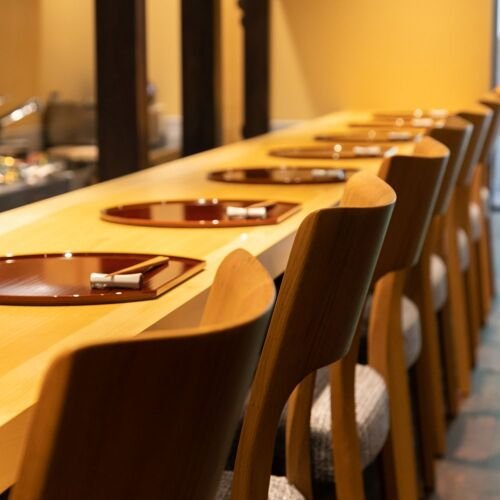
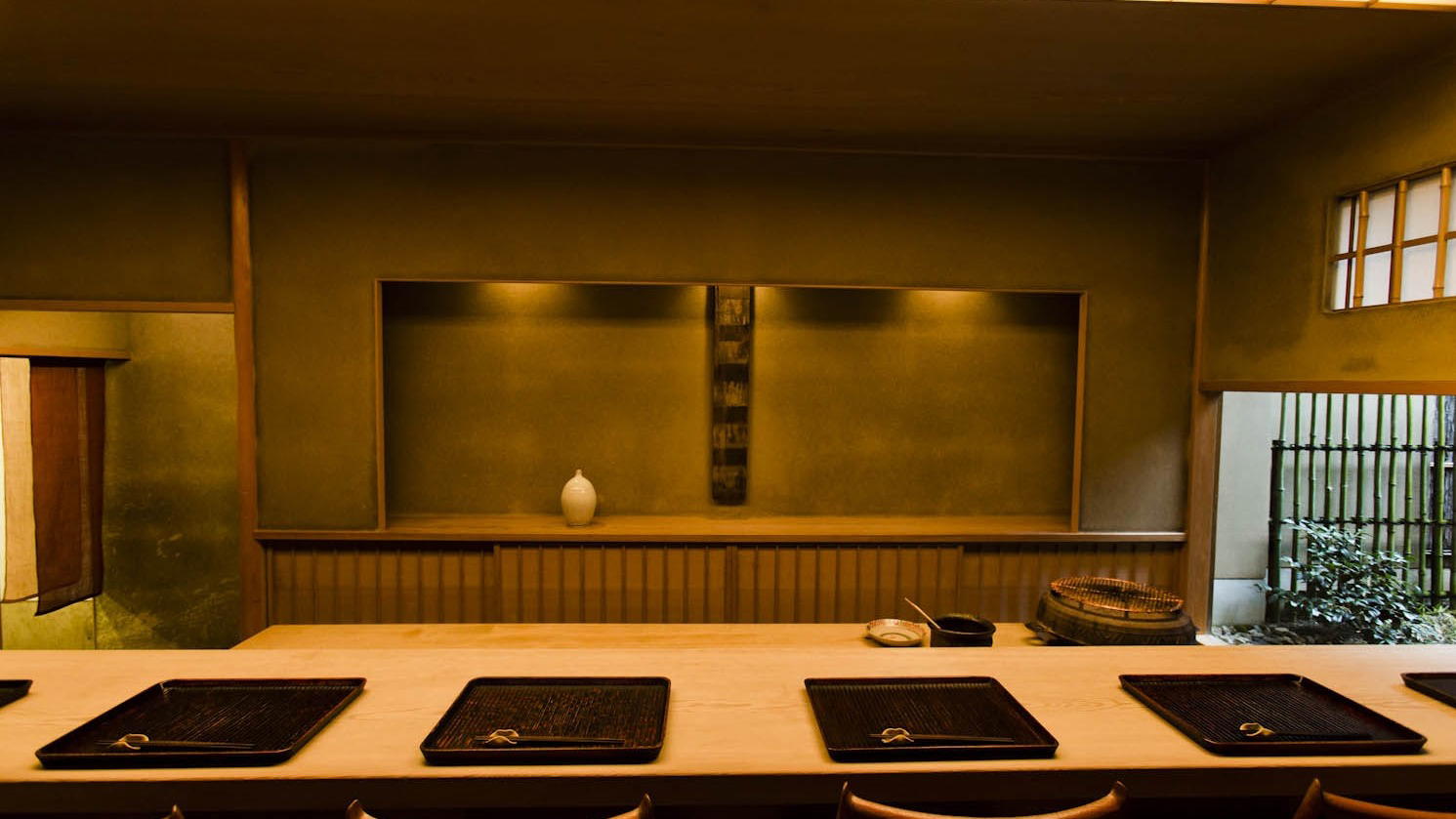
The room at Aoike was crafted by the chef's father-in-law, a sukiya carpenter, the traditional building discipline associated with Japanese tea architecture and its economy of material. The result is a counter space that pairs that restrained craft with a mosaic-studded surface and Scandinavian chairs: a composition that reads as modern without performing novelty. In Kyoto's French category, where interiors tend toward either austere minimalism or studied warmth, this is a considered middle position. The materials signal local rootedness; the furniture signals a different cultural reference point entirely. The friction between the two is what makes it work as a room.
For comparison, Kyoto's Italian counter cenci works with a similarly measured interior logic, while la bûche and La Biographie··· occupy adjacent price points in the city's French mid-tier. What distinguishes the Aoike room is the sukiya lineage embedded in its construction, a detail that connects the space to Kyoto's architectural tradition in a way that most imported-cuisine interiors do not attempt.
The Pressed Vegetables and What They Represent
The Michelin entry for Aoike singles out one preparation as its clearest expression: pressed vegetables arranged to resemble a kitchen garden in cross-section, multiple colours, multiple textures, structured into a coherent visual form. Mushrooms and root vegetables appear elsewhere in mousse and thick soup preparations. These are not decorative gestures. They reflect a French technical vocabulary applied to produce that the chef has selected himself hours earlier, which changes the nature of the relationship between technique and ingredient.
In classical French cooking, the cook receives the ingredient and applies method. Here, the sequence is reversed in one important respect: the ingredient's condition on a given morning informs what method gets applied. That reversal is what separates the chef-as-gardener model from the chef-as-technician model, and it places Aoike in a category of French restaurants where the vegetable counter, rather than the protein, carries the editorial weight of the menu.
This approach has parallels elsewhere in Japan. L'Effervescence in Tokyo has long positioned vegetables as the structural centre of its French tasting menus. HAJIME in Osaka operates at a higher Michelin tier but with a similarly ingredient-driven architecture. akordu in Nara draws on local Yamato produce within a European framework. Aoike at ¥¥¥ sits below those reference points in price but within the same philosophical current: French structure, Japanese ingredient logic, personal agricultural control.
Placing Aoike in Kyoto's French Category
Kyoto's French restaurant tier at ¥¥¥ is competitive and increasingly defined. Droit and anpeiji occupy adjacent positions in the city's mid-tier French category. Above that band, Hiramatsu Kodaiji operates with greater institutional scale. The kaiseki tier, Gion Sasaki at three Michelin stars, Ifuki at two, Kyokaiseki Kichisen at two, sits in a different price bracket entirely at ¥¥¥¥, and is governed by different expectations about format and ritual.
Within the ¥¥¥ French tier, Aoike's distinguishing position is agricultural rather than technical or biographical. The Michelin Plate recognition (2025) places it inside the guide's recommended tier without star status, a bracket that, in Kyoto, still represents meaningful curation given the density of the city's dining options. For broader perspective on how Kyoto's French and European counters compare with peers elsewhere in Japan, Goh in Fukuoka, 1000 in Yokohama, and 6 in Okinawa each represent different regional takes on the same question of how European form adapts to Japanese ingredient culture.
For European context, Hotel de Ville Crissier in Crissier represents the classical French tradition from which this style of cooking draws its technical lineage, and the contrast in context, Swiss classicism versus Kyoto garden produce, clarifies what is specifically local about what Aoike is doing.
Planning a Visit
Aoike sits in Nakagyo Ward, the central administrative district that runs between Kyoto Station and the Kamogawa riverbank. The address on Takakura-nishi-iru places it within the ward's denser commercial interior, accessible from multiple subway lines. Given the counter format and the morning-harvest model, advance booking is advisable; the preparation sequence that begins in the garden does not accommodate walk-in volumes. The ¥¥¥ price point positions an evening here above a casual dinner but below the kaiseki-tier restaurants that represent Kyoto's highest price bracket, a reasonable entry point for French cooking that takes Kyoto's ingredient culture seriously.
For those building a broader Kyoto itinerary, the full editorial guides cover restaurants, hotels, bars, wineries, and experiences across the city. Harutaka in Tokyo offers a useful counterpoint for travellers moving between cities: a different cuisine category entirely, but the same logic of sourcing precision driving format.
Frequently asked questions
Does Aoike work for a family meal?
Aoike is better suited to adult dining than family gatherings. The counter format and ¥¥¥ pricing point toward a focused tasting progression, and the room, a sukiya-carpentry interior with mosaic counter and Scandinavian chairs, is intimate rather than casual. Children looking for flexibility will find the format restrictive.
What kind of setting is Aoike?
Aoike is a counter-format French restaurant in Kyoto's Nakagyo Ward, holding a 2025 Michelin Plate. The interior was built by the chef's father-in-law, a sukiya carpenter, the discipline tied to Japanese tea architecture, resulting in a room that pairs a mosaic-studded counter with Scandinavian chairs: traditional craft framing a modern dining posture.
Does Aoike have a Michelin star or similar recognition?
Aoike has received recognition including: The star ingredients are vegetables from Kamigamo. Every morning the chef harvests them himself from his garden, and that’s when the process of imagining his creations begins. A classic example is the pressed vegetables; this dish is full o….
What's the must-try dish at Aoike?
The Michelin Guide entry points directly to the pressed vegetables: a multi-colour arrangement of produce from the chef's Kamigamo garden, structured to resemble a cross-section of a kitchen garden in bloom. It functions as the clearest statement of Aoike's approach, vegetables harvested the same morning, shaped into something closer to still-life composition than garnish.
What's the price range at Aoike?
Pricing at Aoike is listed as ¥¥¥.
Where do I go for Aoike?
Aoike is located at Japan, 〒604-0884 Kyoto, Nakagyo Ward, Heinouchicho, 631 高倉西入, Kyoto.
Cuisine and Credentials
| Venue | Cuisine | Price | Awards | Notes |
|---|---|---|---|---|
| AoikeThis venue (the venue you are viewing) | Kappo French with Kyoto Vegetables | $100–150 | Michelin Plate · Tabelog 100 #13 | Not listed |
| Gion Sasaki | Modern Kaiseki | $300–500 | 3 Michelin Stars · La Liste Top Restaurants | Kaiseki, Japanese |
| cenci | Innovative Italian-Japanese Fusion | $100–150 | 1 Michelin Star · World's 50 Best #76 | Italian |
| Ifuki | Sumibi Kappo Kaiseki | $200–300 | 2 Michelin Stars · La Liste Top Restaurants | Kaiseki |
| Kyokaiseki Kichisen | Kyoto Kaiseki | $200–300 | 2 Michelin Stars · La Liste Top Restaurants | Japanese |
| Kyo Seika | Modern Chinese Fine Dining | $150–200 | 1 Michelin Star · Tabelog Bronze #216 | Chinese |
Recognition history
Dated appearances from independent guides and award organizations, with the underlying list record or original source where available.
Michelin Plate
Michelin
Tabelog 100 #13 · No. 13
Tabelog · Tabelog 100 - French - WEST - 2025
Full recognition history (3 entries)
Michelin Plate
Michelin
Continue exploring
More in Kyoto
Restaurants in Kyoto
All restaurants in Kyoto →
Bars in Kyoto
All bars in Kyoto →
Hotels in Kyoto
All hotels in Kyoto →
Wineries in Kyoto
Browse all →
Details
- Elegant
- Sophisticated
- Intimate
- Modern
- Cozy
- Date Night
- Special Occasion
- Chefs Counter
- Open Kitchen
- Sake Program
- Extensive Wine List
- Local Sourcing
- Garden
- Counter Dining
- Wine
- Sake
- Vegetarian Friendly
Current opening hours
- Monday
- 12–3 PM, 6–9:30 PM
- Tuesday
- 12–3 PM, 6–9:30 PM
- Wednesday
- 12–3 PM, 6–9:30 PM
- Thursday
- 12–3 PM, 6–9:30 PM
- Friday
- 12–3 PM, 6–9:30 PM
- Saturday
- 12–3 PM, 6–9:30 PM
- Sunday
- Closed
Hours can change for holidays and private events. Hours as of .
Quiet, unostentatious sophistication with modern mosaic-studded counter, Scandinavian chairs in sukiya-crafted interior and small garden view.