Google: 4.3 · 277 reviews



Yukimoto holds Tabelog Gold for three consecutive years and ranks 46th among Japan's restaurants on Opinionated About Dining (2025), yet operates from a quiet residential address in Iida, a city most travelers pass through rather than stop for. Chef Takayuki Hagiwara's kaiseki draws on the seasonal produce of the Southern Alps, served across 20 seats in a tatami-room setting at JPY 30,000–39,999 per person.
 Discover on Pearl
Pearl is the En Primeur Club membership app — saves, bookings, and concierge access live there. Same editors, same standards.

Kaiseki at Altitude: Iida's Place in Japan's Regional Fine Dining Shift
For much of the past decade, Japan's serious kaiseki conversation has concentrated in three cities: Kyoto, where the tradition is codified and densely starred; Tokyo, where demand and capital sustain a broad top tier; and Osaka, where chefs like those behind HAJIME have pulled the form toward innovation. What that conversation tends to undercount is the tier of regional restaurants operating outside those three markets, achieving national recognition on technical merit alone, without the foot traffic or tourism infrastructure that sustains big-city fine dining. Iida, a modest city in Nagano's Ina Valley, sits firmly in that underweighted tier, and 柚木元 (Yukimoto) is its most instructive example.
Yukimoto holds a Tabelog score of 4.61 and won the Tabelog Gold Award in 2024, 2025, and 2026, after climbing through Silver from 2019 onward. It has been selected for the Tabelog Japanese Cuisine EAST 100 list in 2021, 2023, and 2025. On Opinionated About Dining's 2025 ranking, it sits at 46th in Japan overall, up from 146th in 2024 and a Highly Recommended designation in 2023. La Liste placed it at 84 points in 2026, up from 80 in 2025. That upward trajectory across four separate evaluation frameworks, over a seven-year span, is not the profile of a regional novelty; it is the profile of a restaurant performing consistently at a high level and being progressively recognized for it. For reference on how that positions Yukimoto relative to peers, kaiseki counters in Kyoto with comparable Tabelog scores, such as those featured in our guide to Aca 1° in Kyoto or Gion Sasaki, draw international visitors as a primary planning anchor. Yukimoto draws them despite the absence of that infrastructure, which says something about the strength of the underlying cooking.
The Kaiseki Frame: Seasonality as Structure
Kaiseki is the most format-dependent of Japan's major culinary traditions. Unlike omakase sushi, where the counter and the chef's sourcing relationships define the experience regardless of calendar date, kaiseki is explicitly organized around the progression of the Japanese season. Each course sequence, from the sakizuke opening through nimono and yakimono to the shokuji closing, exists to present a seasonal argument: this is what is worth eating, in this form, right now. The discipline requires not just cooking skill but an editorial sensibility about which ingredients have peaked and which pairings carry meaning beyond the plate.
Iida's geography makes that argument unusually specific. The city sits at the southern end of the Ina Valley, flanked by the Central Alps to the west and the Southern Alps to the Eat, at an elevation that produces distinct seasonal rhythms compared to lowland Nagano or coastal Honshu. Mountain vegetables arrive on a different schedule than in Kyoto or Tokyo. River fish from the Tenryu, which runs through the valley, are available to local kitchens in ways that metropolitan kaiseki houses cannot replicate with equivalent freshness. A kaiseki in this location is making a specific regional claim, not simply executing a universal template. That regional specificity, when handled with the consistency Yukimoto's award record suggests, is precisely what the Tabelog 100 evaluators and Opinionated About Dining panelists tend to recognize and reward.
For readers exploring how other regional kaiseki practitioners approach the same tension between tradition and local identity, our guide to Aoyagi in Tokyo offers a useful metropolitan counterpoint, while Goh in Fukuoka shows how the form adapts to a different regional food culture entirely.
The Room and the Setting
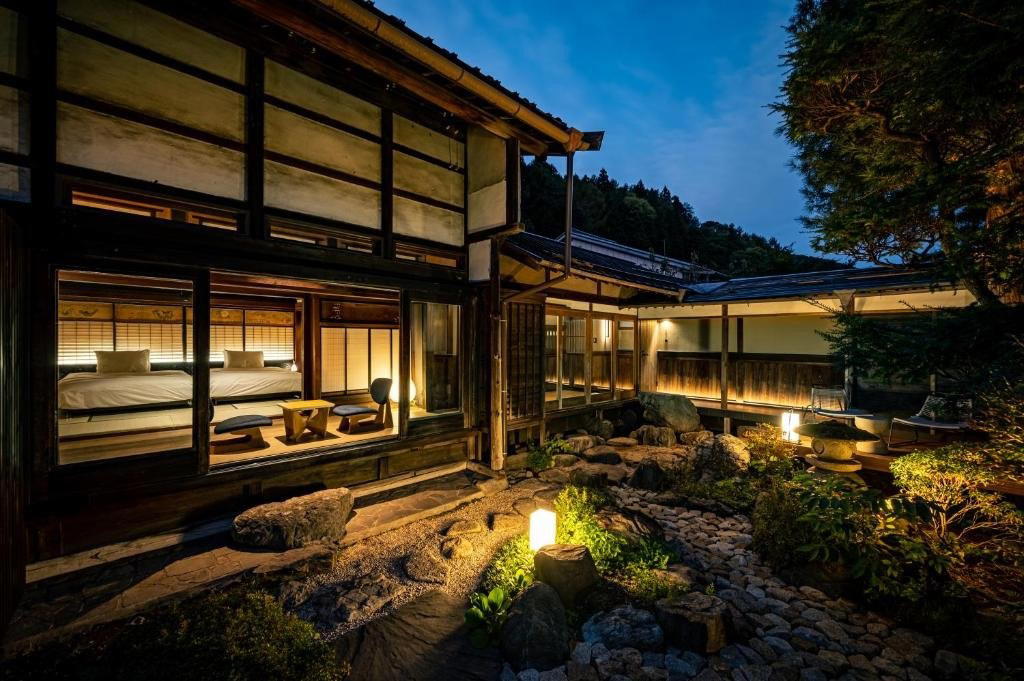
Yukimoto is categorized on Tabelog as a house restaurant, meaning the physical space functions as a converted residential building rather than a purpose-built dining room. The format is more common in Kyoto's machiya tradition than in regional Nagano, and it carries specific implications for atmosphere: lower ceilings, smaller total capacity, and an interior logic shaped by domestic rather than commercial architecture. The dining room seats 20 across four private rooms, with a tatami room among the available configurations. Private room options scale from two-person bookings to groups of ten to twenty, and the large hall can accommodate gatherings of up to 50 for event formats.
That physical intimacy is part of what separates this tier of Japanese kaiseki from larger-format restaurants. The 20-seat total is not a constraint; it is the condition under which the service-to-guest ratio and the kitchen's ability to time courses precisely become viable. Parking is available for 20 vehicles, which matters in Iida, where most visitors will arrive by car rather than on foot, and the restaurant is also accessible on foot from Iida Station on the JR Iida Line, approximately three minutes away.
Pricing and the Regional Calculus
Kaiseki pricing in Japan follows a predictable tier structure. Kyoto's top-tier addresses, including those with Michelin three-star status, typically run from JPY 40,000 to JPY 60,000 or beyond per person. Tokyo equivalents span a wide range but cluster similarly at the recognized leading. Yukimoto's Tabelog-listed price band of JPY 30,000 to JPY 39,999 for both lunch and dinner places it just below that ceiling, at a price point consistent with Tabelog Gold-tier regional kaiseki rather than metropolitan three-star pricing. The review-based average spend noted on Tabelog, around JPY 100,000 per visit, likely reflects multi-person bookings with beverage pairing rather than a per-head course price, but this figure comes from user-submitted data and should be treated as directional rather than definitive.
For travelers calibrating their Japan itinerary across multiple high-end meals, this pricing positions Yukimoto in the same general band as comparable regional experiences at restaurants such as akordu in Nara or affetto akita, where regional specificity and recognition outperform metropolitan saturation. Readers assembling a broader Japan dining plan can reference our full Iida restaurants guide for wider context across the city's dining options.
Planning a Visit
Yukimoto operates Tuesday through Sunday, with lunch service running from 11:30 with a last order at 12:30, and dinner from 17:30 with last order at 18:30. The kitchen is closed on Mondays. Both lunch and dinner are priced equivalently, which is less common in kaiseki, where lunch is often positioned as a lower-cost entry point; here, the format appears consistent across both services. Reservations are available and credit cards are accepted, including Visa, Mastercard, JCB, American Express, and Diners Club. Electronic money and QR code payments are not accepted. Smart casual dress is expected, with the restaurant's own guidance specifying elegant, respectful attire.
For visitors extending their time in the region, our guides to Iida hotels, Iida bars, Iida wineries, and Iida experiences cover the surrounding options. Drink pairings at Yukimoto span sake, shochu, wine, and cocktails, giving the kitchen's course structure a range of accompaniment options that match the kaiseki format's flexibility. For those who cannot travel to Iida, the restaurant offers a delivery service through a separate online channel.
Yukimoto in the Wider Japan Picture
Japan's recognized fine dining scene now includes a significant cohort of restaurants operating at high technical levels in cities and towns outside the major metropolitan areas. Yukimoto sits comfortably in that cohort, alongside places like Aji Arai in Oita, Ajidocoro in Yubari District, and 6 in Okinawa, each of which builds a case that regional produce and local context can produce cooking that evaluators rank alongside metropolitan peers. The trajectory from Tabelog Silver in 2019 to Gold from 2024, combined with consistent Opinionated About Dining placement and a rising La Liste score, describes a restaurant that is not just established but improving and drawing broader critical attention year over year.
Travelers who have already eaten at Tokyo-based kaiseki or sushi addresses, such as those reviewed at Harutaka or the broader Tokyo scene catalogued alongside 1000 in Yokohama, will find Yukimoto occupying a distinct register: quieter, more architecturally domestic, and rooted in a mountain valley food culture that has no metropolitan equivalent. That distinction is the visit's primary argument.
At-a-Glance Comparison
These are the closest comparables we have in our database for quick context.
| Venue | Cuisine | Price | Awards | Notes |
|---|---|---|---|---|
| 柚木元 - Yukimoto | Japanese Kaiseki | {"Year":"2026","Award Source":"Tabelog",… | This venue | |
| Harutaka | Sushi | ¥¥¥¥ | Michelin 3 Star | Sushi, ¥¥¥¥ |
| RyuGin | Kaiseki, Japanese | ¥¥¥¥ | Michelin 3 Star | Kaiseki, Japanese, ¥¥¥¥ |
| HAJIME | French, Innovative | ¥¥¥¥ | Michelin 3 Star | French, Innovative, ¥¥¥¥ |
| L'Effervescence | French | ¥¥¥¥ | Michelin 3 Star | French, ¥¥¥¥ |
| HOMMAGE | Innovtive French, French | ¥¥¥¥ | Michelin 2 Star | Innovtive French, French, ¥¥¥¥ |

At a Glance
- Elegant
- Classic
- Intimate
- Cozy
- Special Occasion
- Date Night
- Private Dining
- Garden
- Sake Program
- Local Sourcing
- Zero Waste
- Garden
Traditional Japanese atmosphere with seasonal Japanese garden views, tatami rooms, and warm, relaxing spaces that evoke the beauty of the four seasons.