
Yakiniku Tokuyama places Iida’s meat culture in a modest, regional register rather than a luxury grill-room one. Its 2025 selection for Tabelog 100 Yakiniku EAST gives it a clear trust signal, while the format remains approachable: Japanese barbecue and tripe in a 40-seat, non-smoking house-style restaurant suited to families and groups of friends.
Pearl is the En Primeur Club membership app — saves, bookings, and concierge access live there. Same editors, same standards.
- Address
- 長野県飯田市中央通り3-44
- Phone
- +81265244816
- Website
- tabelog.com
- Directions
- Get directions
 Saves & bookings on Pearl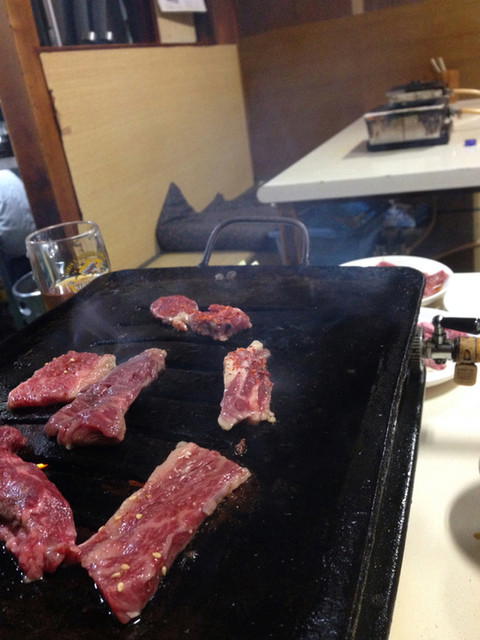
In central Iida, the mood is domestic rather than theatrical: a house-style restaurant, smoke kept out of the room, conversation-friendly tables, and a grill format that asks diners to watch timing rather than ceremony. This is not the polished beef-counter language of Ginza or Kobe. Here, yakiniku reads as regional appetite: shared heat, offal alongside beef cuts, and a meal suited to families or friends lingering over a grill.
That distinction matters. Yakiniku in Japan is often discussed through marbling and brand cattle, but regional restaurants show how beef is eaten outside the capital’s expense-account tier. Tripe on the category line is a useful signal. Offal is not garnish; it is part of the grammar, bringing texture, economy, and a less sanitized view of meat cookery. Yakiniku Tokuyama sits in that lane, with Japanese barbecue and tripe as the stated frame rather than a chef-led tasting-menu narrative.
Iida yakiniku with offal in the foreground
Nagano’s southern valleys do not project the restaurant mythology of Tokyo, Kyoto, or Osaka, so local recognition carries different weight. A 2025 selection for Tabelog 100 Yakiniku EAST places Yakiniku Tokuyama in a regional field of specialist grill restaurants rather than generic neighborhood rooms. Its 3.55 score is not a luxury badge; it shows a plain format drawing enough attention to enter a competitive category.
Yakiniku is ingredient-led by design. The kitchen butchers, seasons, and portions; the diner finishes over direct heat. In that exchange, sourcing and cut selection matter more than elaborate plating. Beef with too much surface moisture punishes the grill. Poorly cleaned or trimmed offal announces itself immediately. The category is unforgiving because diners are close to the product, and small mistakes cannot hide under sauce or architecture.
That is why tripe matters here. Restaurants placing tripe beside yakiniku speak to diners who understand chew, fat, and grill management, not only softness. In many Japanese barbecue rooms, pleasure comes from alternating richer cuts with leaner or more textured pieces, pacing the meal through contrast instead of ordering only the familiar. For travelers, this is the difference between beef tourism and understanding yakiniku as practical, social cuisine.
Iida’s dining map reinforces the point. Nearby Japanese dining can lean toward kaiseki formality, as at 柚木元 - Yukimoto and Nihonryori Yukimoto, where sequence and seasonality do much of the work. Yakiniku answers a different need: less choreographed, more tactile, and built around heat at the table. Readers can compare these modes in our full Iida restaurants guide, where Iida’s smaller scale becomes an advantage rather than a limitation.
A regional grill room, not a capital-city performance
The room’s practical shape tells the story. Forty seats make this a mid-sized local restaurant, large enough for family tables but not a banquet hall. Private rooms are not part of the format, so the experience belongs to the open dining room: shared grills, audible table talk, and the rhythm of ordering more as the meal develops. Children are welcome, placing it closer to everyday Japanese dining than to special-occasion beef temples with hushed service codes.
There is an editorial trap with regional Japanese restaurants: over-romanticizing simplicity. The better reading is concrete. A no-smoking dining room, cash-centered payment setup, and approachable price band point to a restaurant built for repeat local use. The 2025 Tabelog 100 Yakiniku EAST selection adds outside validation. Together, those details describe appeal based not on spectacle, but category competence: meat, offal, grill, table.
For Nagano itineraries, this kind of restaurant fits the region’s broader food habits. Mountain towns and inland cities often prize preserved foods, soba, river fish, game, and carefully handled meat; yakiniku fits by making sourcing and cut variation visible. The comparison extends beyond Iida. Out-of-metro names such as Yamasato no Soba Marutomi, Suya Nishiki, and Kurinton Honke Suya Honten sit in lower price bands and show how regional Japanese dining rewards narrow specialization. Yakiniku Tokuyama follows the same logic, though its medium is the grill.
International visitors should understand the category before judging it against Western steakhouse expectations. Yakiniku is not a finished plate served at a fixed temperature. It is collaborative cooking, with the table responsible for doneness and pacing. That makes the meal more social and ingredient handling easier to read. Good yakiniku needs little explanation if the cuts are clean, the grill behaves, and ordering lets a table move from familiar beef into offal without friction.
How to place it in an Iida itinerary
This is stronger for travelers wanting a grounded Iida meal than for diners seeking a chef biography, wine program, or high-form tasting menu. Its value lies in how clearly it represents a regional yakiniku idiom: accessible, meat-focused, open to children, and credible enough to appear on a specialist 2025 award list. It is also useful for groups because the format scales across appetites, with the table controlling tempo instead of surrendering to a fixed procession.
For a fuller city plan, the restaurant sits alongside Iida’s other categories rather than replacing them. Use our full Iida hotels guide for overnight planning, our full Iida bars guide for drinking options, our full Iida wineries guide for regional wine context, and our full Iida experiences guide for the non-restaurant side of the trip. Japan-wide readers following meat and grill formats may also find contrasts in -Grilled beef Sukiyaki- KAMAKURA TANUKIAN 鎌倉 たぬき庵 in Kamakura, #肉といえば松田 奈良本店 in Kashihara, and the broader casual spectrum represented by. 鮪と炭火焼き うお炭 秋葉原店 in Tokyo.cafe in Osaka.know in Kumamoto, (Shoku) Vietnam in Kawasaki, [Curry Senmon Ten] Maruyama Kyoju. in Sapporo, [ki:] in Kyoto, 1/3 HAMBURGER FACTORY in Kanazawa, Jōdo Saké Bar in Los Angeles, and Onigiri Time in Pasadena.
The critical read is simple: the restaurant is compelling because it keeps the category close to everyday roots while earning specialist recognition. For Iida, that is more useful than polish: a grill restaurant with a clear identity, credible award signal, and enough informality to feel local rather than staged for visitors.
How It Stacks Up
Comparable venues by cuisine and price in the same metro.
| Venue | Cuisine | Price | Notes |
|---|---|---|---|
| Yakiniku Tokuyama | Traditional Yakiniku (Japanese BBQ) & Horumon | $$ | Chuo-dori, Iida |
| Nihonryori Yukimoto | Japanese Kaiseki | $$$$ | Towa-cho |
| 柚木元 - Yukimoto | Modern Japanese Kaiseki with Wild Game | $$$$ | Iida |
| Katsu Sando Kobo Panton | Japanese Katsu Sando | $$ | Nakao-cho, Takasaki |
| Maruyoshi Shokudo | Traditional Miyako Soba | $$ | Gusukube |
| Muromachi Sunaba (室町砂場) | Traditional Edo-style Soba | $$ | Nihonbashi Muromachi |
Recognition history
Dated appearances from independent guides and award organizations, with the underlying list record or original source where available.
Tabelog 100 #52 · No. 52
Tabelog · Tabelog 100 - Yakiniku - EAST - 2025
Continue exploring
More in Iida
Restaurants in Iida
Browse all →
Bars in Iida
Browse all →
Wineries in Iida
Browse all →
At a Glance
- Lively
- Cozy
- Rustic
- Energetic
- Family
- Group Dining
- Casual Hangout
- Solo
- Celebration
- After Work
- Standalone
- Beer Program
A compact, house-style neighborhood yakiniku with a retro, down-to-earth feel: grills smoking, close-set tables, and a bustling, laughter-filled room that skews casual and energetic rather than polished, while still being welcoming for families and solo diners alike.