

Leading Hotels of World Member · Forbes Recommended
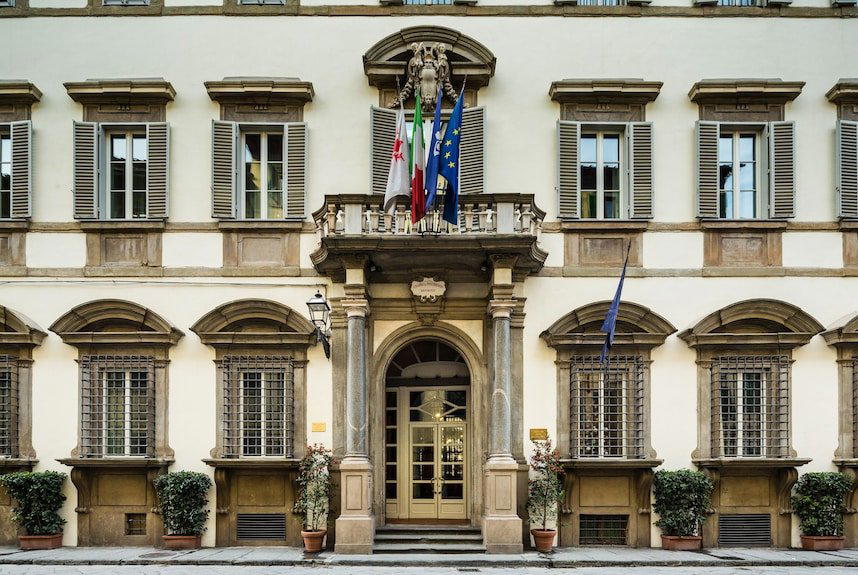
On Via Ghibellina, one of Florence's longest and most animated streets, Palazzo Firenze occupies a historic palace steps from the Bargello Museum and Santa Croce basilica. A member of Leading Hotels of the World, the property pairs Tuscan marble bathrooms and period-inspired interiors with the Guelfi e Ghibellini restaurant and an atmospheric piano lounge. For milestone stays in the city's cultural heart, it sits in a genuinely useful position between heritage weight and contemporary comfort.

Pearl is the En Primeur Club membership app, where members save venues, book tables and use the concierge.
A Street With a Storyline
Via Ghibellina is not a tourist corridor in the way that the streets around the Duomo or Piazza della Repubblica tend to be. It is longer, quieter after the dinner hour, and lined with the kind of accumulated detail, family crests set into facade stone, tabernacles at irregular intervals, doorways scaled for a different century, that rewards the slow walker rather than the sprint between monuments. Booking a room on this street is, in effect, a decision about what kind of Florence you want. The Palazzo Firenze positions itself at the intersection of that neighbourhood character and the expectations that come with Leading Hotels of the World membership, the group's 2025 affiliation confirming a baseline of service and physical standard against which the property can be fairly assessed.
The Case for Milestone Stays in the Santa Croce Quarter
Florence has a well-established hierarchy of celebration hotels. The Four Seasons Hotel Firenze sets the ceiling with its garden palazzo format; the Palazzo Portinari Salviati Residenza D'Epoca draws guests who want deep-archive Florentine history in every room. The Palazzo Firenze occupies a different position in that conversation: a boutique property where the neighbourhood does much of the heavy lifting for occasion stays. Three of the most resonant sites in the city are within walking distance, the Bargello Museum, with its concentration of Renaissance sculpture from Donatello to Michelangelo; the Basilica of Santa Croce, where Michelangelo, Galileo, and Machiavelli are all entombed; and the Teatro Verdi, whose programming range runs from opera to magic shows. For an anniversary dinner, a significant birthday, or a trip built around cultural weight, the proximity to this particular cluster of institutions matters as a practical itinerary point, not just a selling proposition.
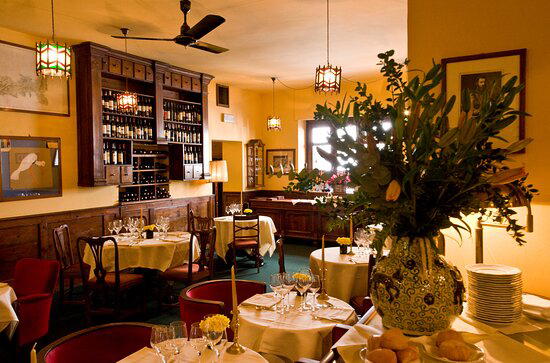
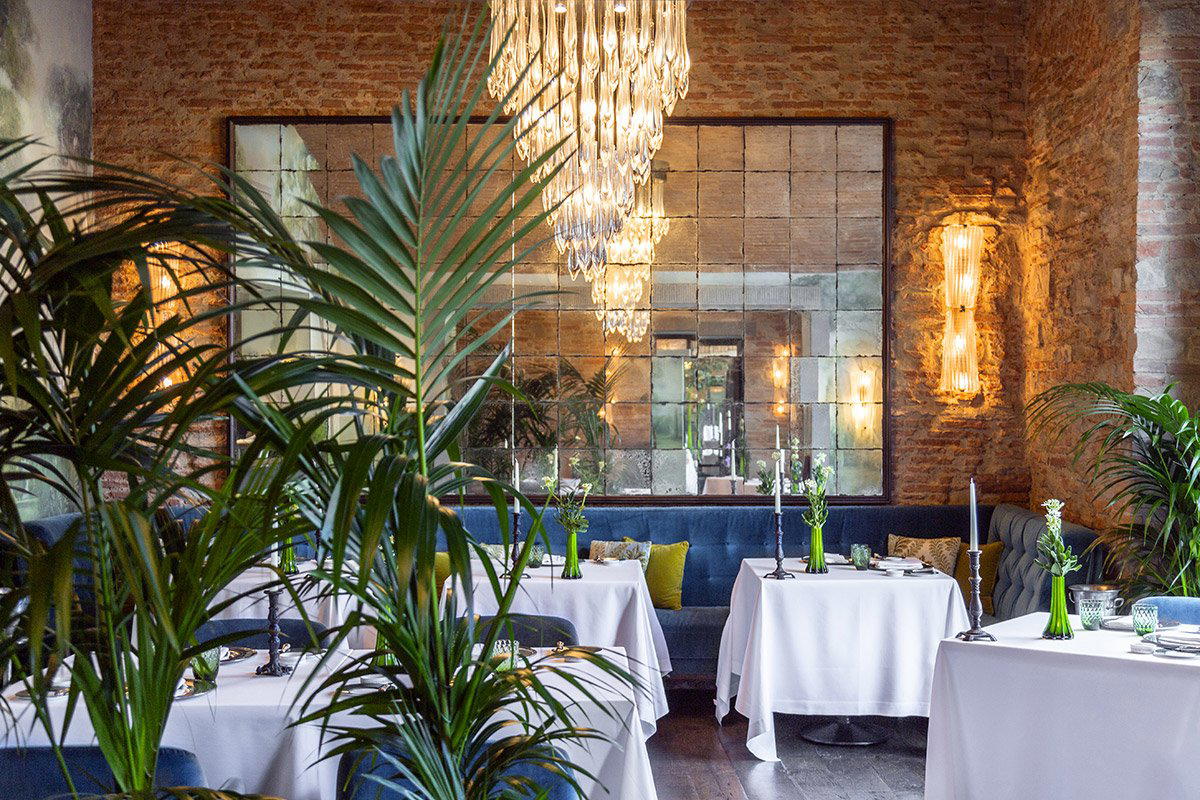
The hotel's own dining offering reinforces the occasion logic. The Guelfi e Ghibellini restaurant, named for the medieval conflict between papal and imperial factions that shaped Florence's political identity for centuries, is described in inspector notes as modestly sized but refined. In Italian hotel dining, that scale tends to signal an environment suited to conversation and deliberate meals rather than high-volume turnover. The name itself carries the kind of historical layering that Florence does better than almost any city in Europe: if you are going to name a restaurant after a civil war, you want the context to be genuinely legible, and in Florence, it is. Separately, the Sala della Musica functions as a piano lounge serving aperitivo, and on selected evenings converts into a temporary theatre space, making it a potential venue for an occasion evening that does not require leaving the building.
Also worth noting for occasion planning: Enoteca Pinchiorri, one of Italy's most formally recognised fine dining addresses and a three-Michelin-star institution, occupies the ground floor of the building. It is independently managed and not part of the hotel's operations, but its presence in the same address is a logistical convenience that very few Florence hotels can claim. A milestone dinner at Pinchiorri followed by a return to rooms upstairs has an obvious appeal for guests who want to build a serious celebratory evening around proximity rather than taxi coordination.
What the Rooms Actually Tell You
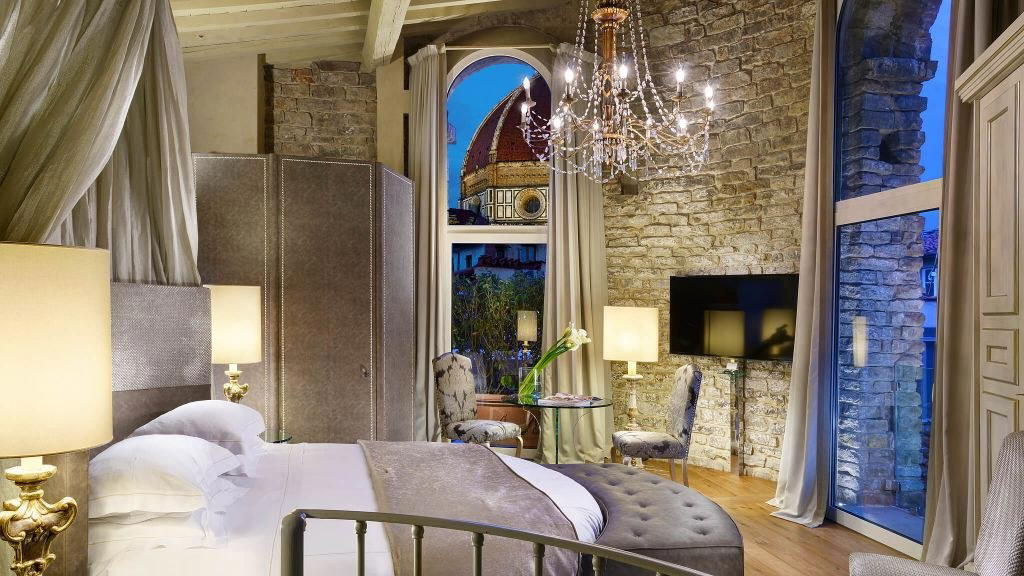
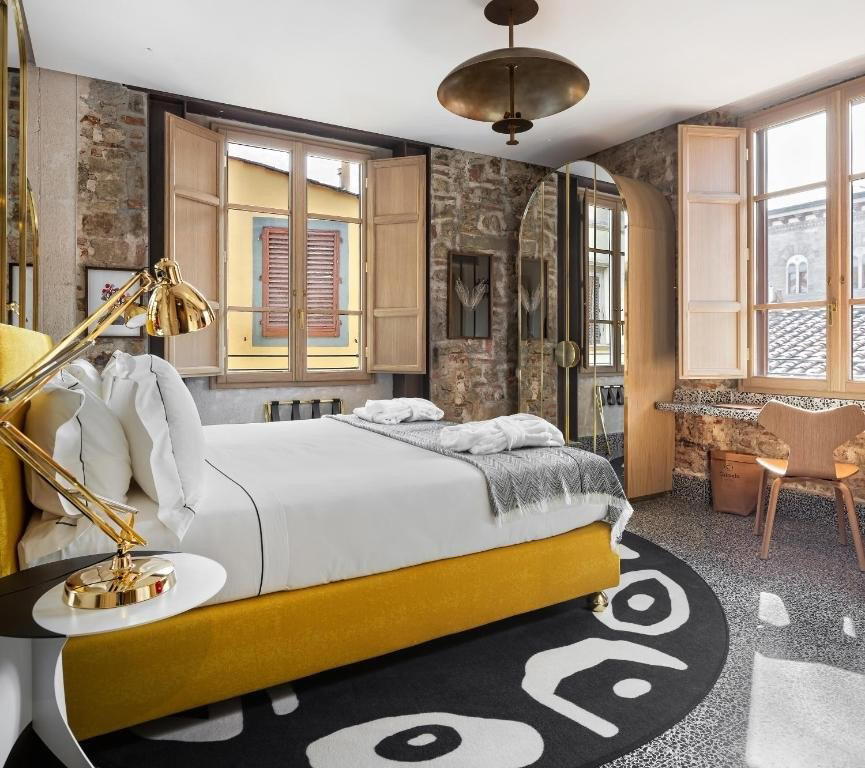
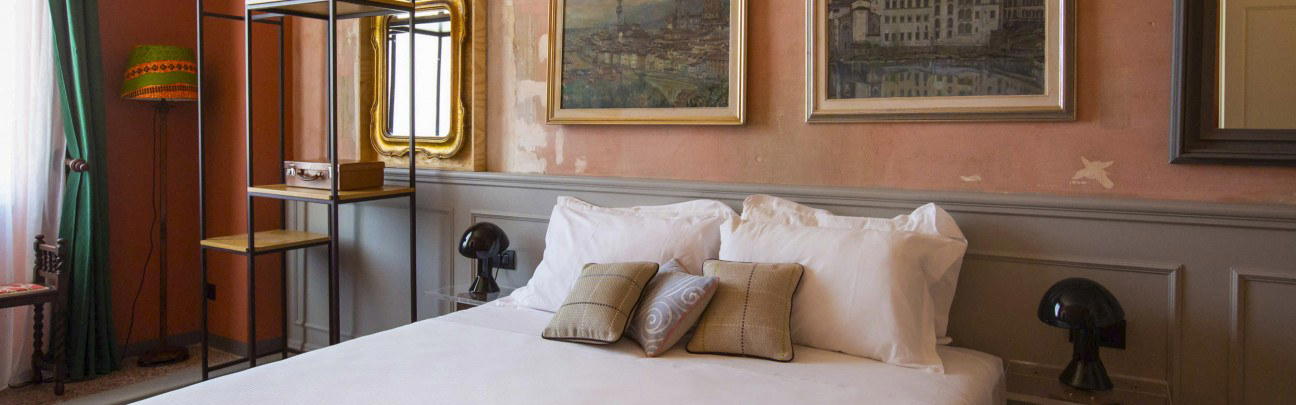
The room design at Palazzo Firenze draws on Florentine reference points that go beyond the expected frescoes-and-stone formula. Inspector notes point to inspiration taken from the city's historic pharmacies and perfume traditions, a more specific, less generic design vocabulary than the standard Renaissance-revival approach. Tuscan marble bathrooms appear across most room categories, and the overall aesthetic is described as classic-contemporary, a balance that tends to work better in historic buildings than either full preservation or full modernisation. The framing matters for occasion bookings: a room that reads as liveable rather than museum-like tends to sustain multi-night milestone stays better than spaces where the history is so dominant it becomes oppressive.
At the suite level, the Verrazzano Royal Suite extends across two salon-style living spaces and a large bedroom. Its furnishings are described as suited to the tastes of high-flying Florentines, a phrase that suggests comfort over theatrical luxury, which is a reasonable tone for a city that has always preferred substance to display. The suite also includes private workout equipment and a Turkish steam bath, additions that shift the proposition from purely historic immersion toward a more complete in-room offering for extended stays or guests who want self-contained convenience alongside cultural access.
Comparable boutique options in Florence worth considering for the same occasion-stay market include Ad Astra, Hotel Calimala, and Hotel Lungarno, each positioned in different neighbourhoods with different proximity advantages. For those extending their Italian itinerary beyond Tuscany, the Aman Venice, Portrait Milano, and Bulgari Hotel Roma represent the top tier of city-hotel occasion stays across the north and the capital. Tuscany itself offers alternatives at different scales: Rosewood Castiglion Del Bosco in Montalcino for wine-country immersion, or Villa La Massa for a riverside estate closer to the city. For broader Italian comparisons, Borgo Egnazia in Puglia and Il Pellicano in Porto Ercole each represent a different mode of Italian occasion travel. Passalacqua on Lake Como and Castello di Reschio in Umbria add further reference points for guests building a multi-stop Italian itinerary. For the Amalfi coast comparison set, Borgo Santandrea and Il San Pietro di Positano operate at a similar tier of boutique deliberateness. Those planning international milestone trips with Italy as one stop might also look at Aman New York or The Fifth Avenue Hotel for the North American leg.
Planning Your Stay
The hotel sits at Via Ghibellina, 87, in the 50122 postal district, placing it firmly in the Santa Croce neighbourhood rather than the Duomo cluster. Inspector notes confirm that the street, while part of the established visitor circuit, avoids the congestion of the major shopping corridors and monumental squares. After dark, it is described as safe and well-lit, with pedestrian traffic but minimal nightlife noise, a practical consideration for guests who want easy evening returns after late dinners or theatre at the Teatro Verdi. For broader Florence planning, our full Florence restaurants guide covers the city's dining scene in detail. Other properties worth comparing directly in the Florence upper-tier market include the Brunelleschi Hotel and Villa Cora.
Awards and Standing
Comparable venues nearby, for context on price, style, and recognition.
| Venue | Cuisine | Price | Awards | Notes |
|---|---|---|---|---|
| Palazzo FirenzeThis venue (the venue you are viewing) | Eighteenth-century residence offering the intimacy of a private palazzo with luxury services. | Not listed | Leading Hotels of World Member · Forbes Recommended | Not listed |
| Dimora Palanca Boutique & SPA | Timeless five-star elegance harmonizing classic architecture with bold modern art. | Not listed | Michelin Selected | Historic Centre |
| Porta Rossa Hotel Firenze, Colbert Collection | Historic luxury hotel in a restored landmark building | $750–1,000 | Not listed | Centro Storico |
| The James Suite Hotel Firenze 1564 | 16th-century Renaissance palazzo with modern luxury restyling | $750–1,000 | 1 Michelin Key · Small Luxury Hotels of the World Member | San Niccolo |
| Borgo Pignano Florence - A Virtuoso Preview Property | Historic Tuscan estate blending Renaissance heritage with contemporary luxury and artistic curation | Not listed | Virtuoso Luxury Hotel Partner | La Pietra |
| Dimora Ghirlandaio | Historic Tuscan estate with authentic Florentine charm | $500–750 | Michelin Selected · Virtuoso Luxury Hotel Partner | Galluzzo |
Recognition history
Dated appearances from independent guides and award organizations, with the underlying list record or original source where available.
Forbes Recommended
Forbes
Leading Hotels of World Member
Leading Hotels of World
Continue exploring
More in Florence
Hotels in Florence
All hotels in Florence →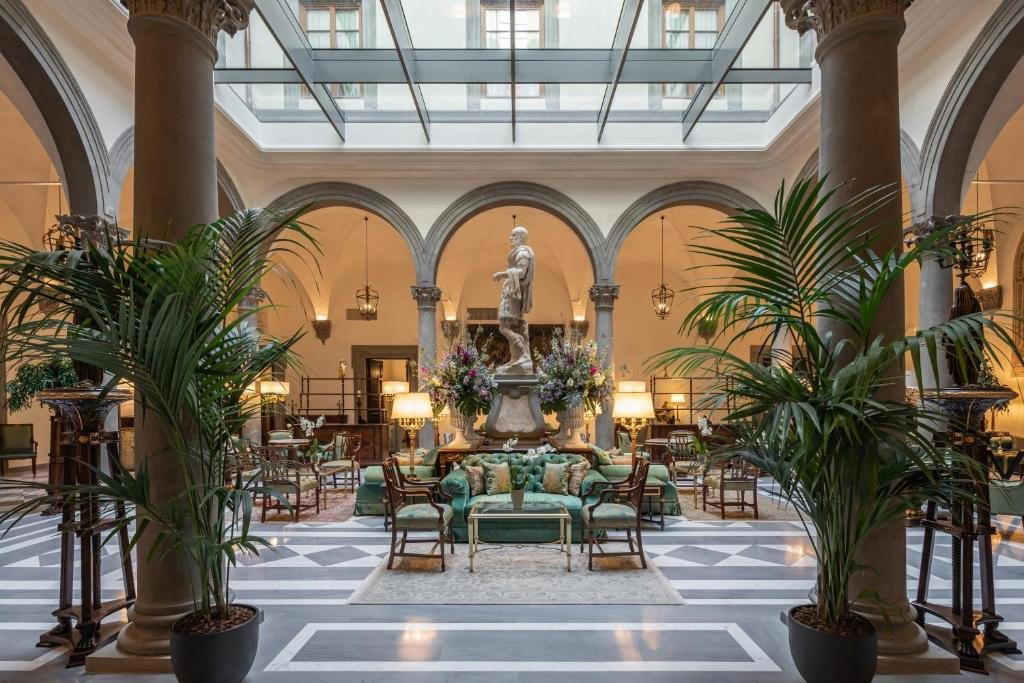
Bars in Florence
All bars in Florence →
Restaurants in Florence
All restaurants in Florence →

Details
- Elegant
- Sophisticated
- Romantic
- Classic
- Intimate
- Ornate
- Honeymoon
- Romantic Getaway
- Anniversary
- Historic Building
- Terrace
- Wi Fi
- Spa
- Room Service
- Concierge
- Restaurant
- Valet Parking
- Business Center
- Street Scene
- Elevator
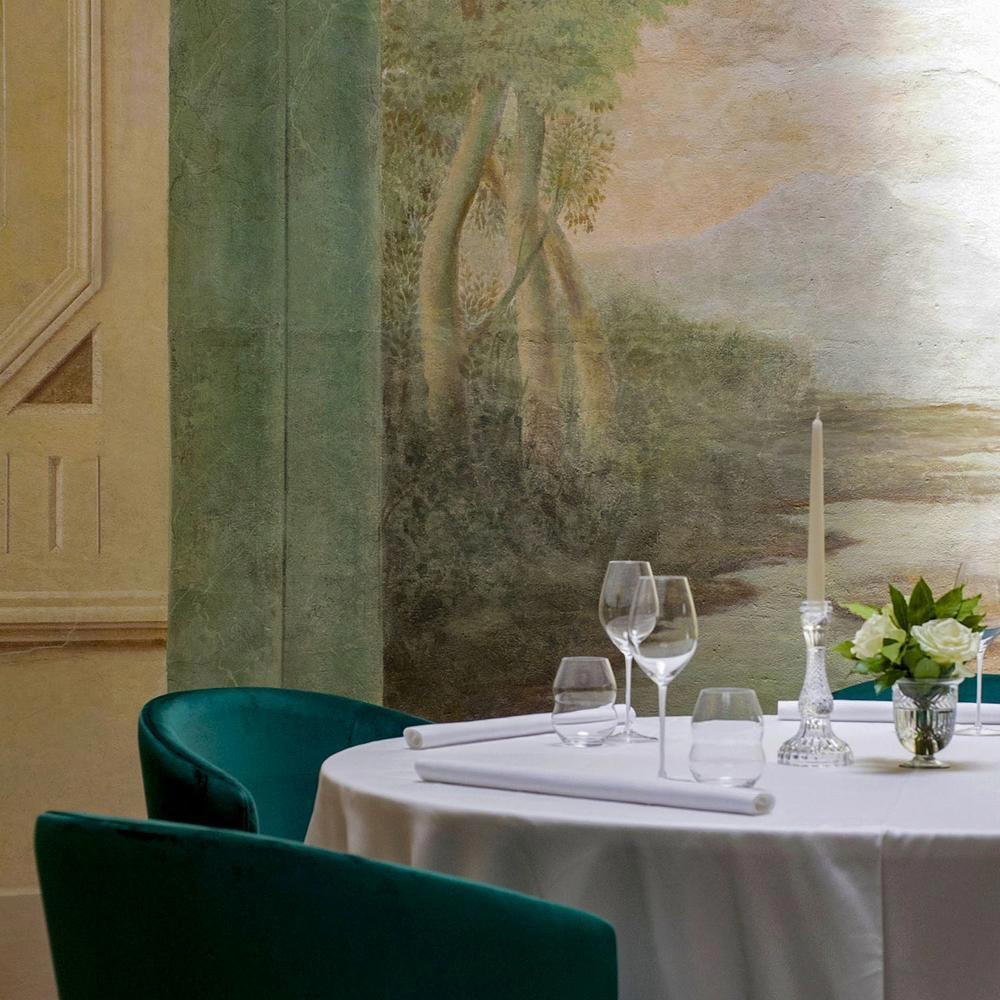
Refined historic atmosphere with sumptuous furnishings, frescoed ceilings, elegant common spaces like the music room, and a quiet, intimate residential feel.