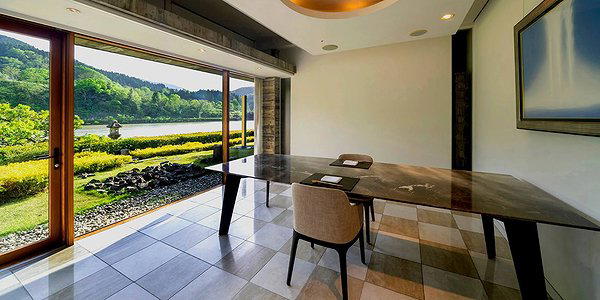
On Noto Island in Ishikawa Prefecture, Hitotsu Notojima distills the region's quiet, coastal character into eight rooms, each framed by floor-to-ceiling windows that open onto water views. The design draws equally from traditional Japanese craft and Scandinavian minimalism, tatami, blonde wood, dark tile, and soaking tubs oriented toward the sea. Select rooms include private terraces and saunas; all connect to a spa with fragranced outdoor baths.
Pearl is the En Primeur Club membership app — saves, bookings, and concierge access live there. Same editors, same standards.
- Address
- 42-4 Notojima Susomachi, Nanao, Ishikawa 926-0213
- Phone
- +81 767-85-2150
- Website
- hitotsu-notojima.com
- Directions
- Get directions
 Saves & bookings on Pearl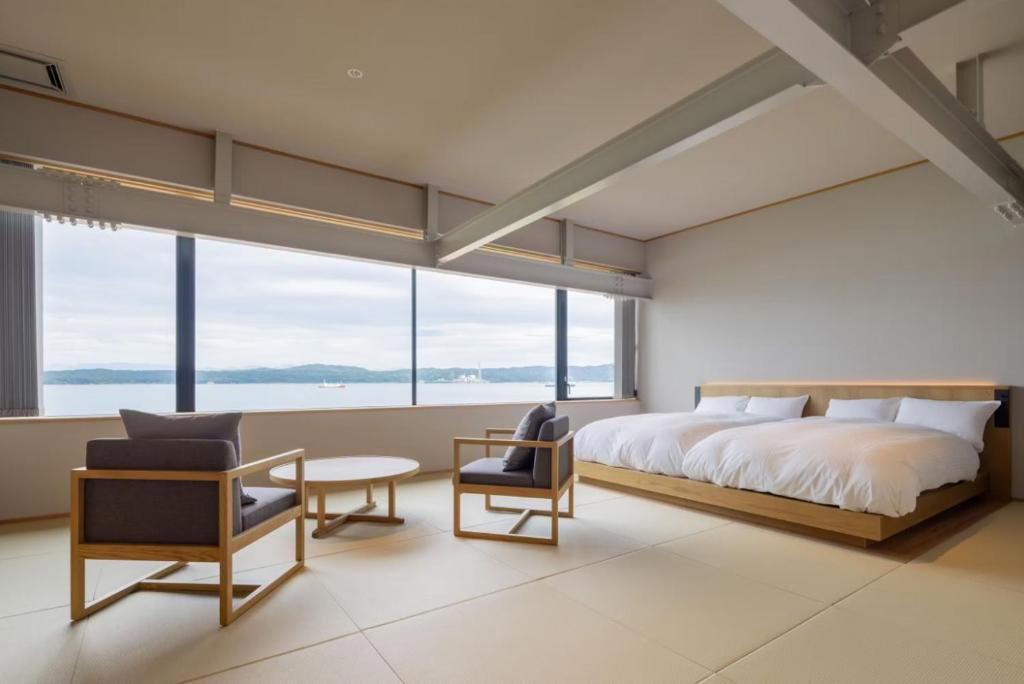
Where Water and Wood Define the Room
Japan's small-format ryokan and boutique hotel sector has split into two recognizable camps over the past decade: properties that lean heavily into traditional architecture as a kind of preserved cultural artifact, and those that read Japanese spatial principles through a contemporary lens. Hitotsu Notojima is a 4-star hotel in Nanao, Ishikawa, with a 1 Michelin Key. Its eight rooms occupy a building where the primary design move is the window, floor-to-ceiling glass that makes the Sea of Japan and Nanao Bay the dominant visual element in every interior. The architecture does not ask you to notice itself. It steps aside.
This kind of restrained framing is more demanding to execute than it appears. When a room is built around a view, every material choice becomes either a distraction or a complement. At Hitotsu Notojima, the palette stays close to the water's own register: blonde timber platforms, dark-tiled bathrooms, tatami mat sections, and soaking tubs positioned to face the ocean or bay. The combination of Japanese craft materials with a Scandinavian-inflected economy of form is a design language that has been refined across a handful of Japanese properties over the past two decades, but it remains less common in the Noto Peninsula than in, say, Kyoto or Hakone. Here, the relative isolation of the island means the design conversation is with the landscape rather than with neighbors.
Noto Island and What Makes It Worth the Journey
Noto Island, Notojima, sits in Nanao Bay off the Noto Peninsula in Ishikawa Prefecture, connected to the mainland by two bridges. Ishikawa is best known internationally through Kanazawa, the prefecture's largest city and a long-established stop on Japan's cultural circuit, but the peninsula extending north is a slower, fishing-community world that draws a different kind of traveler. The island itself is small enough that the absence of urban noise is the point: what you hear on Notojima is wind, water, and the particular quiet of a coastline that has not been developed for scale tourism.
That context matters for understanding why a property like Hitotsu Notojima functions differently from destination hotels in more trafficked parts of Japan. Properties like Amanemu in Mie or Gora Kadan in Hakone operate within established resort corridors where the surrounding infrastructure, transport links, day-trip options, nearby attractions, does much of the contextual work. On Notojima, the hotel is itself the context. Guests who arrive expecting a base from which to explore a dense activity menu will be recalibrating. Those who arrive knowing what they are there for, water, stillness, deliberate slowdown, are precisely the audience the architecture was designed to serve.
The Room Hierarchy and What the Spa Adds
Eight rooms is a count that places Hitotsu Notojima squarely in the small-format boutique tier that has come to define high-end coastal properties across Japan. Compare this to the intimacy models at Zaborin in Kutchan or Jusandi in Ishigaki, where low room counts function as a quality signal rather than simply a supply constraint. At this scale, the staff-to-guest ratio allows a level of attention that larger resort formats, including properties like Halekulani Okinawa, cannot match on a per-room basis.
Within the eight rooms, the key differentiator is access to private terraces and in-room saunas, available in select configurations. All guests share access to the hotel's spa, which includes fragranced outdoor baths and a wood-burning sauna. The outdoor bath format, typically drawing on the onsen tradition of therapeutic, thermally or naturally sourced bathing, is one of the defining sensory anchors of the premium Japanese rural stay. At a property framed around water views, the outdoor bath extends that orientation from the visual into something more physical. The wood-burning sauna adds a Nordic layer that echoes the Scandinavian design references visible throughout the interiors.
For guests weighing room categories, the private terrace and sauna options represent a meaningful step up in terms of what you are actually purchasing. Guests who plan to spend significant time in-room, which is the implicit proposition of a destination like Notojima, will find the private outdoor access justifies the difference against the baseline room, where the shared spa remains the primary outdoor bathing option. Properties with comparable in-room sauna formats, like ENOWA Yufu in Yufu, position this feature as a genuine privacy premium rather than a cosmetic upgrade.
How Hitotsu Notojima Sits in the Wider Japanese Boutique Market
Japan's premium rural hospitality segment has matured considerably since the early 2010s, when a handful of design-forward properties began reframing what a high-end stay outside a major city could mean. Properties in that generation, Asaba in Izu, Nishimuraya Honkan in Kinosaki-cho, were largely working within the classical ryokan tradition with varying degrees of contemporary intervention. More recent openings across the country have pushed the design vocabulary further, incorporating international architectural references while retaining Japanese spatial logic around views, bathing, and the relationship between interior and exterior. The hotel operates in this more recent register.
Within the Hokuriku region specifically, which includes Ishikawa alongside Toyama and Fukui, the premium accommodation scene is sparser than in Kyoto or Hakone. Araya Totoan in Kaga and Beniya Kofuyuden in Awara are among the established reference points in the wider region, both operating within the classical ryokan tradition. The hotel occupies a different design position, which means it appeals to a different traveler profile, one drawn more by the Scandinavian-Japanese aesthetic synthesis and the island's coastal framing than by a deep familiarity with ryokan conventions. For those arriving from urban Japan, the contrast with properties like Bvlgari Hotel Tokyo or HOTEL THE MITSUI KYOTO could not be sharper, which is rather the point.
Travelers comparing coastal boutique properties elsewhere in Japan may also find useful reference points in Azumi Setoda in Onomichi, Benesse House in Naoshima, and Sekitei in Hatsukaichi-shi, each of which uses a coastal or island setting as the primary design argument.
Planning a Stay
Notojima is accessible from Kanazawa, Ishikawa's main city and a bullet-train stop on the Hokuriku Shinkansen line from Tokyo. The drive from Kanazawa to Nanao and across to the island takes roughly 90 minutes under normal conditions, making this a destination that requires intentional commitment rather than a casual detour. Booking is essential given the eight-room capacity.
How It Stacks Up
Comparable venues nearby, for context on price, style, and recognition.
| Venue | Cuisine | Price | Awards | Notes |
|---|---|---|---|---|
| Hitotsu NotojimaThis venue — the venue you are viewing | Contemporary minimalist ryokan-inspired boutique resort blending traditional Japanese design with modern luxury. | $$$$ | Michelin 1 Key | Not listed |
| Shoraiso | Traditional Japanese ryokan with modern reconstruction | $$$$ | Michelin 1 Key | Yamanouchi-machi |
| Ochiairo | Traditional sukiya-style onsen ryokan blending historical architecture with modern comforts. | $$$$ | Michelin 1 Key | Yugashima |
| Satoyama-Jujo | Renovated 150-year-old kominka ryokan fusing Japanese folk architecture with Scandinavian influences. | $$$$ | Michelin 1 Key | Minamiuonuma |
| Banyan Tree Higashiyama Kyoto | Contemporary Japanese luxury ryokan with natural hot springs | $$$$ | Michelin 1 Key | Higashiyama |
| Arcana Izu | Modern luxury auberge blending contemporary minimalism with traditional Japanese ryokan hospitality in a forest setting. | $$$$ | Michelin 1 Key | Yugashima, Izu Peninsula |
Continue exploring
More in Kōda
Hotels in Kōda
Browse all →
Restaurants in Kōda
Browse all →
Wineries in Kōda
Browse all →
At a Glance
- Minimalist
- Romantic
- Quiet
- Scenic
- Elegant
- Romantic Getaway
- Honeymoon
- Anniversary
- Wellness Retreat
- Waterfront
- Panoramic View
- Private Dining
- Beachfront
- Wi Fi
- Sauna
- Restaurant
- Bar
- Free Parking
- Luggage Storage
- Waterfront
- Wi Fi
- Sauna
- Restaurant
- Bar
- Free Parking
- Luggage Storage
Serene and minimalist with a cozy fireplace in the lobby, floor-to-ceiling windows showcasing panoramic bay views, and a peaceful seaside setting that evokes tranquility and refined elegance.