ESPACIO The Hakone Geihinkan Rin-Poh-Ki-Ryu


Nine private villas perched above the Hayakawa river valley in Hakone, ESPACIO The Hakone Geihinkan Rin-Poh-Ki-Ryu is a Leading Hotels of the World member where kumiko woodwork, lacquer, and centuries-old hot spring traditions converge in a nine-room property priced from $2,685 per night. The arrival alone, by cable car through forested hillsides, signals the deliberate remove from ordinary resort rhythms.
Pearl is the En Primeur Club membership app — saves, bookings, and concierge access live there. Same editors, same standards.
- Address
- 72 Miyanoshita, Hakone, Ashigarashimo District, Kanagawa 250-0404
- Phone
- +81 460-87-9200
- Website
- houoh.jp
- Directions
- Get directions
 Saves & bookings on Pearl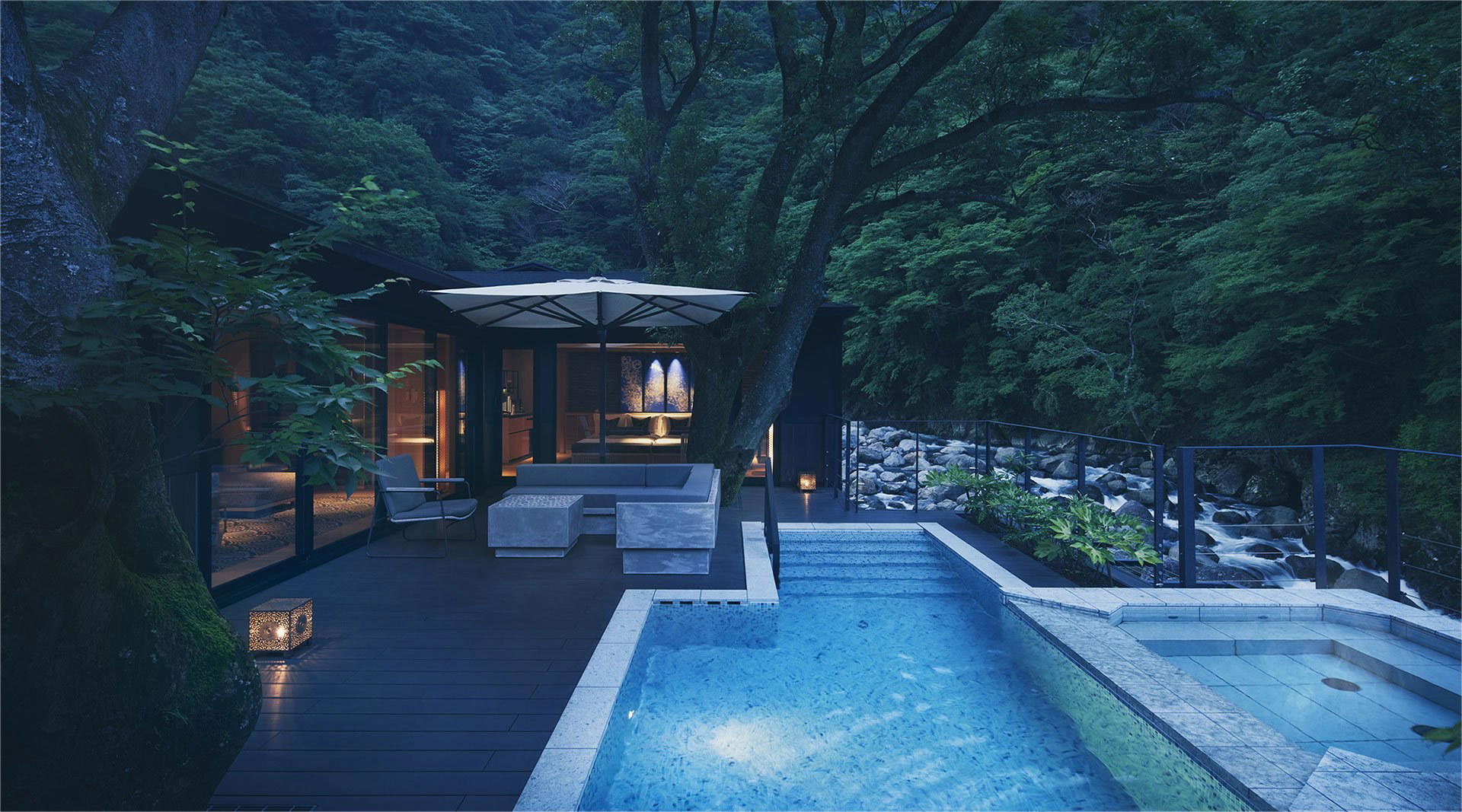
A Valley Floor Reached by Cable Car
Hakone has long occupied a particular place in Japanese luxury travel: close enough to Tokyo for a weekend, far enough into the mountains to feel genuinely elsewhere. The Hayakawa river valley, where the onsen tradition has drawn visitors for over seven centuries, now hosts a narrow tier of properties that treat the hot spring as architecture rather than amenity. ESPACIO The Hakone Geihinkan Rin-Poh-Ki-Ryu belongs to that tier. Its nine villas sit at the bottom of steep, forested hillsides, reached by cable car. The descent through cedar and bamboo is not incidental theatre; it is the actual transition from the ordinary rhythm of travel to something more considered.
At this end of the Hakone market, properties are not competing on room count or facilities breadth. They compete on the quality of seclusion, the integrity of their materials, and how coherently the physical space reflects the cultural tradition it sits within. At $2,685 per night and nine rooms total, the Rin-Poh-Ki-Ryu positions itself against a small comparable set of specialist ryokan and villa properties rather than against international resort brands. For comparison, Gora Kadan in Hakone operates a similarly intimate format in the same valley region, while Amanemu in Mie represents the Aman approach to Japanese thermal bathing at comparable price brackets. The Rin-Poh-Ki-Ryu's nine-room ceiling places it closer to the specialist end of that spectrum.
Kumiko, Lacquer, and the Geometry of Enclosure
Japan's traditional craft vocabulary is well-documented, but the quality of its application varies considerably across properties that invoke it. Kumiko woodwork, in which thin timber strips are interlocked without nails into geometric lattice panels, requires significant skill to execute at a standard where the craftsmanship reads as architecture rather than decoration. At the Rin-Poh-Ki-Ryu, kumiko detailing is deployed structurally across the villa interiors alongside delicate paper screens and gleaming lacquer surfaces. The combination is not merely ornamental: paper screens modulate light through the day, lacquer reflects the surrounding forest, and kumiko patterns create depth in partition walls that solid timber would flatten.
This design approach reflects a broader tension visible across Japan's premium ryokan category. Properties built in the 1970s and 1980s often retrofitted traditional elements onto contemporary shells, producing interiors where the craft feels applied. A more recent cohort, which includes properties like Zaborin in Kutchan and Benesse House in Naoshima, treats materiality as the primary design language, where the building's character derives from the stuff it is made of rather than the objects placed inside it. The Rin-Poh-Ki-Ryu reads as part of this latter tendency. Each villa is described as a strikingly original interpretation of the same material language, which at nine rooms means there is meaningful variation rather than the repetition typical of larger properties.
The Onsen as Architecture
Hakone's thermal springs have been in use since at least the eighth century, and the area's reputation as an onsen destination predates its current status as a weekend retreat from Tokyo by many generations. The distinction that matters at this price point is between properties where the bath is shared and those where it is integrated directly into the villa. At the Rin-Poh-Ki-Ryu, select villas include attached sauna and open-air hot springs, a rotenburo arrangement that positions the soaking experience as part of the room's spatial sequence rather than a facility to be visited. The minerals in Hakone's waters vary by source and elevation; the valley floor location along the Hayakawa river places these springs in a specific geological context that the longer onsen tradition recognises as distinct from the higher-altitude sources further into the caldera.
For travellers who have experienced the onsen format at properties like Asaba in Izu or Nishimuraya Honkan in Kinosaki-cho, the Rin-Poh-Ki-Ryu's private-villa rotenburo represents the more solitary end of a tradition that runs from large communal baths to entirely private arrangements. The trade-off at the private end is the loss of the communal bathing culture that defines older ryokan formats; what you gain is a thermal experience calibrated entirely to the villa's own rhythm and the sound of the Hayakawa below.
What the Villa Format Means in Practice
Nine rooms is a specific constraint with specific implications. At that scale, the property cannot run the parallel service channels that larger ryokan rely upon, which means the quality of attention per guest is structurally higher but also means the property has limited flexibility in absorbing last-minute changes or large group configurations. The Leading Hotels of the World membership, confirmed for 2025, signals that the operation meets the collection's documented service and physical standards. The same affiliation connects it to a comparable set that includes Araya Totoan in Kaga and Beniya Kofuyuden in Awara, both of which operate at similarly tight room counts within the Leading Hotels framework.
The cable car arrival is also a logistical reality. Access to the valley floor is managed rather than open, which means the separation from the surrounding area is structural. Visitors planning excursions to Hakone's broader attractions, including the Owakudani volcanic zone and Lake Ashi, should factor in the ascent and descent as deliberate transitions rather than quick exits. For travellers whose priority is withdrawal and immersion in the physical environment, this is a feature; for those who want a base for active regional exploration, the friction deserves consideration.
Properties at comparable price points elsewhere in Japan include ENOWA Yufu in Yufu, which applies a similarly design-led approach to Oita Prefecture's thermal tradition, and Fufu Kawaguchiko in Fujikawaguchiko, which occupies an analogous position relative to Mount Fuji. The Rin-Poh-Ki-Ryu's specific advantage is the valley-floor immersion and the cumiko material depth, which place it in a narrower bracket than the broader luxury ryokan category. For urban-property comparisons, Bvlgari Hotel Tokyo and HOTEL THE MITSUI KYOTO in Kyoto represent the city-based alternatives for travellers deciding between urban and mountain formats for a Japan stay.
In Context: Similar Options
Comparable venues nearby, for context on price, style, and recognition.
| Venue | Cuisine | Price | Awards | Notes |
|---|---|---|---|---|
| ESPACIO The Hakone Geihinkan Rin-Poh-Ki-RyuThis venue — the venue you are viewing | Exclusive private villa retreat with artist-crafted interiors and 700-year-old hot springs. | $$$$ | Michelin 1 Key | Not listed |
| Hotel Toranomon Hills (ホテル虎ノ門ヒルズ) | Luxury design hotel positioned as a cosmopolitan retreat for business travelers and experienced guests seeking Japanese-Scandinavian aesthetic fusion. | $$$$ | 5-Star | Toranomon |
| Takefue (竹ふえ) | Traditional farmhouse-style ryokan scattered across expansive bamboo forest grounds. | $$$$ | 5-Star | Minamioguni |
| 佳松園 | Traditional Japanese ryokan with modern updates including private onsen rooms | $$$$ | 5-Star | 湯本 |
| Fufu Tokyo Ginza | Small luxury resort blending Japanese onsen tradition with urban Ginza location | $$$$ | 5-Star | Ginza |
| HOSHINOYA Fuji | luxury glamping resort integrated into forested hillside | $$$$ | 5-Star | Fujikawaguchiko |
Recognition history
Dated appearances from independent guides and award organizations, with the underlying list record or original source where available.
Leading Hotels of World Member
Leading Hotels of World
Michelin 1 Key
Michelin
Continue exploring
More in Ashigarashimo-Gun
Hotels in Ashigarashimo-Gun
Browse all →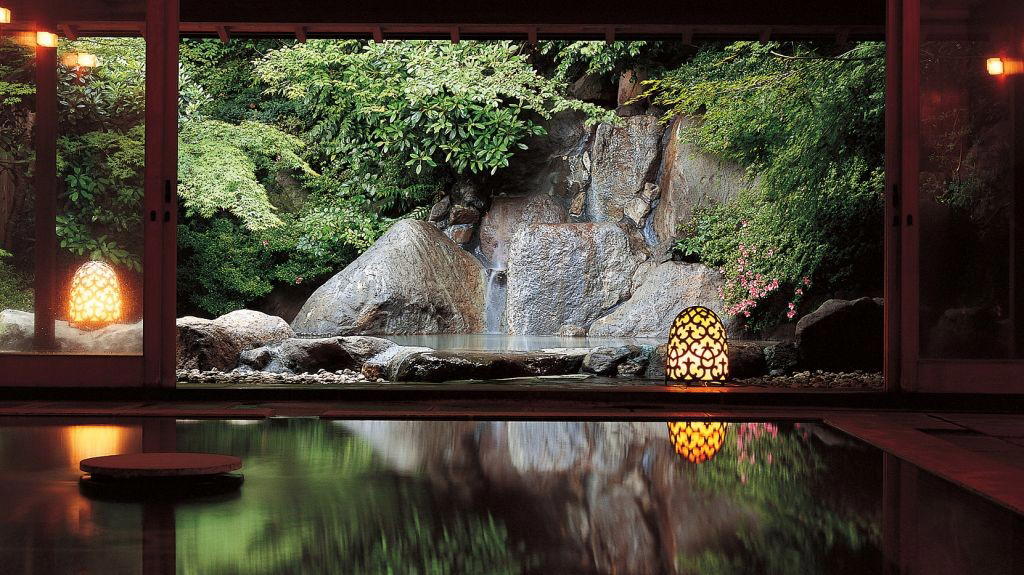
Bars in Ashigarashimo-Gun
Browse all →
Restaurants in Ashigarashimo-Gun
Browse all →
Wineries in Ashigarashimo-Gun
Browse all →
At a Glance
- Quiet
- Elegant
- Scenic
- Sophisticated
- Intimate
- Honeymoon
- Romantic Getaway
- Wellness Retreat
- Anniversary
- Private Villa
- Panoramic View
- Wi Fi
- Pool
- Spa
- Sauna
- Room Service
- Concierge
- Valet Parking
- Mountain
- Garden
- Wi Fi
- Pool
- Spa
- Sauna
- Room Service
- Concierge
- Valet Parking
Tranquil and serene atmosphere surrounded by nature, with soundproofed rooms, murmuring river sounds, and mystical Ghibli-esque tranquility featuring traditional Japanese materials like kumiko wood and lacquer.