Our verdict
Yakitori Trip Sannomiya sits in Kobe's Chuo Ward, where the city's izakaya tradition and its appetite for refined skewer cooking converge. The address places it squarely in the Sannomiya district, the commercial and nightlife center that anchors central Kobe's after-dark dining. For visitors working through the city's broader restaurant scene, it represents the yakitori tier of a food culture more often discussed through its beef and sushi counters.

Pearl is the En Primeur Club membership app, where members save venues, book tables and use the concierge.
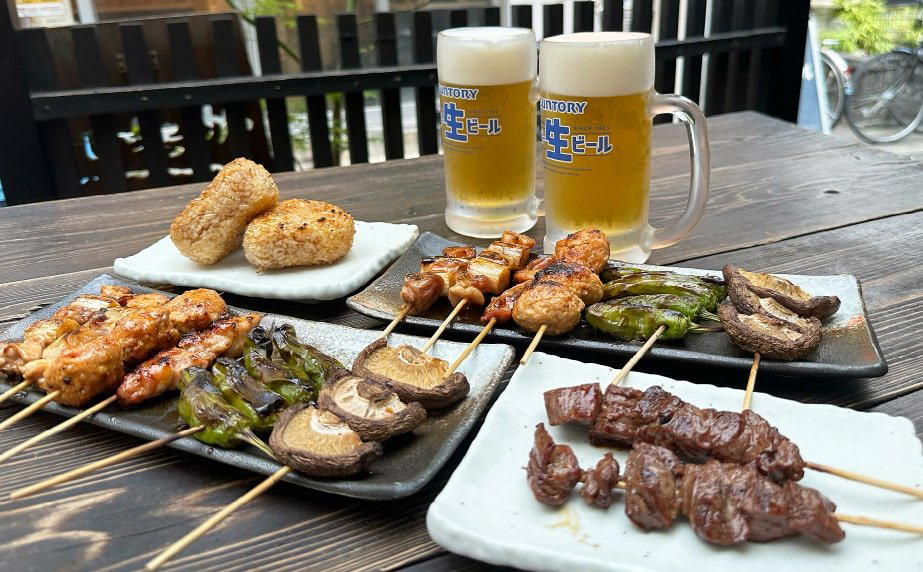
Smoke, Skewer, and the Architecture of a Yakitori Menu
Sannomiya, the dense commercial core of central Kobe, operates as the city's most legible after-dark address. The train station draws foot traffic from Osaka commuters and Hyogo locals alike, and the streets radiating south and east from it are stacked with drinking establishments, standing bars, and the kind of focused single-item restaurants that Japanese cities do better than almost anywhere else. It is in this context, a neighbourhood built around the ritual of eating and drinking after work, that yakitori as a format makes particular sense. The skewer counter is not an anomaly here; it is a structural feature of how Sannomiya organizes its evenings.
Yakitori Trip Sannomiya occupies an address on Nakayamatedori, a stretch of Chuo Ward that sits slightly uphill from the station's immediate bustle, in the direction of the old foreign settlement and Kitano. That positioning matters. The venue is accessible to the Sannomiya crowd without being absorbed entirely by it, which tends to produce a more settled dining tempo than the addresses directly adjacent to the station concourse.
What the Menu Structure Reveals
Yakitori menus carry more information than they first appear to. The sequencing of skewers, which cuts open the meal, which arrive mid-session, which close it, reflects deliberate decisions about intensity, fat content, and the pace of drinking. Serious yakitori operations tend to move from lighter preparations (breast, neck, seasonal vegetables) toward richer ones (thigh with tare, skin, cartilage) before finishing with something starchy or broth-based that signals the meal is done. This is not casual ordering; it is menu architecture in the same sense that kaiseki is menu architecture, just working with charcoal and chicken rather than dashi and seasonal produce.
The distinction between shio (salt) and tare (sweet soy glaze) preparations is another structural layer. Salt tends to read as the more technically demanding option, it exposes the quality of the bird and the precision of the grill, while tare offers more latitude and broader appeal. Counters that handle both with equal confidence position themselves in a different tier than those that default to tare across the board. In Kobe, a city where dining expectations are calibrated by proximity to the Michelin-dense corridor running from Osaka through Kyoto, that tier distinction carries weight.
For reference on how Kobe's broader restaurant scene is organized, our full Kobe restaurants guide maps the city's dining categories from beef counters to kaiseki and beyond. Yakitori occupies a specific register within that, less formal than kaiseki, less expensive than the premium wagyu houses like Aragawa, and more focused in format than the Spanish-influenced cooking at Ca Sento or the seasonal approach at Ash Restaurant.
Kobe's Yakitori Tier in Regional Context
Japan's yakitori scene has its own internal hierarchy, and Kobe sits in an interesting position within it. The city is not the first name that surfaces in national yakitori conversations, Tokyo's Ginza and Shinjuku, Osaka's Namba, and the specialist counters scattered through Fukuoka tend to dominate that discussion. But Kobe's food culture is precise and locally demanding, shaped by a port-city history that made it one of Japan's earliest points of contact with imported ingredients and cooking techniques. That history runs through the beef tradition most visibly, but it also informs a general expectation of quality at the counter level.
Within the Kansai region, yakitori operates against a backdrop that includes destination-level restaurants across multiple categories. HAJIME in Osaka anchors the haute end of the region's dining identity, while Gion Sasaki in Kyoto represents the kaiseki tradition at its most demanding. Yakitori sits outside that formal register but benefits from the same regional appetite for precision. Elsewhere in Japan, skewer-focused operations like Birdland in Sakai demonstrate how seriously the format is taken when handled with the right discipline.
Internationally, the single-subject tasting format that yakitori represents, a narrow ingredient set explored through technique and fire, has parallels in how places like Le Bernardin in New York City approach seafood: constraint as a design principle, not a limitation. The comparison is not about price tier or formality; it is about what menu architecture communicates when a kitchen commits to one primary ingredient.
Planning Your Visit
Sannomiya is the main transit hub for central Kobe, accessible by JR, Hankyu, and Hanshin rail lines, making it practical to combine with a wider Kansai itinerary that might include Harutaka in Tokyo, akordu in Nara, or Goh in Fukuoka for visitors moving through the archipelago. The Nakayamatedori address is a short walk from the main Sannomiya exits, uphill toward the residential and mixed-use streets of Chuo Ward. Yakitori counters in this part of Japan typically operate on an evening-only schedule, with seatings that align with the post-work and early-evening dinner rhythm of Japanese hospitality. Given the nature of the format, counter seating, charcoal grill, focused production, capacity at operations like this tends to be limited, and reservations are generally advisable rather than optional.
Kobe's dining scene also includes a range of other focused formats worth considering alongside a yakitori visit: Fushin and fuxing represent different registers of the city's current restaurant moment, and for those building a multi-day itinerary, pairing a skewer counter with a higher-formality meal gives the kind of range that reflects how Kobe actually eats.
Frequently asked questions
Where exactly is Yakitori Trip Sannomiya?
Yakitori Trip Sannomiya is located at Japan, 〒650-0004 Hyogo, Kobe, Chuo Ward, Nakayamatedori, 1 Chome−15−2 富士ビル, Kobe.
How does Yakitori Trip Sannomiya's location in Sannomiya affect the dining experience?
Sannomiya functions as Kobe's central rail interchange, JR, Hankyu, and Hanshin lines all terminate or pass through, which makes the Chuo Ward address straightforward to reach from Osaka, Kyoto, or Himeji on the same day. The density of the district means Yakitori Trip Sannomiya sits within walking distance of Kobe's broader restaurant and bar strip, making it a practical anchor for an evening that continues elsewhere. That transit access also brings a mixed crowd of locals and day-trippers, which tends to keep Sannomiya counters operating at consistent capacity.
What's the best thing to order at Yakitori Trip Sannomiya?
Yakitori menus are structured deliberately, so the most reliable approach is to follow the kitchen's sequencing rather than ordering à la carte from the top. In Kobe's yakitori tier, counters typically open with lighter cuts, breast or tsukune, before moving through fattier, smoke-intensive pieces like thigh and tail. Trust the progression rather than anchoring on a single skewer.
Should I book Yakitori Trip Sannomiya in advance?
Sannomiya is Kobe's busiest after-dark district, drawing foot traffic from three converging rail lines, JR, Hankyu, and Hanshin, which keeps demand high at compact yakitori counters throughout the week. Walk-ins are possible off-peak, but for weekend visits or groups larger than two, contacting the venue ahead is the practical course. No online reservation system is publicly listed at this time.
What's Yakitori Trip Sannomiya best at?
The venue sits inside Japan's yakitori tradition at its most focused: charcoal, skewer, sequence. Kobe is not Osaka or Tokyo in terms of yakitori name recognition, which means counters here tend to compete on craft and consistency rather than profile. Yakitori Trip Sannomiya, positioned in Chuo Ward's Nakayamatedori, draws from that competitive local standard.
Can Yakitori Trip Sannomiya accommodate dietary restrictions?
Yakitori is a chicken-centric format by definition, and most counters in this category build their menus around poultry cuts, offal, and occasionally vegetable skewers. Guests avoiding meat entirely will find the format limiting.
The Essentials
Comparable venues nearby, for context on price, style, and recognition.
| Venue | Cuisine | Price | Awards | Notes |
|---|---|---|---|---|
| Yakitori Trip SannomiyaThis venue (the venue you are viewing) | Charcoal-Grilled Yakitori | $30–50 | Not listed | Not listed |
| Banshu Jizake Hino | Japanese Izakaya | $30–50 | Tabelog 100 #43 | Chūō, Japanese Izakaya |
| 老虎菜 本店 | Higashinada, japanese | Not listed | Tabelog 100 #65 | Not listed |
| European Ryori Mon | Classic Yoshoku (Japanese Western-style) | $30–50 | Tabelog 100 #4 | Chūō, Classic Yoshoku (Japanese Western-style) |
| Kobe Onsen Sosaku Dining So | Creative Japanese set meals in an onsen complex | $10–20 | Tabelog 100 #14 | Kita, Creative Japanese set meals in an onsen complex |
| Tori Yoshi | Traditional Yakitori / Chicken Dishes | $30–50 | Tabelog 100 #65 | Higashinada, Traditional Yakitori / Chicken Dishes |