

1 Michelin Star · Tabelog Bronze #522
Our verdict
An eight-seat counter in Osaka's Kita Ward, Yonemasu holds a Michelin star and has earned Tabelog Silver recognition in six consecutive years. The kaiseki-rooted course places seasonality at its centre, with ingredients mapped by origin across Japan and presented according to the traditional calendar. Cash-only and reservation-required, this is Osaka's ingredient-forward Japanese dining at a measured, serious level.

Pearl is the En Primeur Club membership app, where members save venues, book tables and use the concierge.
A Counter Where the Calendar Drives the Kitchen
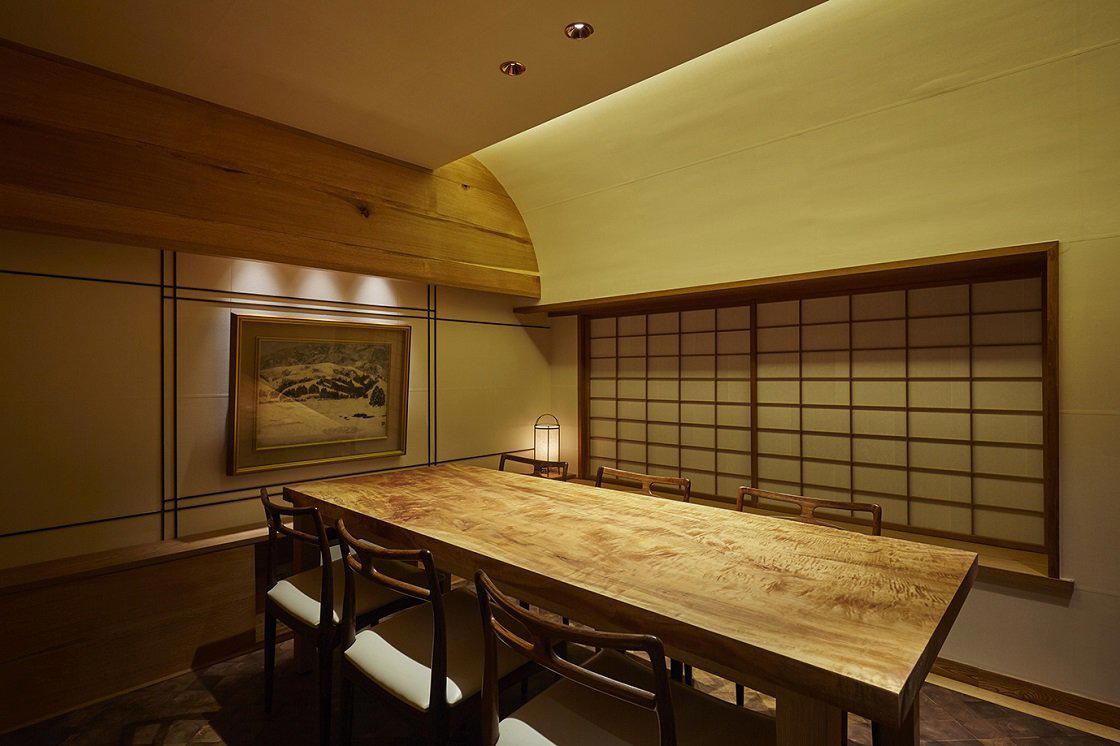
In the Oyodominami district of Kita Ward, a short walk from JR Fukushima Station, the physical address of Yonemasu gives little away. The first floor of a low-rise building on a quiet stretch of Naniwa-suji, the room turns on a single row of eight counter seats. There is no ambient spectacle, no staging for entrance. The focus shifts immediately to what is in front of you, and in a kaiseki context, that is precisely the point. Japan's most considered restaurant formats have long used spatial restraint to direct attention toward the meal, and Yonemasu operates squarely within that tradition.
The Ingredient as Argument
Osaka's top-tier Japanese cuisine houses sit in a competitive tier that includes Kashiwaya Osaka Senriyama and Miyamoto, alongside kaiseki specialists such as Tenjimbashi Aoki and Oimatsu Hisano. Within that set, Yonemasu occupies a position defined above all by its relationship with raw materials. The kitchen describes itself as particular about fish, and the course structure reflects that orientation: ingredients are plotted on a map of Japan to show their provenance, and the menus are organised around the traditional Japanese calendar, so seasonal divisions, not contemporary fashion or individual technique, determine what appears on the counter.
This is a meaningful editorial choice. In the broader Japanese fine-dining scene, a chef-as-auteur framing has become increasingly common, with counter experiences built around the personality and biography of a single practitioner. Yonemasu moves in a different direction. The proprietor and the kitchen team begin service by introducing the raw ingredients before cooking begins, working as a team rather than foregrounding any single figure. The result places the diner in a more directly educational relationship with the material. When the course opens, you already know what region produced which fish, which vegetable was cut this morning, which supplier sent the seasonal item that will anchor the meal. Yugen takes a similar counter-forward approach at its price point, but Yonemasu's explicit provenance mapping is more granular.
Temperature, Texture, and the Logic of Serving Vessels
Japanese kaiseki training places extraordinary weight on temperature discipline. A soup that arrives two degrees below its intended serving point, a piece of fish held fractionally too long, these are not minor oversights in a tradition that treats thermal precision as part of the flavour itself. Yonemasu's documented approach makes temperature and texture explicit kitchen priorities. Courses are presented with attention to the freshly cooked aromas that carry through the counter format, where the distance between preparation and service is measured in seconds rather than minutes.
The choice of serving vessels, and the use of paper and leaf garnishes as presentation surfaces, connects to what the kitchen calls hallowed customs in Japanese cuisine. These are not decorative decisions. In the Japanese culinary canon, the vessel is considered an extension of the dish, its material, weight, and age carry information about season and occasion. Guests who have spent time with kaiseki at comparable counters, such as Gion Sasaki in Kyoto or Harutaka in Tokyo, will recognise the register immediately. For those newer to the format, the team's introductory explanation of each ingredient provides scaffolding that makes the vessel choices legible rather than merely atmospheric.
Recognition Over Time
Yonemasu's awards record is consistent in a way that separates it from newer entrants to Osaka's serious Japanese dining tier. The restaurant has held Tabelog Silver recognition every year from 2019 through 2023, with Bronze in 2018, 2024, and again in 2026. It was selected for the Tabelog Japanese Cuisine WEST Top 100 in 2021, 2023, and 2025. Its current Tabelog score of 4.37 places it in a bracket where sustained peer review carries more signal than a single award cycle. The 2024 Michelin star adds a separate data point from a different evaluation methodology, confirming that the kitchen performs at a consistent level across both critic-facing and user-review frameworks.
For context within Osaka's wider fine-dining map: the city's French-rooted innovative houses, including Hajime and La Cime, operate at the ¥¥¥¥ tier with Michelin three and two stars respectively. Yonemasu holds its Michelin recognition at ¥¥¥, which positions it as a high-credential entry point into Osaka's serious Japanese cuisine without requiring the full commitment of the city's most expensive counters. The comparison set in kaiseki and nihon-ryori terms runs closer to Taian, which also occupies the ¥¥¥ tier with Michelin recognition. Across Japan, the format finds its Tokyo parallel at places like Azabu Kadowaki and Myojaku, both of which operate in the same counter-kaiseki tradition at broadly comparable price levels.
The Kita Ward Location
The Fukushima and Oyodominami stretch of Kita Ward has become a secondary destination within Osaka's restaurant geography, drawing serious Japanese cuisine counters that do not need the visibility of Namba or Shinsaibashi to maintain full bookings. The neighbourhood sits close enough to JR Osaka Station (approximately 15 minutes on foot) and directly accessible from JR Fukushima Station (7 minutes) to be practical for visitors staying in central Osaka. It lacks the density of Minami's dining corridor, which is part of its appeal for a certain type of counter: lower ambient noise, a residential pace, and a clientele that came specifically for the meal rather than as part of a broader evening circuit. For other serious meals nearby, the Our full Osaka restaurants guide covers the full range of the city's current options, and the Our full Osaka experiences guide maps non-dining programming worth scheduling around a Yonemasu visit.
Those building a wider Kansai itinerary will find relevant context in akordu in Nara for a contrasting modern-European approach to regional produce, while Gion Sasaki in Kyoto offers a Kyoto-based kaiseki comparison at a higher price bracket. Further afield, Goh in Fukuoka, 1000 in Yokohama, and 6 in Okinawa represent how the same Japanese counter format reads differently when the surrounding ingredient culture shifts.
Planning Your Visit
Reservations: Required, with advance booking until the day before at minimum; given sustained Tabelog recognition and an eight-seat counter, demand consistently outpaces availability and booking several weeks ahead is the practical approach. Budget: The listed course price is ¥20,000 per person (tax excluded), with a 10% service charge; review-based averages suggest actual spend typically reaches ¥30,000–¥49,999 per person depending on drink selection. Payment: Cash only, credit cards, electronic money, and QR code payments are not accepted; plan accordingly. Hours: Lunch from 14:00, dinner from 17:30; closed Wednesdays and Sundays. Access: 7 minutes on foot from JR Fukushima Station, 15 minutes from JR Osaka Station. Drinks: Sake (nihonshu), shochu, and wine are available. Note: Children are not permitted; the space is entirely non-smoking.
For Osaka hotel options near Kita Ward, see our Our full Osaka hotels guide. Bar recommendations for the area are in our Our full Osaka bars guide, and the Our full Osaka wineries guide covers producers worth pairing with a broader food itinerary.
Frequently asked questions
What should I order at Yonemasu?
Yonemasu runs a single set course, there is no à la carte selection. The course, priced at ¥20,000 before tax, centres on seasonal Japanese ingredients sourced from across the country and introduced to guests before cooking begins. The kitchen describes itself as particular about fish, so the course typically gives the most structural weight to seafood. Given a Michelin star and six years of Tabelog Silver recognition, the course as a whole is the reason to book, the specific content shifts with each seasonal cycle.
How far ahead should I plan for Yonemasu?
An eight-seat counter with a Michelin star and consistent Tabelog Top 100 placement fills quickly. The reservation policy requires booking at least the day before, but in practice a single day's notice is rarely sufficient for a restaurant with this awards profile and this few seats. If Osaka is a fixed stop in your itinerary, targeting four to six weeks ahead is a reasonable working assumption, particularly for weekend slots. For travellers with firm travel dates, booking as soon as dates are confirmed is the direct approach. The Osaka dining tier this restaurant occupies, alongside peers at the ¥¥¥ Michelin level, operates on booking timelines closer to Tokyo's leading counters than to the city's more accessible mid-market options.
Credentials Lens
Comparable venues nearby, for context on price, style, and recognition.
| Venue | Cuisine | Price | Awards | Notes |
|---|---|---|---|---|
| YonemasuThis venue (the venue you are viewing) | Traditional Japanese Kaiseki | $30–50 | 1 Michelin Star · Tabelog Bronze #522 | Not listed |
| il Centrino | Modern Italian with Japanese Seasonal Ingredients | $150–200 | 1 Michelin Star · Tabelog 100 #33 | Chūō |
| Terada | Modern Kaiseki | $150–200 | 1 Michelin Star · We're Smart World 2 Radishes | Tennōji |
| Ono | Awaji Island Kaiseki | $200–300 | 1 Michelin Star · Tabelog Bronze #337 | Kita |
| Ñ | Modern Spanish Fine Dining | $150–200 | 1 Michelin Star · Tabelog Bronze | Kita |
| Nishitemma Nakamura | Seasonal Kaiseki with Western Influences | $150–200 | 1 Michelin Star | Kita |
Recognition history
Dated appearances from independent guides and award organizations, with the underlying list record or original source where available.
Michelin 1 Star
Michelin
Tabelog Bronze #522
Tabelog
Full recognition history (5 entries)
Tabelog Silver
Tabelog
Tabelog 100 #81 · No. 81
Tabelog · Tabelog 100 - Japanese cuisine - WEST - 2025
Michelin 1 Star
Michelin
Continue exploring
More in Osaka
Restaurants in Osaka
All restaurants in Osaka →



Bars in Osaka
All bars in Osaka →



Hotels in Osaka
All hotels in Osaka →



Wineries in Osaka
Browse all →
Details
- Elegant
- Quiet
- Classic
- Intimate
- Sophisticated
- Date Night
- Business Dinner
- Special Occasion
- Standalone
- Set Menu
Current opening hours
- Monday
- 2–8:30 PM
- Tuesday
- 2–8:30 PM
- Wednesday
- Closed
- Thursday
- 2–8:30 PM
- Friday
- 2–8:30 PM
- Saturday
- 2–8:30 PM
- Sunday
- Closed
Hours can change for holidays and private events. Hours as of .
Quiet, deliberate, and formal, with a smart and elegant room that feels removed from the pace of the nearby station area.