
Michelin Selected
Hotel Noum OSAKA holds a Michelin Selected distinction in the 2025 Michelin Hotels guide, placing it among a curated tier of Osaka properties recognised for quality and character. Located in Temma, Kita-ku, the hotel sits at a considered remove from the city's more saturated tourist circuits, offering a base oriented around deliberate rest and recovery rather than spectacle.

Pearl is the En Primeur Club membership app — saves, bookings, and concierge access live there. Same editors, same standards.
- Address
- 4 Chome-1-18 Tenma, Kita Ward, Osaka, 530-0043, Japan
- Phone
- +81 6-6940-0882
- Website
- no-um.jp
- Directions
- Get directions
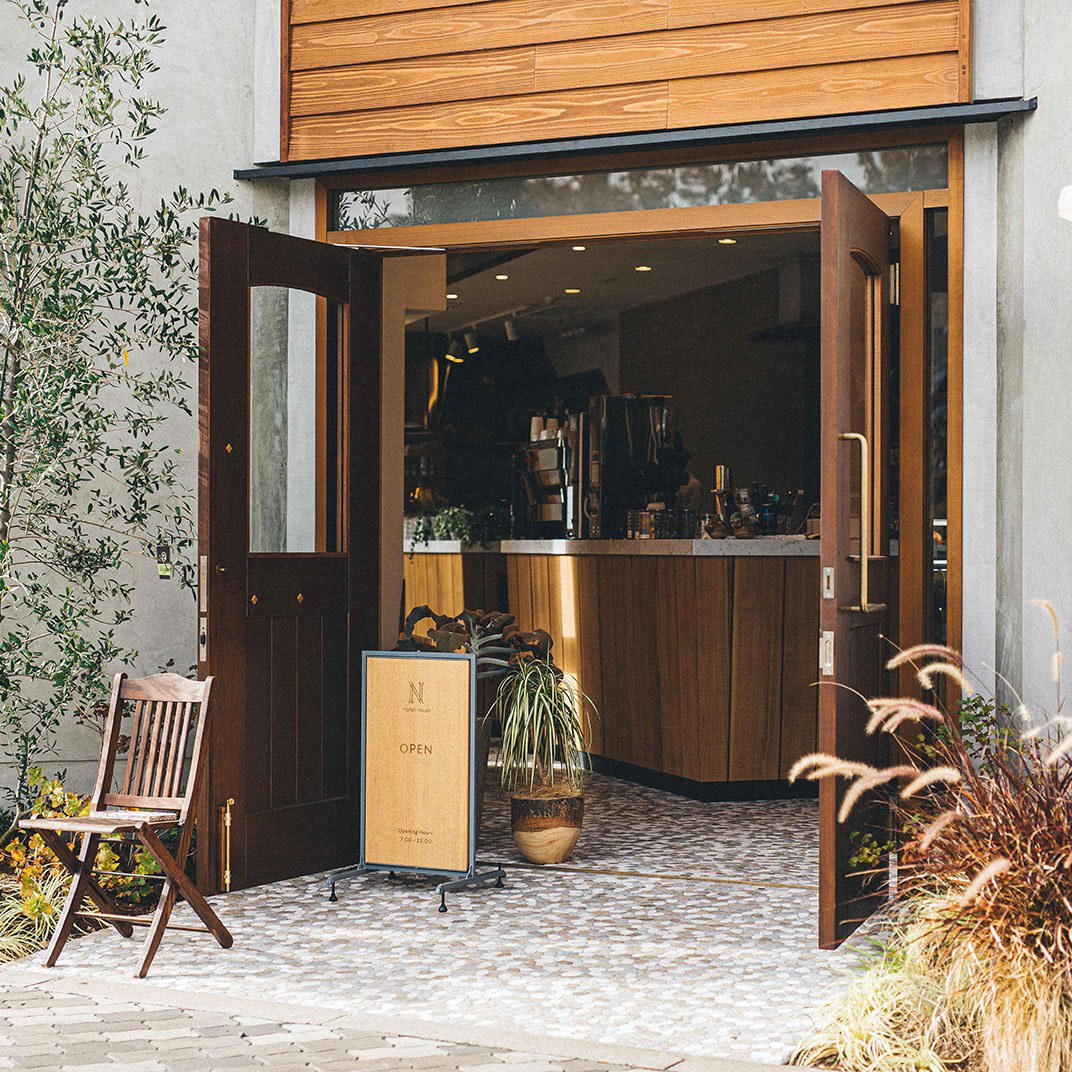
Temma as a Base for Deliberate Rest
Osaka's accommodation market has long been weighted toward the southern corridors of Namba and Shinsaibashi, where international chain flags cluster and foot traffic rarely drops below overwhelming. The northern wards tell a quieter story. Kita-ku holds the city's main commercial and transport hub around Umeda, but Temma — just east of that node — occupies a transitional register: accessible enough for practical movement across the city, yet removed from the sensory intensity that defines Osaka's better-known quarters. Hotel Noum OSAKA, at 4-1-18 Temma, sits in this intermediate zone, and that positioning is not incidental to how the property functions as a retreat within an urban setting.
The Michelin Selected distinction awarded to Hotel Noum OSAKA in the 2025 Michelin Hotels guide is a calibration signal worth reading carefully. Michelin's hotel selection process evaluates properties against criteria that include design coherence, service quality, and the overall clarity of the hospitality offer, it is a recognition of considered execution rather than raw scale. Within Osaka's broader hotel field, where properties like The Ritz-Carlton, Osaka and Conrad Osaka represent the large-footprint international tier, the Michelin Selected category tends to capture a different cohort: properties with a more specific point of view on the guest experience.
The Retreat Orientation of a City Hotel
Urban wellness hospitality in Japan has developed its own logic, distinct from the resort-and-onsen model that dominates the country's rural and coastal hotel culture. Properties like Gora Kadan in Hakone or Amanemu in Mie can anchor their wellness offer in natural landscape and thermal water traditions. City hotels have to construct that sense of retreat from different materials: architecture that manages external noise and light, programming that supports recovery rhythms, and a general restraint in the design language that allows guests to decompress rather than perform. This is the challenge Hotel Noum OSAKA is positioned to address.
The name itself, Noum, carries associations with the Japanese concept of nourishment at a foundational level, suggesting an intent to align the property with restorative rather than purely transactional hospitality. In a city that rewards persistence and appetite across long days of eating, walking, and sensory absorption, having a base calibrated for genuine rest changes the texture of the stay. The contrast between Osaka's street-level intensity and a hotel designed around recovery is, for many travellers, the point.
This approach puts Hotel Noum OSAKA in a different competitive conversation from the high-capacity flagships around Umeda. InterContinental Osaka and W Osaka compete on breadth of facilities and brand recognition; the Michelin Selected tier tends to compete on the quality of the specific experience delivered, particularly the coherence between design intent and actual guest feeling. For travellers whose priority is recovery, focus, and a considered environment rather than a full-service resort program, that distinction matters.
Locating the Property in Osaka's Hotel Tiers
Osaka's hotel options have diversified significantly over the past decade, adding both ultra-luxury entrants and design-conscious mid-tier properties to a market that was once more narrowly stratified. The current spread runs from internationally recognised luxury addresses, the Ritz-Carlton and Conrad both in the upper reaches, through a growing cohort of design-led properties like Aloft Osaka Dojima and Candeo Hotels Osaka The Tower, down to value-oriented options around the major transit hubs.
Hotel Noum OSAKA's Michelin Selected status positions it above the purely functional tier without requiring it to compete on the amenity volume of the large international properties. This is the space in Osaka's hotel market where character and intention carry more weight than square footage or pool count. Comparable logic applies to Michelin Selected properties elsewhere in Japan: HOTEL THE MITSUI KYOTO in Kyoto and Zaborin in Kutchan each occupy tiers defined less by size than by specificity of vision.
For travellers comparing Osaka city options, Candeo Hotels Osaka Shinsaibashi and Caption by Hyatt Namba Osaka offer design-conscious alternatives in the southern entertainment districts, with more immediate proximity to Dotonbori and the izakaya belts. Hotel Noum OSAKA's Temma address trades some of that immediate adjacency for a quieter operating register, a reasonable exchange for guests who want the city's energy on demand but not as a constant condition.
Planning the Stay
Temma connects directly to Osaka's rail network, placing the property within practical reach of the city's main attraction nodes: Umeda's department stores and the Osaka Station complex to the west, the Tenjinbashi-suji shopping arcade within walking distance, and the broader Minami district accessible by subway in under twenty minutes. For Osaka's restaurant scene, among the densest and most serious in Japan, the northern location means easy access to the Honmachi and Kitahama areas as well as shorter transit times to Kyoto and Nara for day excursions. The full shape of what the city offers is mapped in our full Osaka restaurants guide.
Travellers planning a wider Japan itinerary often pair an Osaka base with properties in adjacent prefectures. Nishimuraya Honkan in Kinosaki-cho is a natural extension northward toward the Japan Sea coast, while Benesse House in Naoshima and Sekitei in Hatsukaichi-shi anchor routes through the Seto Inland Sea region. For those extending to Tokyo, Bvlgari Hotel Tokyo operates at the ultra-luxury end of the capital's market. Further afield, Halekulani Okinawa, Jusandi in Ishigaki, and Kamenoi Besso in Yufu cover the southern and island options for travellers seeking a warmer, slower counterpoint to an Osaka city stay. For those drawing international comparisons, the scale and ambition of properties like Badrutt's Palace Hotel in St. Moritz or Hôtel de Paris Monte-Carlo represent a different tradition of resort-anchored luxury; The Fifth Avenue Hotel in New York City offers perhaps the closest urban-boutique parallel in a Western context. And for those who prize stillness and intentionality in the same way that Hotel Noum OSAKA's Michelin distinction implies, Asaba in Izu and Fufu Nikko in Nikko offer ryokan-tradition properties that carry the same ethos into a more remote, nature-adjacent register.
Booking is handled directly through the property. Given the Michelin Selected designation and the relatively contained scale implied by a boutique Temma address, availability during peak Osaka periods, sakura season in late March to early April, and the autumn travel window from October through November, should be confirmed well in advance.
Recognition Snapshot
Comparable venues nearby, for context on price, style, and recognition.
| Venue | Cuisine | Price | Awards | Notes |
|---|---|---|---|---|
| Hotel Noum OSAKAThis venue — the venue you are viewing | Contemporary minimalist boutique hotel emphasizing comfort and authenticity with warm materials and curated local design elements. | Not listed | Michelin Selected | Not listed |
| Hotel Granvia Osaka (ホテルグランヴィア大阪) | Contemporary urban tower hotel with direct train station access | $100–200 | Not listed | Umeda |
| Aloft Osaka Dojima | Lifestyle hotel blending history and modernity in Umeda. | $100–200 | Michelin Selected | Kita |
| Caption by Hyatt Namba Osaka | Modern lifestyle hotel with self-service check-in and do-it-yourself approach; trendy, lower-cost positioning focused on location and local neighborhood integration. | $100–200 | Michelin Selected | Chūō |
| Osaka Excel Hotel Tokyu | Osaka Kaleidoscope concept blending lively opulence with city night views | $100–200 | Preferred Hotels Member | Chūō |
| voco Osaka Central | Design-oriented IHG sub-brand emphasizing contemporary aesthetics with cultural heritage integration | $200–300 | Michelin Selected | Kyomachibori, Nishi-ku |
Recognition history
Dated appearances from independent guides and award organizations, with the underlying list record or original source where available.
Michelin Selected
Michelin
Continue exploring
More in Osaka
Hotels in Osaka
Browse all →




Bars in Osaka
Browse all →




Restaurants in Osaka
Browse all →




Wineries in Osaka
Browse all →
Details
- Minimalist
- Quiet
- Modern
- Scenic
- Weekend Escape
- Family Vacation
- Business Trip
- Waterfront
- Garden
- Panoramic View
- Design Destination
- Wi Fi
- Bicycle Rental
- Luggage Storage
- Waterfront
- Garden
- Elevator
Serene and tranquil with abundant natural light from floor-to-ceiling windows, sunlit cafe lounge, and views of the river and adjacent green parklands creating a peaceful urban retreat.