Michelin Plate · SCMP 100 Top Tables Restaurants
Our verdict
Udatsu Sushi brings the omakase counter tradition from Tokyo to Tsim Sha Tsui, operating from The Stable at House 1881 on Canton Road. Chef Hisashi Udatsu holds a Michelin Plate in both 2024 and 2025, with the Hong Kong counter earning recognition alongside the original Japan listing on Opinionated About Dining's 2025 rankings. Price range sits at the upper tier of Hong Kong's sushi market.

Pearl is the En Primeur Club membership app, where members save venues, book tables and use the concierge.
The menu
What to order
- Double sea urchin with seaweed tempura nigiri
- Double-smoked fatty tuna
- Local eel nigiri
The Counter at House 1881
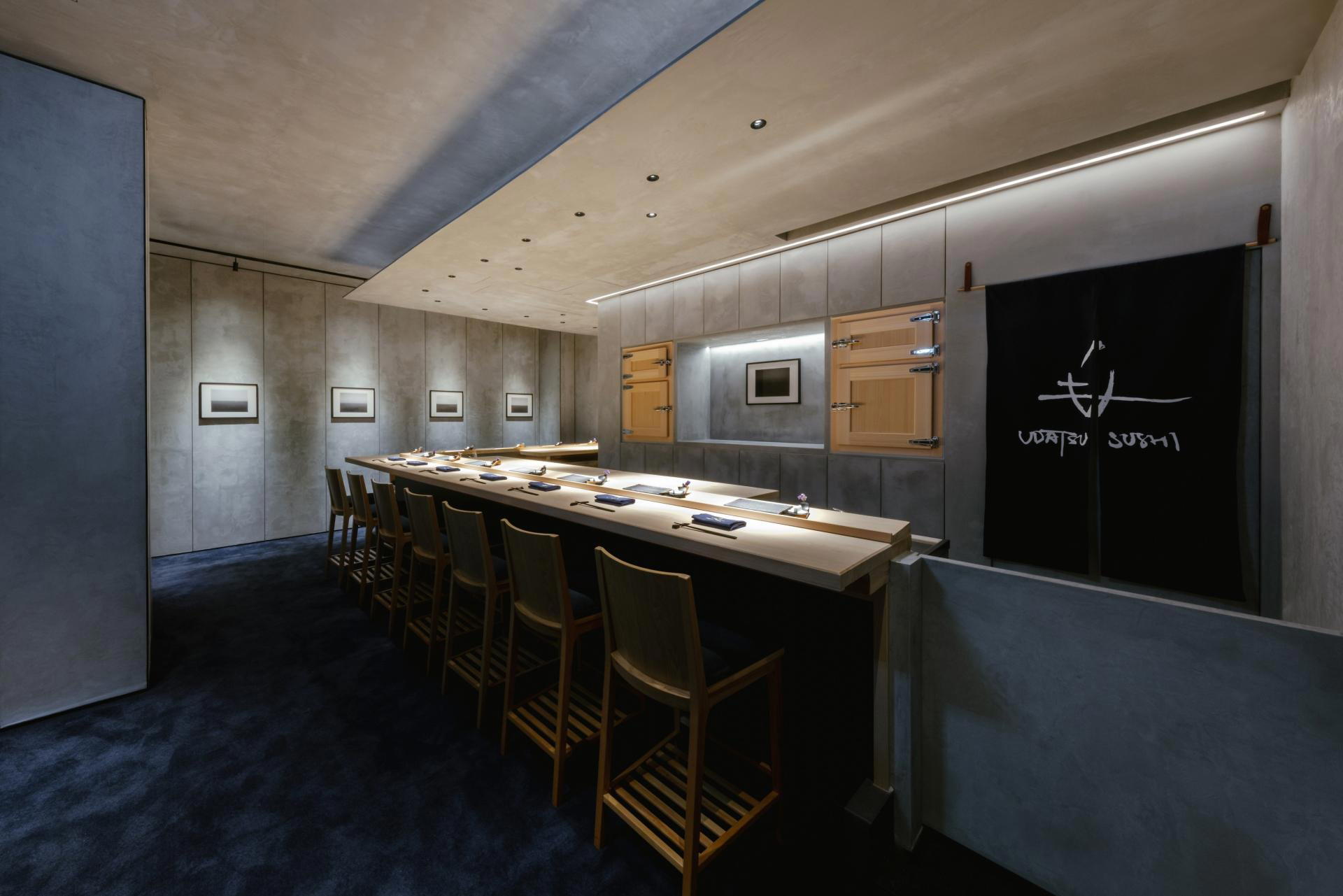
The western end of Canton Road has long been associated with monument-scale luxury: the former Marine Police Headquarters complex at House 1881 now anchors a stretch that includes flagship watch boutiques and hotel lobbies sized for impression. The Stable, a converted Victorian outbuilding on the property, operates at a different register. Low ceilings, stone walls, and the intimacy of a building that predates Hong Kong's verticality by a century create a setting where the ceremony of an omakase meal feels less theatrical and more grounded. Before a single piece of nigiri arrives, the room itself establishes the tempo: slow, deliberate, attentive.
This physical context matters more at Udatsu Sushi than at counters where the fit-out is purpose-built for sushi. The Stable's architecture does some of the ritual work for the chef, framing the meal as something set apart from the surrounding commercial district rather than continuous with it.
Omakase in Hong Kong's Sushi Tier
Hong Kong's leading sushi counters now form a recognisable bracket: a cluster of omakase rooms competing on fish sourcing, Edomae technique, and the tightness of their booking windows. Sushi Shikon anchors the Michelin three-star end of that range. Sushi Saito and Sushi Wadatsumi sit in adjacent tiers. Udatsu occupies a position defined by its dual recognition: a Michelin Plate in both 2024 and 2025, and a listing on Opinionated About Dining's 2025 rankings at position 521, a list that typically rewards technical precision and sourcing depth over ambient luxury. That dual signal places Udatsu in the tier of counters where the fish programme is the primary credential, not the room or the brand.
Within Hong Kong specifically, the Michelin Plate acknowledges consistent cooking without conferring the star that separates Shikon from the rest of the field. For diners comparing options, that distinction is meaningful: a Plate counter at the $$$$ price point is making a claim based on craft rather than ceremony. Peer counters at a similar recognition level include Sushi Fujimoto and Sushi Gin, both operating in the same competitive band. The OAD placement, however, extends Udatsu's reference set beyond Hong Kong: counters recognised on that list sit in a conversation with Harutaka in Tokyo, Sushi Harasho in Osaka, and Edomae Sushi Hanabusa, rather than purely with the local Hong Kong market.
The Ritual of the Omakase Meal
The omakase format, at any serious counter, is less a menu than a contract: the diner surrenders selection in exchange for the chef's judgment on what is at its peak that day. At counters working within the Edomae tradition, the style developed in Edo-period Tokyo, built around vinegared rice and fish either cured, marinated, or aged rather than simply raw, that contract carries specific implications for pacing and sequence.
A properly constructed omakase begins with lighter, more delicate pieces and moves toward fattier, more intense cuts. The rice temperature is calibrated so that nigiri arrives at close to body heat, allowing the vinegar seasoning and the fish to integrate rather than contrast. Soy is applied by the chef at most serious counters, not by the diner; the piece is presented ready to eat and should be consumed in a single motion. These customs are not arbitrary etiquette: they reflect decisions about texture, temperature, and flavour sequencing that took decades of practice to codify.
Chef Hisashi Udatsu trained and established his reputation in Japan before extending the counter to Hong Kong, a pattern that has become increasingly common as Tokyo-lineage sushi expands into Southeast Asian and East Asian cities. The same trajectory applies to Shoukouwa in Singapore and Hamamoto, both operating with Japan-trained chefs in non-Japanese markets. What distinguishes counters that maintain credibility in this model is whether the sourcing infrastructure travels with the chef: fish flown from Toyosu, aged in-house, and prepared with the timing discipline the format demands. The OAD ranking for Udatsu's Japan location, alongside recognition for the Hong Kong counter, suggests the programme has held.
For diners less familiar with the format, the key practical adjustment is temporal: omakase is not a meal to compress. Counters in this tier typically run between 90 minutes and two hours. Arriving with other plans immediately after is a structural misread of what the format requires.
Tsim Sha Tsui as a Dining Address
The concentration of serious Japanese dining in Tsim Sha Tsui has shifted over the past decade. The neighbourhood's hotel density and proximity to Harbour City create a commercial gravity that attracts both high-volume Japanese chains and smaller counter operations. The House 1881 site sits slightly removed from the densest retail corridor on Canton Road, which gives The Stable a degree of physical separation that its address might not suggest. Tsim Sha Tsui's sushi addresses now compete directly with those in Central and Wan Chai for the same pool of serious diners; geography is less determinative than it was when Japanese fine dining in Hong Kong concentrated almost entirely on the Island side.
For visitors building a broader itinerary, the full Hong Kong restaurants guide covers the city's dining range across neighbourhoods and price tiers. The hotels guide, bars guide, experiences guide, and wineries guide map the city's wider hospitality offer.
How Udatsu Compares to Counters Beyond Hong Kong
The migration of Tokyo-trained sushi chefs to major Asian cities has created a legible tier of counters that can be assessed against each other across geographies. Sukiyabashi Jiro Roppongiten and Sushi Kanesaka in Tokyo represent the upper end of that reference set. Sushi Sho in New York operates in a similar cross-border conversation. Udatsu's dual Japan and Hong Kong recognition positions it within this international cohort rather than purely as a local Hong Kong option, a meaningful distinction for visitors who move regularly between Japanese sushi markets and want a counter that meets a consistent standard.
Planning Your Visit
Address: The Stable, House 1881, 2A Canton Road, Tsim Sha Tsui. Reservations: Booking in advance is expected at all $$$$ omakase counters in this category; no booking method is listed in current public records, so contact through the House 1881 property directly or check current listings. Budget: $$$$, the upper tier of Hong Kong's sushi market, consistent with Michelin-recognised omakase counters in the city. Dress: No formal dress code is listed, but the setting and price tier align with smart casual as a baseline. Timing: Allow a full evening; 90 to 120 minutes is standard for a properly paced omakase sequence at this level.
Frequently asked questions
What should I budget for a meal at Udatsu Sushi?
Pricing at Udatsu Sushi is listed as $$$$.
What cuisine category does Udatsu Sushi fall under?
What awards or recognition does Udatsu Sushi have?
Udatsu Sushi has received recognition including: Opinionated About Dining Top Restaurants in Japan Ranked #521 (2025); Michelin Plate (2025); Michelin Plate (2024).
What should I order at Udatsu Sushi?
Udatsu Sushi operates as an omakase counter, so the selection is not yours to make, Chef Hisashi Udatsu sets the sequence based on the kitchen's current fish sourcing. The format is the point: you are eating whatever the chef has judged to be at its best that day, which at a Michelin Plate-recognised counter in the $$$$ bracket is the correct way to eat here. Arrive without a specific dish agenda.
Where do I go for Udatsu Sushi?
Udatsu Sushi is located at House 1881, FWD, The Stable, 2A Canton Rd, Tsim Sha Tsui, Hong Kong, Hong Kong.
A Pricing-First Comparison
A quick peer reference to anchor this venue in its category.
| Venue | Cuisine | Price | Awards | Notes |
|---|---|---|---|---|
| Udatsu SushiThis venue (the venue you are viewing) | Modern Omakase Sushi | $200–300 | Michelin Plate · SCMP 100 Top Tables Restaurants | Not listed |
| 8 1/2 Otto e Mezzo Bombana (Hong Kong) | 3 Michelin-Star Italian Fine Dining | $200–300 | 3 Michelin Stars · World's 50 Best #94 | Italian |
| Ta Vie | Modern French-Japanese Fine Dining | $300–500 | 3 Michelin Stars · World's 50 Best #68 | Japanese - French, Innovative |
| Caprice | Contemporary French Fine Dining | $200–300 | 3 Michelin Stars · World's 50 Best #35 | French, French Contemporary |
| Feuille | Modern Vegetable-Forward French | $200–300 | 1 Michelin Star · World's 50 Best #93 | French Contemporary |
| Neighborhood | Modern French with Asian Influences | $50–100 | 1 Michelin Star · World's 50 Best #24 | International, European Contemporary |
Recognition history
Dated appearances from independent guides and award organizations, with the underlying list record or original source where available.
Michelin Plate
Michelin
SCMP 100 Top Tables Restaurants
SCMP 100 Top Tables
Opinionated About Dining Top Restaurants in Japan Ranked #521
Opinionated About Dining
Full recognition history (5 entries)
Michelin Plate
Michelin
Michelin Plate
Michelin