



2 Michelin Stars · La Liste Top Restaurants · Tabelog 100 #27
Our verdict
A two-Michelin-starred sushi counter in Osaka's Tennoji Ward, Sushi Harasho operates on a philosophy of deliberate restraint: no sugar in the rice, minimal seasoning, and technique stripped to its essentials. Recognised by La Liste 2026 and Opinionated About Dining, it sits among Osaka's most decorated sushi addresses. Open Tuesday through Saturday, noon to 8:30 pm.

Pearl is the En Primeur Club membership app, where members save venues, book tables and use the concierge.
The Tea-House Counter and the Case for Less
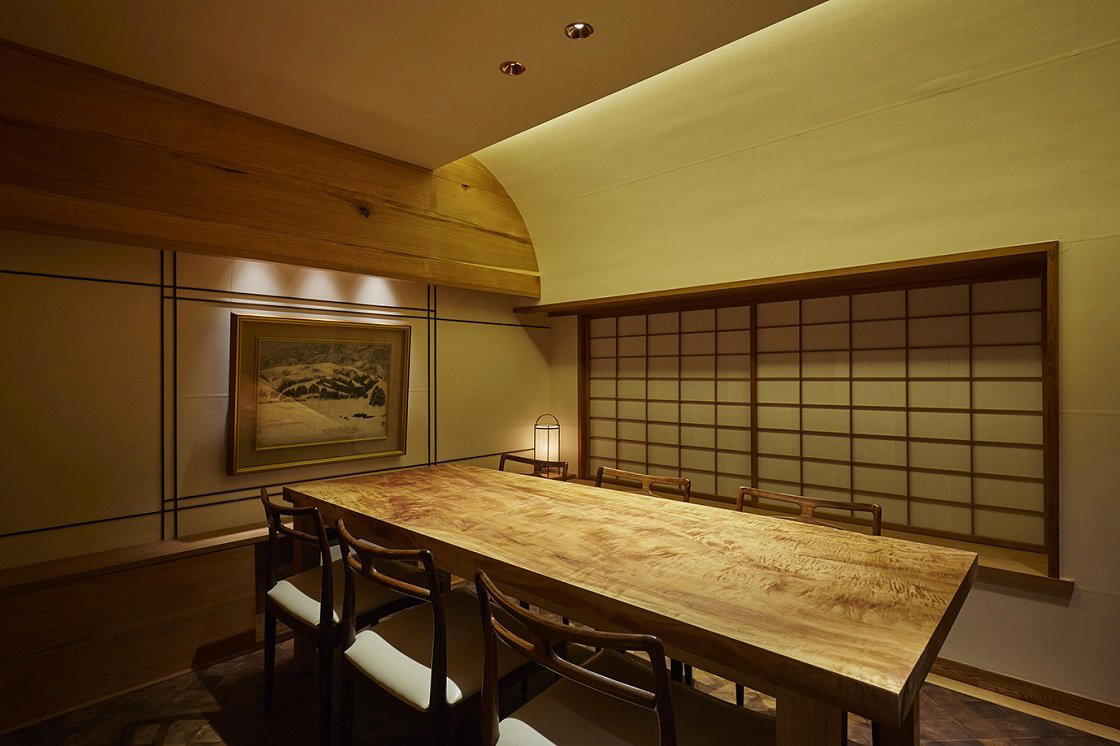
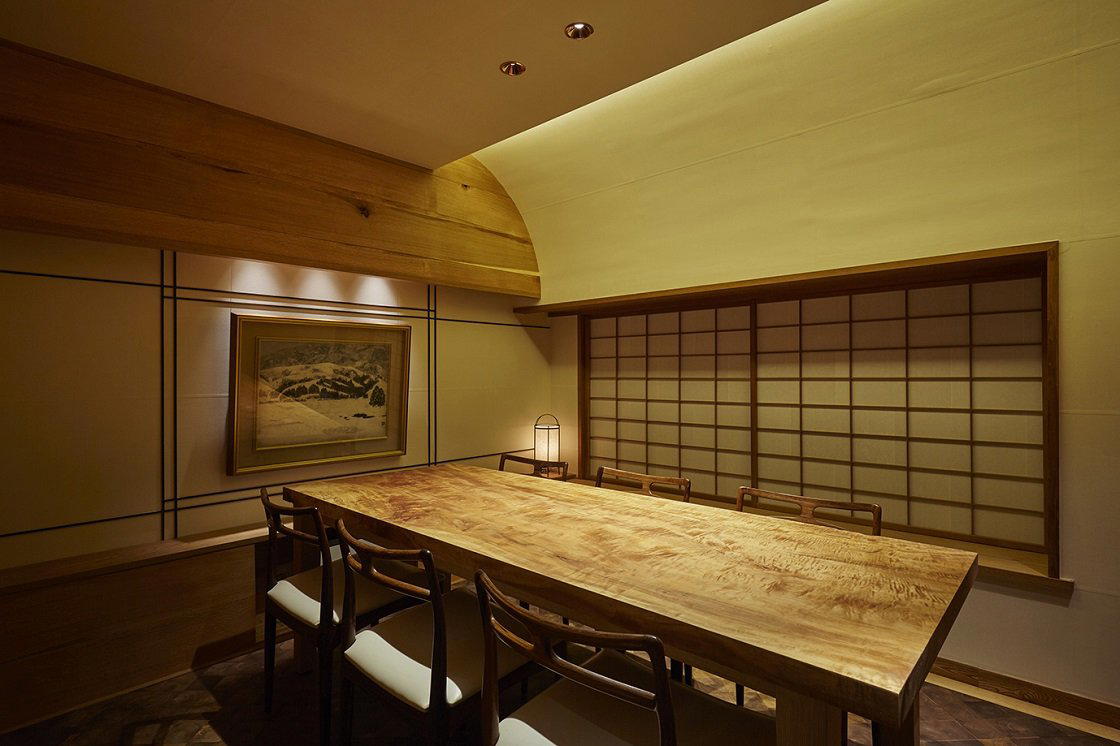
There is a particular category of serious Japanese restaurant that announces itself not through grandeur but through quiet. Sushi Harasho, located in Tennoji Ward at 3-30 Uenomiyacho, belongs to that category. The interior takes the form of a stately tea-house, its walls carrying Japanese-style painting depicting the spray from a waterfall, imagery chosen not for decoration but for atmosphere. Guests settle into a space that is deliberately, architecturally calm before a single piece of sushi has been formed. In an era when many premium dining rooms compete on visual spectacle, that choice of stillness is itself a statement about what the meal prioritises.
Tennoji occupies a different register in Osaka's dining map from the dense bar-and-restaurant corridors of Namba or the corporate-facing luxury blocks near Umeda. It is a residential and temple district, home to Shitenno-ji and the Tennoji Zoo, and its dining culture has historically served a local clientele rather than tourists in transit. A two-Michelin-starred counter operating here, rather than in a hotel or a prestige retail tower, tells you something about the kitchen's orientation: it is not positioning against the city's international foot traffic.
The Logic of the Rice Bowl
The governing principle at a counter like Sushi Harasho is the deliberate removal of interference. Two chefs work the rice with no added sugar, a choice that removes the easiest shortcut to palatability and requires the grain itself, and the vinegar ratio, to carry the work. The natural sweetness of both the rice and the fish then becomes legible to the palate in a way it cannot be when sugar is pulling attention.
Tuna receives only a brief soy marinade rather than the extended soaking that produces a richer, more aggressively seasoned bite. Conger eel is dressed in sauce that registers as only slightly sweet. These are precise calibrations, and they describe a dining ritual built around attention rather than stimulation. The protocol here is to receive each piece at the rhythm the chefs set, to taste without the distraction of elaborate condiment arrangements, and to let the temperature and texture of each piece read clearly.
This approach places Sushi Harasho in a specific lineage within Japanese sushi culture. The Edo-mae tradition, which formed the technical foundation for most of Japan's top-tier omakase, was itself a cuisine of constraint and timing. The contemporary refinement of that tradition, as practiced at counters across Osaka, Kyoto, and Tokyo, has increasingly diverged into two camps: those who amplify the format with aged fish, unusual vinegars, and high theatre, and those who return to a more stripped reading. Sushi Harasho clearly positions in the latter. Peer counters in Osaka such as Matsuzushi, Sushi Hoshiyama, and Sushi Murakami Jiro each bring distinct approaches to the same tradition, the city's sushi scene is broad enough to sustain genuine stylistic variety at the top tier.
Awards and What They Signal
Sushi Harasho holds two Michelin stars in both the 2024 and 2025 guides, and appeared on the 2026 La Liste ranking with 86 points. Opinionated About Dining, a guide compiled from critic and food professional votes rather than anonymous inspectors, listed it as a recommended restaurant among leading establishments in Japan in 2023. That combination of sources is meaningful: Michelin and La Liste each operate on distinct inspection methodologies, and OAD draws on a different evaluative community entirely. Alignment across all three signals a consistency of execution rather than a single well-timed performance.
At the ¥¥¥ price tier, Sushi Harasho sits below the ¥¥¥¥ bracket occupied by Osaka's ambitious French and innovative kitchens such as Hajime, La Cime, and Fujiya 1935, and at the same level as kaiseki addresses including Kashiwaya Osaka Senriyama and Taian. Within sushi specifically, the two-star designation carries significant weight in a city with a sophisticated local dining culture and inspectors well-versed in the category. For regional comparison, Harutaka in Tokyo and Gion Sasaki in Kyoto represent the kind of counters Sushi Harasho competes with in terms of recognition, even if the cities differ in culinary character.
The Pace and Protocol of the Meal
The dining ritual at a counter of this standing follows a logic shaped by decades of sushi culture. The meal is not browsed from a menu; it unfolds in sequence at the chefs' discretion. The tea-house atmosphere is not incidental to this, it actively disciplines the pace of the room. A waterfall does not rush. The atmospheric choice signals to guests that this is not a venue built for rapid throughput.
For those unfamiliar with the format, several conventions apply broadly across serious Osaka sushi counters. Arriving on time, or a few minutes early, is standard, as the experience often begins simultaneously for the full counter. Conversation between guests and chefs is welcomed, but the moment of forming and presenting each piece tends to carry its own quiet. The wasabi is applied by the chef, calibrated to each piece, which removes the need for additional condiment use at the table. Soy sauce, where provided, is for dipping; the chef's seasoning decisions are otherwise the guide.
Chef Ko Ishikawa leads the kitchen. Within the context of Osaka's two-starred sushi addresses, the presence of two chefs working the counter together, as described in the La Liste award notes, is a structural feature worth noting, it affects the rhythm of service and the consistency of execution across a seated service.
Osaka's Sushi Tier in Context
Osaka occupies an unusual position in the geography of Japanese fine dining. Tokyo dominates in sheer density of Michelin stars; Kyoto leads in kaiseki. Osaka's identity is historically associated with kuidaore, eating until you fall down, a culture built on volume, price-to-quality efficiency, and the egalitarian pleasures of tako-yaki, okonomiyaki, and standing sushi bars. The existence of multiple two- and three-starred sushi counters in this context says something about how the city's dining culture has stratified over the past two decades. The casual end and the formal end have both deepened without displacing each other.
Among Osaka's serious sushi addresses, Sushi Sanshin and Sushi Yuden offer further points of comparison for those building a considered itinerary. Beyond Osaka, the Kansai region's broader dining scene, covered in our guides for Kyoto and Nara, illustrates how differently each city within a short train ride can interpret Japanese culinary tradition.
For those considering Japan's wider sushi geography, Fukuoka, Yokohama, and even Okinawa have each developed distinct counter cultures worth understanding on their own terms. International equivalents, Sushi Shikon in Hong Kong and Shoukouwa in Singapore, operate within the same broad tradition but serve different guest populations and market expectations.
Planning Your Visit
Sushi Harasho is open Monday, Tuesday, Thursday, Friday, and Saturday from noon to 8:30 pm. It is closed on Wednesdays and Sundays. The address is 3-30 Uenomiyacho, Tennoji Ward, Osaka, 543-0037. Tennoji is well-served by the JR Loop Line, the Osaka Metro Midosuji Line, and the Tanimachi Line, all of which stop at Tennoji Station.
| Venue | Price Tier | Stars | Format | Closed |
|---|---|---|---|---|
| Sushi Harasho | ¥¥¥ | Michelin 2 | Omakase counter | Wed, Sun |
| Matsuzushi | n/a | n/a | Sushi counter | n/a |
| Sushi Hoshiyama | n/a | n/a | Sushi counter | n/a |
| Sushi Murakami Jiro | n/a | n/a | Sushi counter | n/a |
| Sushi Sanshin | n/a | n/a | Sushi counter | n/a |
For a broader view of where Sushi Harasho sits in Osaka's dining scene, see our full Osaka restaurants guide. If you are building a wider Osaka itinerary, bars guide, and experiences guide cover the city's full premium offering. Wine travellers may also find a useful companion.
Frequently asked questions
What should I order at Sushi Harasho?
At an omakase counter, ordering is not the guest's decision, the chefs set the sequence. At Sushi Harasho, the meal is shaped by the kitchen's restraint philosophy: rice without added sugar, briefly marinated tuna, and conger eel with a lightly sweet sauce. The two Michelin stars and the La Liste 86-point score have been awarded for this stripped approach, which means the experience is the progression the chefs determine, not an a-la-carte selection. The leading preparation is to arrive without specific dish expectations and allow the rhythm of the counter to set the pace. For context on how this approach compares to other serious Osaka and Japanese sushi counters, see our profiles of Matsuzushi, Sushi Hoshiyama, and Harutaka in Tokyo.
Price Lens
A compact comparison to help you place this venue among nearby peers.
| Venue | Cuisine | Price | Awards | Notes |
|---|---|---|---|---|
| Sushi HarashoThis venue (the venue you are viewing) | Traditional Edomae Omakase | $100–150 | 2 Michelin Stars · La Liste Top Restaurants | Not listed |
| HAJIME | Avant-Garde Japanese Fine Dining | $300–500 | 3 Michelin Stars · World's 50 Best #83 | French, Innovative |
| La Cime | Modern French with Japanese Ingredients | $150–200 | 2 Michelin Stars · World's 50 Best #13 | French |
| Kashiwaya Osaka Senriyama | Seasonal Kaiseki Omakase | $200–300 | 3 Michelin Stars · La Liste Top Restaurants | Japanese |
| Taian | Traditional Japanese Kaiseki Omakase | $150–200 | 3 Michelin Stars · La Liste Top Restaurants | Kaiseki, Japanese |
| Fujiya 1935 | Modern Japanese with European influences | $100–150 | 2 Michelin Stars · La Liste Top Restaurants | Innovative |
Recognition history
Dated appearances from independent guides and award organizations, with the underlying list record or original source where available.
Michelin 2 Stars
Michelin
La Liste Top Restaurants
La Liste
Opinionated About Dining Top Restaurants in Japan Recommended
Opinionated About Dining
Tabelog 100 #27 · No. 27
Tabelog · Tabelog 100 - Sushi - WEST - 2025
Full recognition history (7 entries)
Michelin 2 Stars
Michelin
Michelin 2 Stars
Michelin
Opinionated About Dining Top Restaurants in Japan Recommended
Opinionated About Dining
Continue exploring
More in Osaka
Restaurants in Osaka
All restaurants in Osaka →



Bars in Osaka
All bars in Osaka →

Hotels in Osaka
All hotels in Osaka →




Wineries in Osaka
Browse all →
Details
- Quiet
- Elegant
- Intimate
- Sophisticated
- Special Occasion
- Date Night
- Chefs Counter
- Sake Program
- Sustainable Seafood
- Omakase
- Counter Dining
- Sake Program
- Allergy Accommodating
Current opening hours
- Monday
- 12–8:30 PM
- Tuesday
- 12–8:30 PM
- Wednesday
- Closed
- Thursday
- 12–8:30 PM
- Friday
- 12–8:30 PM
- Saturday
- 12–8:30 PM
- Sunday
- Closed
Hours can change for holidays and private events. Hours as of .
Serene tea-house interior with hinoki wood counter, Japanese-style waterfall painting, and tranquil residential setting.