Michelin Bib Gourmand
Our verdict
A Michelin Bib Gourmand-recognised trattoria in Koto City, TRATTORIA BUCA'MASSIMO delivers a focused Tuscan menu at mid-range prices. Chicken-liver crostini, Florentine-style tripe, and charcoal-grilled meats mark out a kitchen with a clear regional point of view. It holds its own in Tokyo's increasingly serious Italian dining scene.

Pearl is the En Primeur Club membership app, where members save venues, book tables and use the concierge.
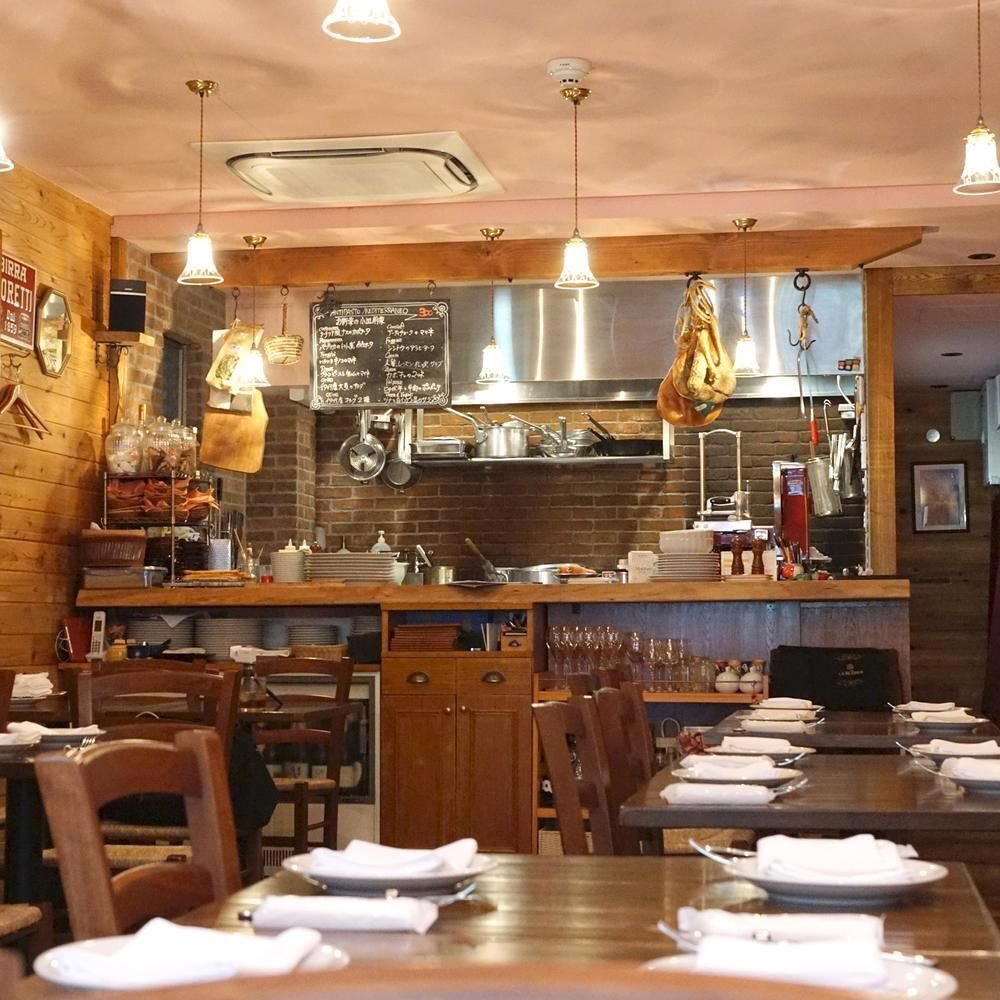
The menu
What to order
- Special assorted appetizers
- Pasta
- Risotto
Tuscany in Koto City: Reading the Menu at TRATTORIA BUCA'MASSIMO
Pici, the thick, hand-rolled Sienese pasta that sits somewhere between spaghetti and a thicker tonnarelli, is not a dish you find on many Italian menus in Tokyo. Its presence at TRATTORIA BUCA'MASSIMO, served in a tomato ragù, signals something specific: this kitchen is not building an Italian-inflected omakase, and it is not chasing the fusion energy of Tokyo's more experimental Italian rooms. It is working through a Tuscan syllabus, dish by dish, and the menu architecture makes that commitment visible before you order a single thing.
Tokyo has developed one of the most layered Italian dining scenes outside Italy itself. At the leading end, places like Aroma Fresca and PRISMA operate at the ¥¥¥¥ tier, where the Italian framework is stretched around premium Japanese product and multi-course tasting formats. Gucci Osteria da Massimo Bottura Tokyo brings a global brand identity into the mix. TRATTORIA BUCA'MASSIMO sits in a different register entirely: ¥¥ pricing, a backstreet address in Koto City's Tomioka neighbourhood, and a menu that reads less like a tasting event and more like a regional Italian cookbook opened to a single chapter.
How the Menu Is Built, and What It Argues
The Tuscan trattoria format has a logic to it: antipasti lead with offal and preserved things, primi run through pasta shapes tied to specific towns and traditions, and secondi lean on fire and meat. TRATTORIA BUCA'MASSIMO follows that structure with enough specificity to suggest it is a conscious editorial decision rather than a default.
The chicken-liver crostini at the opening stage is the kind of dish that tells you where a kitchen's priorities sit. Crostini di fegatini, chicken liver paste on grilled bread, is a Florentine table staple, the kind of thing served as a matter of course at lunch in the Oltrarno. The fact that it leads the menu here, rather than a safer bruschetta or carpaccio, positions the restaurant firmly in the tradition it is claiming. It is the equivalent of a Japanese kitchen opening with dashi rather than edamame: a signal of intent.
Beef tripe in the Florentine style (trippa alla fiorentina, braised with tomato and aromatics) occupies the kind of menu position that separates trattorie from ristoranti. It is a dish that demands patience in execution and comfort from the diner. Putting it on the menu in Tokyo, where the customer base spans international visitors and adventurous locals, reflects a degree of confidence in the kitchen's direction. Principio and AlCeppo each take their own routes through Italian tradition in Tokyo; at TRATTORIA BUCA'MASSIMO, the regional specificity is narrower and more Tuscan in its orientation.
The pici in tomato ragù is the pivot point of the menu. Pici is a Sienese shape: thick, irregular, hand-rolled without egg, with enough surface texture to hold a simple sauce. Serving it alongside the crostini and the tripe creates a menu that moves coherently from one course to the next within the same regional tradition rather than assembling a greatest-hits Italian selection. That internal coherence is what separates a menu with a point of view from one that simply covers the bases.
The charcoal-grilled meats at the close of the menu complete the arc. Tuscan cooking has a long relationship with wood and charcoal fire, from the bistecca alla fiorentina on upwards. Here, the recommendation to pair the grilled meat with a bottle of red wine is less a sales prompt and more a structural instruction: this is the dish around which a longer, more relaxed dinner is built. At the ¥¥ price point, a bottle of Italian red alongside the meat becomes a reasonable proposition rather than a luxury extension.
Koto City and the Address Question
Tomioka address in Koto City places this restaurant in a part of Tokyo that does not appear in most dining itineraries. The neighbourhood sits east of central Tokyo, outside the circuits that connect Ginza, Roppongi, and Shinjuku. For Italian dining specifically, that address is notable: most of the city's recognised Italian rooms cluster in central or western neighbourhoods. A Michelin Bib Gourmand at this address, awarded in 2024, functions as a navigation tool as much as a quality signal. It tells a visitor that the drive or transit ride is worthwhile, and it tells locals in surrounding areas that there is a serious kitchen in reach.
Bib Gourmand distinction in the 2024 Michelin Guide Tokyo is meaningful in category terms. It marks restaurants that deliver quality cooking at moderate prices, and in a city where the Michelin coverage is among the most thorough in the world, inclusion at any level carries weight. At a ¥¥ price point, it also makes this one of the more accessible entries in Tokyo's Italian tier.
For context on the wider Japan Italian dining scene, cenci in Kyoto represents a different Italian-Japanese dialogue, while 8½ Otto e Mezzo Bombana in Hong Kong shows what Italian cooking looks like at the three-star level in the Asian context. TRATTORIA BUCA'MASSIMO makes no argument with either of those registers; it occupies a different position, and its value is in how precisely it holds that position.
If your Japan trip extends beyond Tokyo, HAJIME in Osaka, Gion Sasaki in Kyoto, akordu in Nara, Goh in Fukuoka, 1000 in Yokohama, and 6 in Okinawa offer a range of serious dining across the country. Our full Tokyo restaurants guide, Tokyo hotels guide, Tokyo bars guide, Tokyo wineries guide, and Tokyo experiences guide cover the broader picture.
Know Before You Go
- Address: 1 Chome-24-11 Tomioka, Koto City, Tokyo 135-0047, Japan
- Price range: ¥¥ (moderate)
- Cuisine: Italian, Tuscan focus
- Recognition: Michelin Bib Gourmand 2024
- Chef: Henrique Sá Pessoa
- Booking, hours, and phone: Not listed, check directly with the restaurant before visiting
Frequently asked questions
Is there a head chef associated with TRATTORIA BUCA'MASSIMO?
The chef associated with TRATTORIA BUCA'MASSIMO is Henrique Sá Pessoa.
How would you describe the cuisine at TRATTORIA BUCA'MASSIMO?
What should I eat at TRATTORIA BUCA'MASSIMO?
Follow the Tuscan structure the kitchen is built around: open with the crostini of chicken-liver paste, move to Pici in tomato ragú, a hand-rolled Sienese pasta shape rarely represented this faithfully in Tokyo, then let the charcoal-grilled meat carry the main course. Beef tripe simmered in the Florentine style is the clearest signal of how seriously the kitchen takes regional specificity, and it pairs directly with the red wine list the restaurant positions at the centre of the meal.
How much does it cost to eat at TRATTORIA BUCA'MASSIMO?
Pricing at TRATTORIA BUCA'MASSIMO is listed as ¥¥.
What's TRATTORIA BUCA'MASSIMO's location?
TRATTORIA BUCA'MASSIMO is located at 1 Chome-24-11 Tomioka, Koto City, Tokyo 135-0047, Japan, Tokyo.
At-a-Glance Comparison
| Venue | Cuisine | Price | Awards | Notes |
|---|---|---|---|---|
| TRATTORIA BUCA'MASSIMOThis venue (the venue you are viewing) | Italian Trattoria | $50–100 | Michelin Bib Gourmand | Not listed |
| Harutaka | Edo-Style Omakase Sushi | $200–300 | 3 Michelin Stars · World's 50 Best #76 | Sushi |
| RyuGin | Modern Kaiseki | $500+ | 3 Michelin Stars · World's 50 Best #41 | Kaiseki, Japanese |
| L'Effervescence | Modern French with Japanese Influences | $200–300 | 3 Michelin Stars · World's 50 Best #69 | French |
| HOMMAGE | Modern French with Japanese Influences | $150–200 | 2 Michelin Stars · World's 50 Best #78 | Innovtive French, French |
| MAZ | Innovative Peruvian-Japanese Fusion | $150–200 | 2 Michelin Stars · World's 50 Best #28 | Innovative |
Recognition history
Dated appearances from independent guides and award organizations, with the underlying list record or original source where available.
Michelin Bib Gourmand
Michelin
Full recognition history (2 entries)
Michelin Bib Gourmand
Michelin