
Michelin Plate
Our verdict
In Osaka's Nishi Ward, Sushi Kyomachibori Sato operates from a basement counter near Utsubo Park, where a Michelin Plate-recognised menu moves through handmade tofu, shabu-shabu preparations, and nigiri finished with red vinegar and salt. The format reflects old-school Osaka craftsmanship: seasonal fish treated with technique rather than spectacle, at a price point that sits comfortably within the city's mid-to-upper sushi tier.

Pearl is the En Primeur Club membership app, where members save venues, book tables and use the concierge.
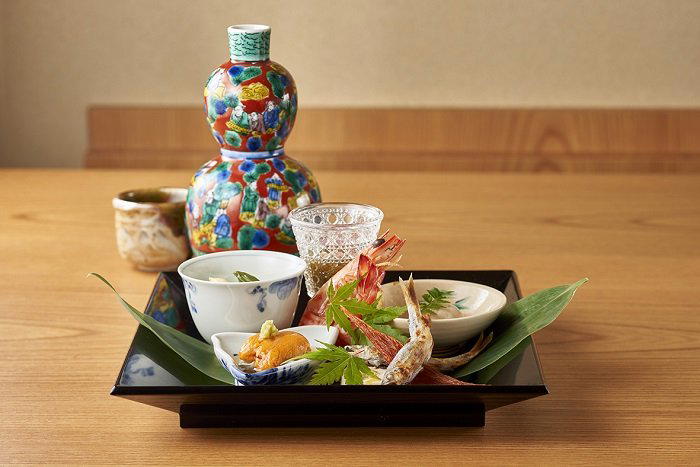
Below Street Level in Nishi Ward
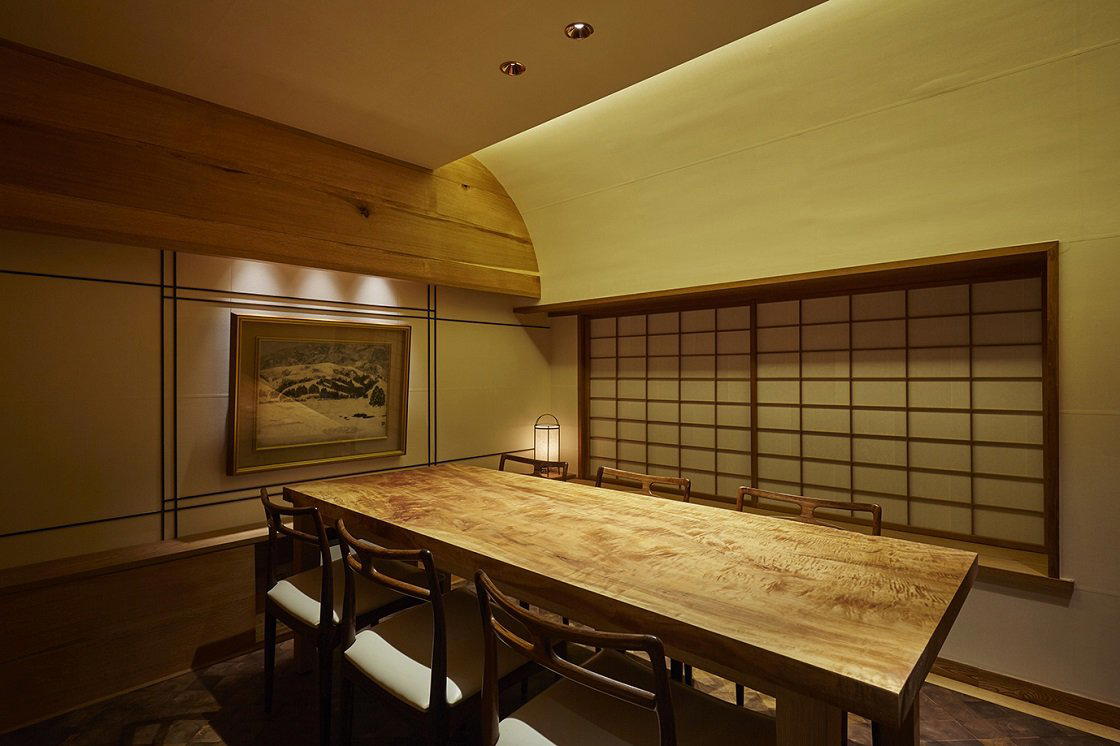
Descend below the Tatto Utsubo Park Building on Kyomachibori and the register drops, quieter, cooler, removed from the canal-side foot traffic of one of Osaka's more composed western neighbourhoods. Basement counters have a long tradition in Japan's sushi culture: they place the guest in a contained world where the focus narrows to the chef, the fish, and the sequence. Sushi Kyomachibori Sato occupies that format in a part of the city that sits outside the high-density dining corridors of Namba and Shinsaibashi, drawing a local crowd rather than a tourist circuit.
Nishi Ward's dining character is shaped by proximity to the financial district and Utsubo Park, which means salaried professionals and neighbourhood regulars rather than the weekend crowds that fill Dotonbori. For a sushi counter operating at the ¥¥¥ price tier, comparable to Kashiwaya Osaka Senriyama and Taian in the mid-to-upper Japanese dining bracket, that neighbourhood composition matters. The room earns its Michelin Plate recognition (awarded in both 2024 and 2025) among guests who return, not among those passing through once.
A Menu Built Around Sequence, Not Spectacle
Omakase counters in Japan's major cities have bifurcated sharply over the past decade. At the upper end, there is an arms race of aged tuna, imported vinegar rice, and near-theatrical presentation. At the other end, quick-turn sushi operations compete on volume and price. Sushi Kyomachibori Sato positions itself in neither camp. The meal opens with handmade tofu or pureed vegetable soup, a deliberately quiet beginning that signals patience rather than an immediate showcase of premium product.
What follows is a structured progression that incorporates hot dishes alongside the expected cold preparations. Tilefish with scored, grilled scales, the scoring technique causing the skin to open like a pinecone under heat, is the kind of detail that separates a technically schooled kitchen from one relying on sourcing alone. Pike conger and longtooth grouper served as shabu-shabu introduce warmth and a different textural register mid-meal, a move more associated with kaiseki sequencing than a direct nigiri omakase. This layering of formats within a single sitting reflects a broader Osaka tendency to treat dinner as a long conversation rather than a concentrated statement.
The nigiri itself arrives in smaller portions, finished with red vinegar rice and salt in place of the soy sauce default. Orient clams and simmered conger eel as toppings signal a preference for Edo-mae technique applied to Osaka's own seasonal pantry: ingredients that require time and skill to prepare rather than the premium-cut tuna that has become shorthand for prestige at higher-priced counters elsewhere in Japan. For comparison, the ¥¥¥¥ tier in Osaka, represented by venues such as Hajime and La Cime, operates with a different ambition, scaling up innovation and production complexity. Sato's register is quieter and more codified.
Drinks at a Craft-Focused Sushi Counter
The editorial angle of a wine list is worth addressing directly here, because it illuminates what kind of counter this is. In Japan's high-end sushi world, drink programs have become increasingly serious: some Ginza and Roppongi counters now maintain curated sake libraries organised by prefecture and rice variety, while a subset of younger establishments have built short but considered wine lists aimed at the growing cohort of guests who prefer Burgundy or Champagne with their omakase. The Michelin Plate designation, rather than a star, places Sushi Kyomachibori Sato outside the tier where elaborate beverage programs tend to operate, and outside the price bracket where sommeliers are positioned full-time at the counter.
At the ¥¥¥ level, the expectation is a functional sake selection alongside beer and possibly a short spirits list, with the focus kept clearly on the food sequence. This is not a limitation so much as a positioning signal: the drink program supports the meal rather than competing with it for attention. Guests seeking the kind of deep sake curation found at top-tier counters in Tokyo, such as Harutaka in Tokyo, will find a different emphasis here. The comparison is useful because it clarifies what Sato offers: a kitchen-first experience where the sequencing and technique carry the weight.
For guests building a broader Japan itinerary, this framing extends across the region. Gion Sasaki in Kyoto operates in an adjacent register, where drinks are present but never the story. Akordu in Nara takes a more European approach to pairing, which illustrates how differently individual restaurants in the Kansai region handle the question of what flows alongside food.
Osaka Sushi in Its Competitive Set
Within Osaka's sushi category, Sushi Kyomachibori Sato sits among a cluster of mid-to-upper counters where Michelin recognition shapes positioning without dictating price at the very highest tier. Sushi Harasho, Matsuzushi, and Sushi Hoshiyama represent the same tier in different parts of the city, each with a house style shaped by neighbourhood and clientele. Sushi Murakami Jiro and Sushi Sanshin extend the map further. Together they form a tier of craft-focused counters where the Michelin Plate designation functions as a quality floor rather than a ceiling: kitchens that have been assessed and found serious, without the premium pricing that comes with starred status.
The global sushi counter comparison is also instructive. Sushi Shikon in Hong Kong and Shoukouwa in Singapore both export the omakase format to markets where imported fish and premium pricing are built into the model. Sato's position in Nishi Ward, with Osaka's own seasonal product and a local clientele, represents the source format rather than the export version. That distinction is worth holding onto.
Planning a Visit
Sushi Kyomachibori Sato is located at 1 Chome-8-22 Kyomachibori, Nishi Ward, Osaka, basement level of the Tatto Utsubo Park Building. The ¥¥¥ price range places it in the same tier as other assessed Osaka restaurants reviewed by Michelin, meaning an omakase dinner will run at a level consistent with mid-to-upper Japanese dining in the city.
| Venue | Cuisine | Price | Michelin | Location |
|---|---|---|---|---|
| Sushi Kyomachibori Sato | Sushi | ¥¥¥ | Plate (2024, 2025) | Nishi Ward |
| Sushi Harasho | Sushi | ¥¥¥ | See listing | Osaka |
| Sushi Hoshiyama | Sushi | ¥¥¥ | See listing | Osaka |
| Sushi Sanshin | Sushi | ¥¥¥ | See listing | Osaka |
For broader Osaka planning, see our full Osaka restaurants guide, our full Osaka hotels guide, our full Osaka bars guide, our full Osaka wineries guide, and our full Osaka experiences guide. For sushi elsewhere in Japan, Goh in Fukuoka, 1000 in Yokohama, and 6 in Okinawa offer regional reference points at a similar or adjacent level.
What Do People Recommend at Sushi Kyomachibori Sato?
According to Michelin's own documented assessment, the preparations that draw the most attention are those reflecting classical technique applied to seasonal Osaka product. The tilefish with pine-cone-scored scales is the detail most cited as evidence of kitchen skill, a preparation that requires precise knife work before the fish reaches heat. The shabu-shabu service for pike conger and longtooth grouper is noted for adding warmth and structural variety to a format that might otherwise feel monotonous across a long nigiri sequence. The nigiri itself, smaller than the Edo-mae norm and seasoned with red vinegar rice and salt, reads as a deliberate house position: closer to old-school Osaka craftsmanship than to the premium-cut minimalism associated with high-end Tokyo counters. Orient clams and simmered conger eel as toppings reinforce that positioning.
Awards and Standing
A compact comparison to help you place this venue among nearby peers.
| Venue | Cuisine | Price | Awards | Notes |
|---|---|---|---|---|
| Sushi Kyomachibori SatoThis venue (the venue you are viewing) | Edomae Omakase Sushi | $100–150 | Michelin Plate | Not listed |
| HAJIME | Avant-Garde Japanese Fine Dining | $300–500 | 3 Michelin Stars · World's 50 Best #83 | French, Innovative |
| La Cime | Modern French with Japanese Ingredients | $150–200 | 2 Michelin Stars · World's 50 Best #13 | French |
| Kashiwaya Osaka Senriyama | Seasonal Kaiseki Omakase | $200–300 | 3 Michelin Stars · La Liste Top Restaurants | Japanese |
| Taian | Traditional Japanese Kaiseki Omakase | $150–200 | 3 Michelin Stars · La Liste Top Restaurants | Kaiseki, Japanese |
| Fujiya 1935 | Modern Japanese with European influences | $100–150 | 2 Michelin Stars · La Liste Top Restaurants | Innovative |
Recognition history
Dated appearances from independent guides and award organizations, with the underlying list record or original source where available.
Michelin Plate
Michelin
Full recognition history (3 entries)
Michelin Plate
Michelin
Michelin Plate
Michelin
Continue exploring
More in Osaka
Restaurants in Osaka
All restaurants in Osaka →


Bars in Osaka
All bars in Osaka →


Hotels in Osaka
All hotels in Osaka →



Wineries in Osaka
Browse all →
Details
- Intimate
- Cozy
- Elegant
- Sophisticated
- Date Night
- Business Dinner
- Solo
- Special Occasion
- Chefs Counter
- Sake Program
- Sustainable Seafood
- Omakase
- Counter Dining
Current opening hours
- Monday
- Closed
- Tuesday
- Closed
- Wednesday
- 5–10:30 PM
- Thursday
- 5–10:30 PM
- Friday
- 12–2 PM, 5–10:30 PM
- Saturday
- 12–2 PM, 5–10:30 PM
- Sunday
- 12–2 PM, 5–10:30 PM
Hours can change for holidays and private events. Hours as of .
Warm and inviting with soft lighting, creating a private, relaxing, and solemn atmosphere.