1 Michelin Star · Tabelog 100 #85
Our verdict
A Michelin-starred French restaurant on Osaka's Imabashi strip, PRESQU'ÎLE draws from classic Lyonnais and Parisian tradition rather than contemporary minimalism. Managed by a Yamanashi winery, the room arrives with baroque music, trolley service, and grape-leaf décor, a deliberate argument for the old ways. At ¥¥¥, it sits a tier below the city's multi-star French houses and makes a credible case for why that tier exists.

Pearl is the En Primeur Club membership app, where members save venues, book tables and use the concierge.
The menu
What to order
- Foie gras and duck tourte
- Seasonal fish and tomato confit
- Red snow crab with cauliflower puree
Where the Old France Argument Still Holds
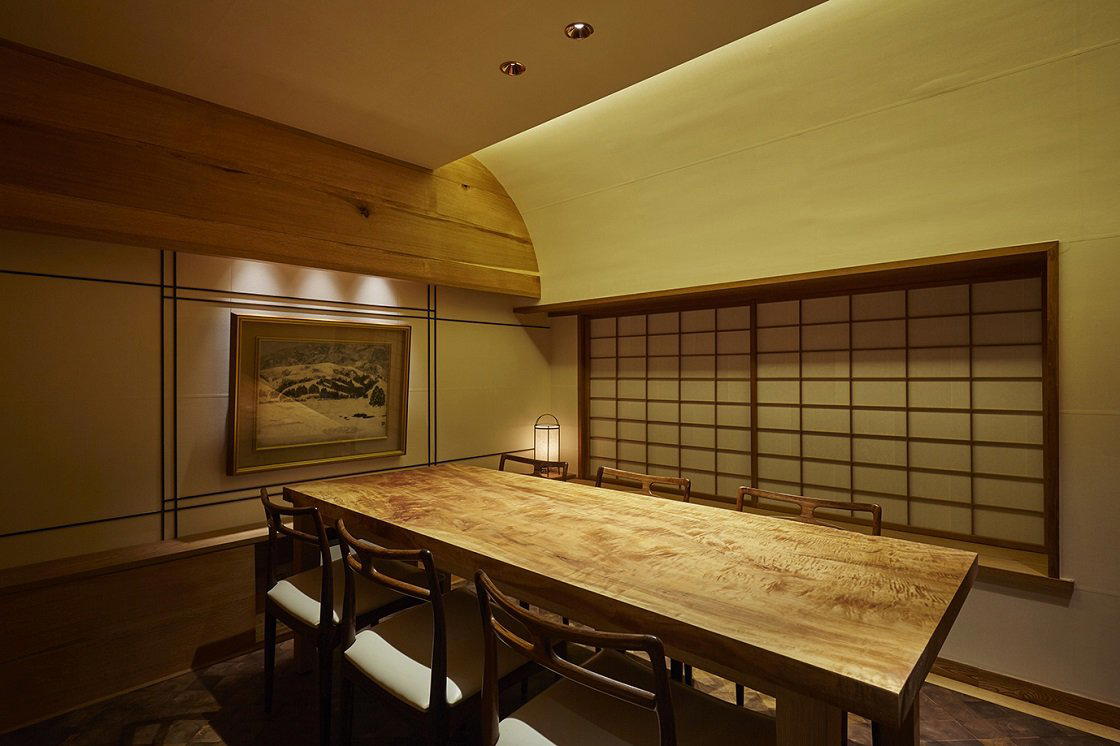
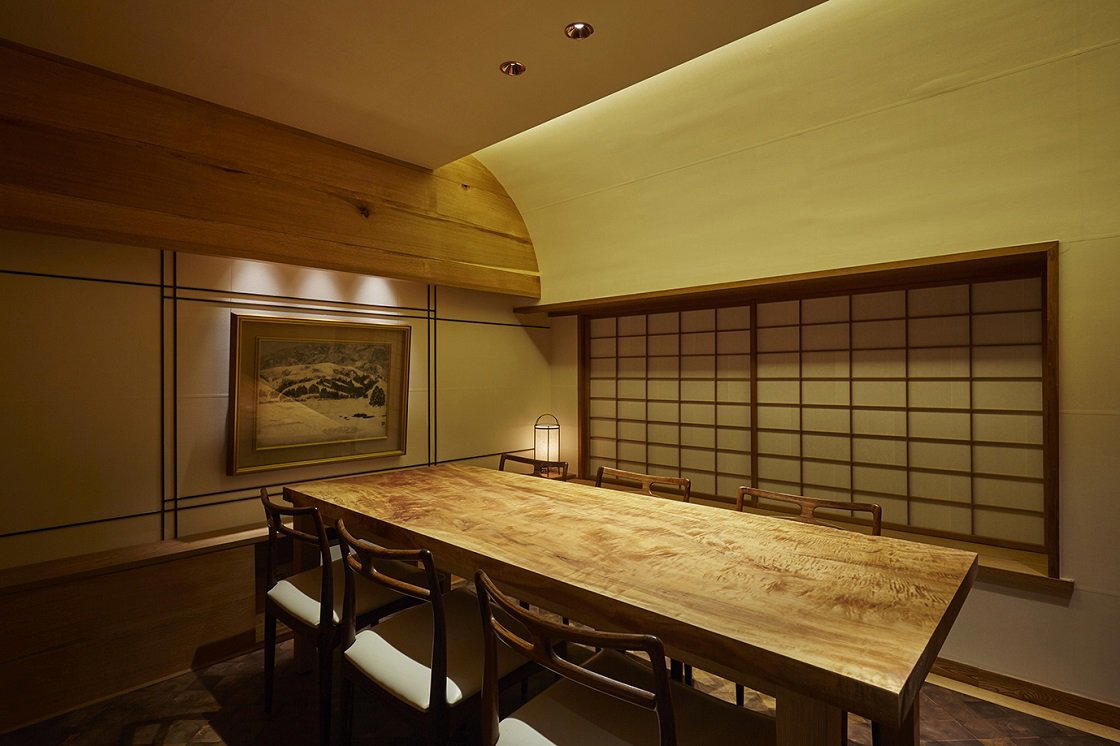
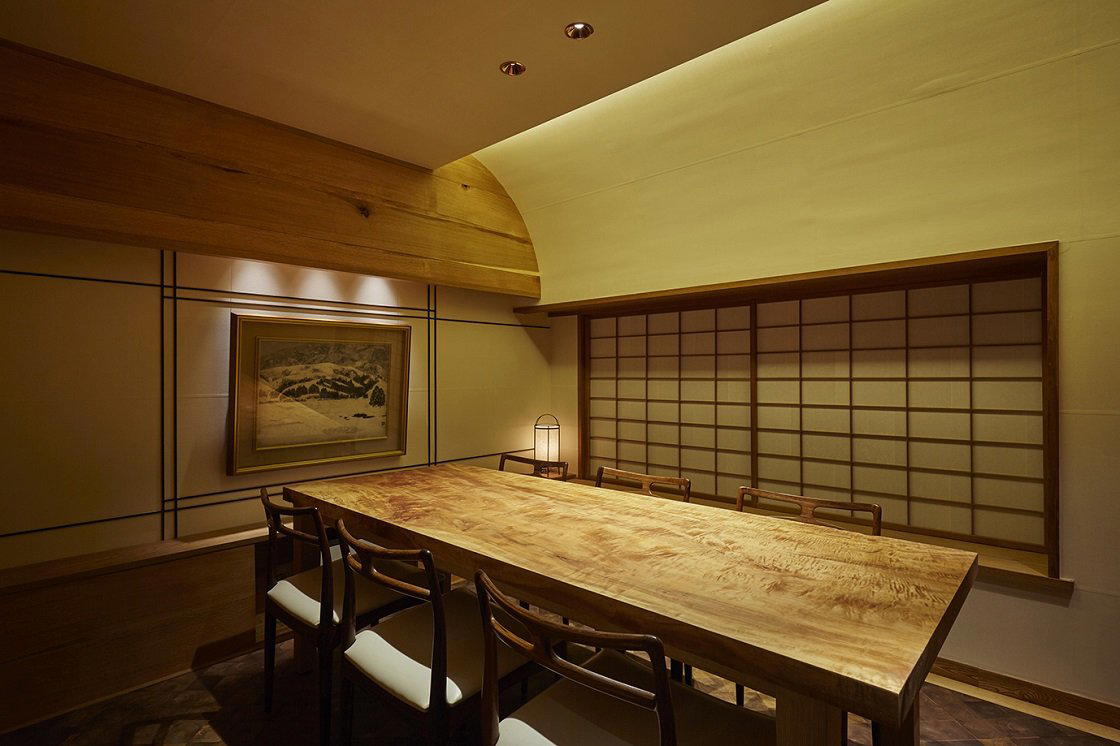
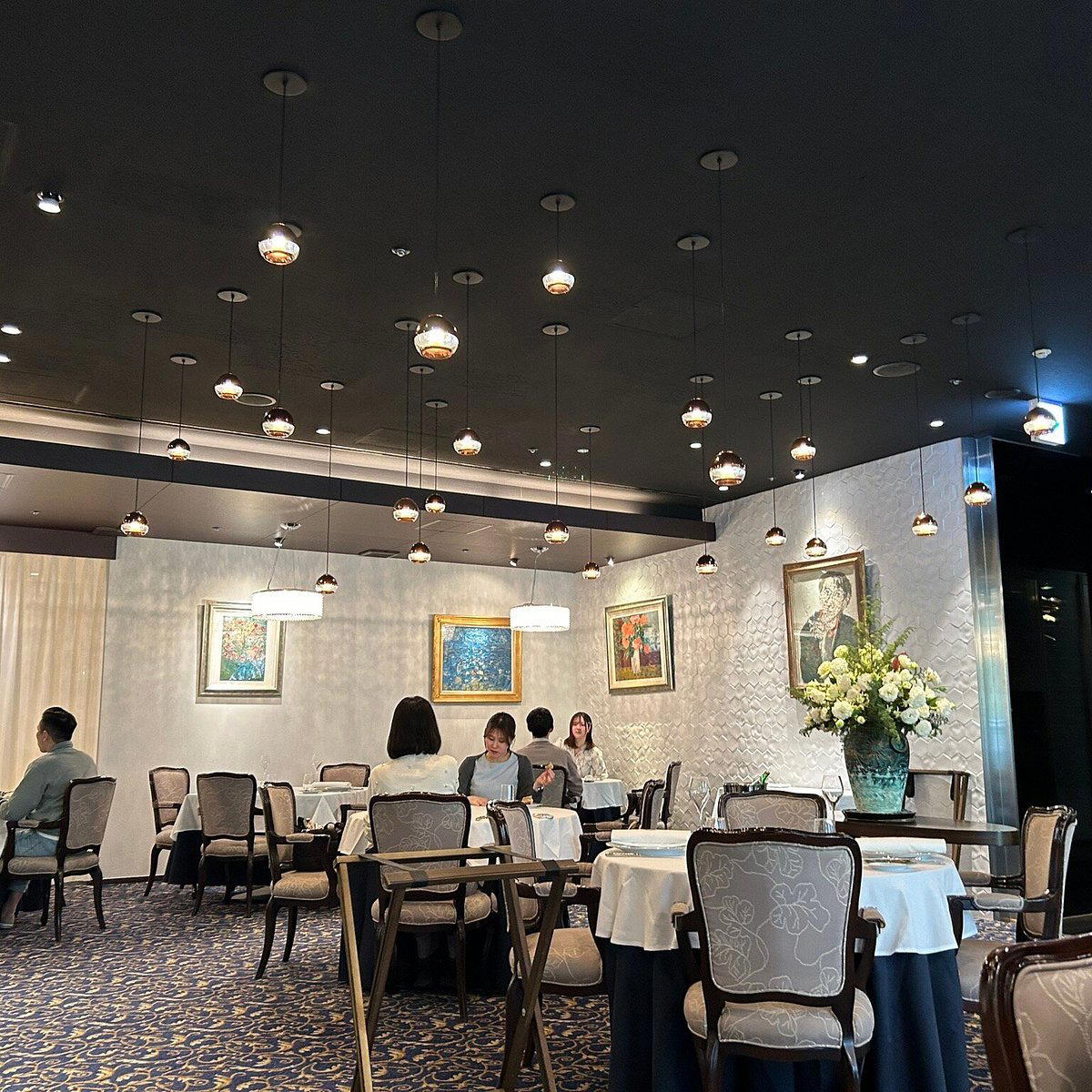
Baroque music through a dining room ceiling is not a detail you encounter often in Osaka's French restaurant circuit, which has spent the last decade tilting toward restraint, white walls, and plated precision. At PRESQU'ÎLE, on the second floor of Yodoyabashi odona in Chuo Ward's Imabashi district, the room makes the opposite case: that the formal French restaurant of the 1970s and 1980s, trolleys, sauces, ritual, generosity, was a cultural achievement worth preserving rather than a convention worth escaping.
This is not nostalgia as interior decoration. The format carries all the way through service, menu logic, and ownership structure. The restaurant is managed by a Yamanashi winery, which explains both the grape-leaf motifs covering the walls and the wine list built around the company's own bottles. The pairing of a country winery with a city restaurant is an older European model, the kind of vertical integration that French regional cooking depended on before distribution and hospitality separated into distinct industries. Seeing it reconstituted in central Osaka gives the room an internal coherence that purely independent establishments sometimes lack.
The Bistro Tradition and What Osaka Has Done with It
The word "bistro" carries a long definitional argument behind it. In Paris, the term has been applied to everything from zinc-countered workers' canteens to neo-bistros charging four-figure bills for natural wine. What it retained across those shifts was an orientation toward generosity over architecture, toward a full plate over a composed aesthetic, toward the cook's hand over the laboratory. PRESQU'ÎLE operates within that older pole of the definition.
Dishes baked in pie crusts and generous sauce work position the kitchen squarely in classical French technique. These are not fashionable choices in 2024, when Japanese interpretations of French cuisine have largely migrated toward lighter preparations and hyper-seasonal tasting menus. The restaurants occupying the ¥¥¥¥ tier in Osaka, La Cime and HAJIME among them, operate with a progressive or innovative identity that treats classical French cooking as a foundation to depart from rather than a destination. PRESQU'ÎLE treats it as the destination itself.
That distinction matters for the reader deciding between tiers. The ¥¥¥ price point here is not a signal of compromise; it reflects a different set of priorities. Butter, pastry, and sauce are inherently expensive cooking media, and a kitchen that builds around them is spending its margin on ingredients and technique rather than on plating labor or forager invoices. A crêpe Suzette finished tableside with the fruit from the decorative arrangement is as technically demanding as most contemporary dessert-course theater, it is simply not the kind of technique that photographs as innovation.
The Room as Position Statement
The Imabashi corridor, which runs through Chuo Ward's financial and retail belt, is a natural address for a restaurant with this sensibility. The district's built fabric is older Osaka commercial architecture rather than the contemporary development that characterizes parts of Namba or the newer Umeda extensions. Yodoyabashi odona occupies a corner of that environment, and the second-floor placement gives PRESQU'ÎLE the separation from street-level foot traffic that formal French dining has traditionally required.
The trolley service format reinforces the room's argument. Trolleys disappeared from most serious French restaurants during the 1990s and 2000s as service moved toward individual plating and away from tableside ceremony. Their reappearance here is not a period affectation but a deliberate service philosophy: the trolley externalizes the kitchen, makes the guest a participant in portion decisions, and slows the meal into a different rhythm. In a city where tasting menu timing is standardized down to the minute, that slower rhythm is itself a distinguishing feature.
Osaka's French restaurant scene is broader and more historically embedded than most international visitors expect. The city has hosted French tables since the postwar decades, and its cooks have maintained closer ties to classical French tradition than Tokyo's, which pivoted harder toward contemporary technique after the 1990s. Within that Osaka lineage, PRESQU'ÎLE sits in the strand that values continuity over reinvention, alongside, in different registers, La Bécasse and LE PONT DE CIEL.
Michelin Recognition and What It Signals Here
The 2024 Michelin one-star designation confirms the kitchen's technical consistency, but the specific language in the Michelin citation does more editorial work than the star itself. The inspectors noted the baroque music, the trolleys, the pie-crust preparations, and the tableside crêpe Suzette, which means the star was awarded with full awareness of, and apparently appreciation for, the classical format. Michelin does not typically reward nostalgia for its own sake; the citation implies that the cooking meets a technical standard that justifies the register, rather than simply adopting the aesthetics of a past era.
For comparison: the one-star tier in Osaka's French dining includes restaurants with substantially different approaches, from the contemporary Japanese-French register of Différence to more experimental formats like nent. Michelin's willingness to star both ends of that spectrum reflects the breadth of the city's French scene rather than any single dominant mode. PRESQU'ÎLE occupies the classical end with a credibility that the star formally validates.
French restaurants operating at this register elsewhere in Japan, Sézanne in Tokyo and the European point of reference Hotel de Ville Crissier in Crissier, approach classical French cooking from very different angles. Sézanne works in a contemporary luxury hotel format; Hotel de Ville Crissier is among the most decorated classicists in Switzerland. PRESQU'ÎLE's Yamanashi-winery ownership and modest price tier place it in a third category: the serious regional French table, confident in its tradition and not competing for the same diner as its multi-star neighbors.
Planning Your Visit
| Factor | PRESQU'ÎLE | La Cime | HAJIME |
|---|---|---|---|
| Price tier | ¥¥¥ | ¥¥¥¥ | ¥¥¥¥ |
| Michelin stars (2024) | 1 | 2 | 3 |
| Format | Classical French, trolley service | Contemporary French | Innovative French |
| Wine focus | Yamanashi winery own-label | Broad French list | Curated international |
| Location | Imabashi, Chuo Ward | Osaka central | Osaka central |
The Imabashi address is a short walk from Yodoyabashi Station on the Osaka Metro Midosuji and Yotsubashi lines, making it accessible from most central Osaka hotels without requiring a taxi. Visitors to the city who are building a broader itinerary will find the full Osaka restaurants guide, the Osaka hotels guide, and the Osaka bars guide useful for anchoring this reservation within a longer stay. Those extending to other Kansai cities should note Gion Sasaki in Kyoto and akordu in Nara for contrast; travelers covering broader Japan will find value in cross-referencing against Harutaka in Tokyo, Goh in Fukuoka, 1000 in Yokohama, and 6 in Okinawa. For those interested in the winery side of the equation, the Osaka wineries guide and Osaka experiences guide extend the regional picture.
Frequently asked questions
Does PRESQU'ÎLE have a Michelin star or similar recognition?
PRESQU'ÎLE has received recognition including: Piped baroque music and service on trolleys recall the goodness of French restaurants in the old days. As befits a restaurant managed by a Yamanashi winery, grape leaves adorn the walls and the company’s own wines are served. A devotee of c….
Is PRESQU'ÎLE more mid-range or high-end?
Pricing at PRESQU'ÎLE is listed as ¥¥¥.
What should I order at PRESQU'ÎLE?
The kitchen's signature lies in dishes baked in pie crusts and sauce-forward classical preparations, both noted explicitly in the 2024 Michelin citation. The table fruit can be finished tableside as crêpes Suzette, which speaks to the restaurant's commitment to old-school French technique over modernist showmanship.
Is PRESQU'ÎLE focused on a specific cuisine style?
What part of town is PRESQU'ÎLE in?
PRESQU'ÎLE is located at Japan, 〒541-0042 Osaka, Chuo Ward, Imabashi, 4 Chome−1−1 淀屋橋odona2F, Osaka.
How far ahead should I plan for PRESQU'ÎLE?
A 2024 Michelin one-star in Osaka's competitive dining circuit means demand runs ahead of walk-in availability, particularly for the business-lunch slot in the Imabashi financial district. Booking one to two weeks out is a reasonable baseline for weekday evenings; weekend tables at the ¥¥¥ price point tend to fill faster.
Quick Comparison
| Venue | Cuisine | Price | Awards | Notes |
|---|---|---|---|---|
| PRESQU'ÎLEThis venue (the venue you are viewing) | Classic French with Japanese Influences | $150–200 | 1 Michelin Star · Tabelog 100 #85 | Not listed |
| HAJIME | Avant-Garde Japanese Fine Dining | $300–500 | 3 Michelin Stars · World's 50 Best #83 | French, Innovative |
| La Cime | Modern French with Japanese Ingredients | $150–200 | 2 Michelin Stars · World's 50 Best #13 | French |
| Kashiwaya Osaka Senriyama | Seasonal Kaiseki Omakase | $200–300 | 3 Michelin Stars · La Liste Top Restaurants | Japanese |
| Taian | Traditional Japanese Kaiseki Omakase | $150–200 | 3 Michelin Stars · La Liste Top Restaurants | Kaiseki, Japanese |
| Fujiya 1935 | Modern Japanese with European influences | $100–150 | 2 Michelin Stars · La Liste Top Restaurants | Innovative |
Recognition history
Dated appearances from independent guides and award organizations, with the underlying list record or original source where available.
Michelin 1 Star
Michelin
Tabelog 100 #85
Tabelog
Full recognition history (3 entries)
Michelin 1 Star
Michelin