Michelin Plate · Tabelog 100 #33
Our verdict
A Michelin Plate-awarded Nepali restaurant in Tokyo's Setagaya ward, Old Nepal delivers a structured set menu built around Dal bhat and creative appetisers, framed by the culinary traditions of pre-modern Kathmandu. At ¥¥¥ pricing, it occupies a distinct niche in Tokyo's international dining scene, where South Asian cuisines rarely reach this level of formal recognition.

Pearl is the En Primeur Club membership app, where members save venues, book tables and use the concierge.
The menu
What to order
- Dal Bhat
- Shyau
- Alooko Achar
- Ghandhau Macha
- Thukpa
- Bangur Ko Sekuwa
- Chamalko Kulfi
Dal Bhat in Setagaya: How One Set Menu Reframes Nepali Cuisine for Tokyo
Tokyo's internationally recognised restaurant scene skews heavily toward its own traditions. The Michelin universe in this city is dominated by sushi counters like Harutaka, kaiseki rooms such as RyuGin, and French kitchens including L'Effervescence and Sézanne. South Asian cuisines, and Nepali cooking in particular, almost never enter that conversation. Old Nepal, in Gotokuji, Setagaya, holds a Michelin Plate for both 2024 and 2025, which makes it a statistically uncommon venue in the Tokyo dining record.
The address places it in residential Setagaya, away from the central wards where most internationally noted restaurants cluster. Gotokuji is a neighbourhood better known for its cat-temple than its dining, which says something about the kind of restaurant Old Nepal is: not positioned around foot traffic or tourist circuits, but operating on the logic that the food itself draws people out.
How the Menu Is Built, and What That Structure Reveals
The architecture of the set menu at Old Nepal is the most instructive thing about what the kitchen is trying to do. It moves in a deliberate sequence: a run of creative appetisers, followed by Dal bhat as the anchor of the meal. That progression is not arbitrary.
Dal bhat is Nepal's national dish in the most literal sense. It is eaten twice daily across the country, from rural farmhouses to Kathmandu apartment blocks, and it is always assembled at the table rather than plated in the kitchen. Rice arrives with a lentil soup (dal), then an array of curries, pickles, and sides that the diner mixes according to their own judgement of balance and proportion. The dish does not have a fixed form, which is part of its identity. Serving it as the centre of a structured restaurant tasting format requires the kitchen to make editorial decisions: what accompanies the dal, how many curries, which regional register to draw from.
The appetiser sequence that precedes it signals that the chef is not treating Dal bhat as a simple centrepiece, but as the destination of a structured build. The appetisers, which carry the most creative latitude in the menu, function as an introduction to the flavour logic of Nepali cooking before the format opens up into the more participatory, mix-at-the-table Dal bhat service. This is a considered menu structure, not a default one.
For comparison, Nepali restaurants operating at more informal registers, like Gorkhali Kitchen in Tampa or Oven in Lisbon, tend to present Dal bhat as a direct menu item rather than as the culmination of a tasting sequence. The distinction matters because it changes what the diner is being asked to do: at Old Nepal, you arrive at Dal bhat with context.
The Room: Kathmandu on the Walls
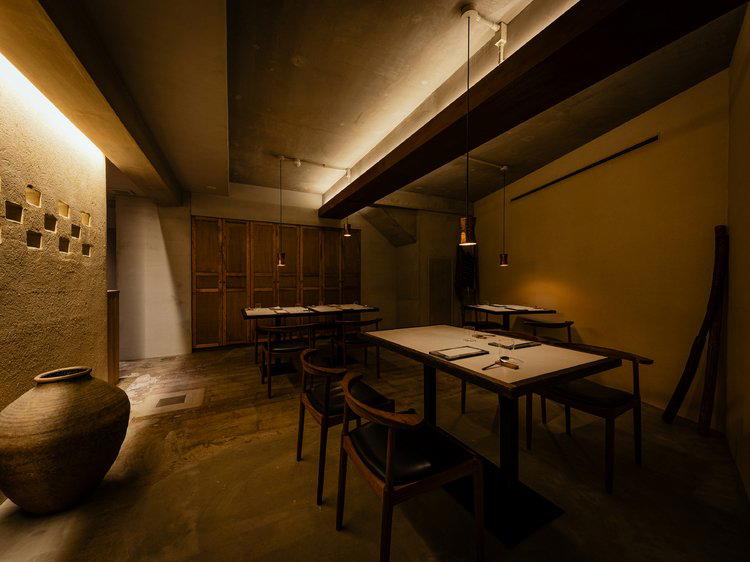
The interior design is consistent with the menu's framing. Street scenes of Kathmandu cover the walls, and the restaurant's name signals the register it is working in: Old Nepal, not contemporary Nepal, not modern Nepali cuisine. The reference point is the culinary culture of an earlier era, one associated with the bazaars and communal cooking traditions of pre-industrial Kathmandu rather than the influence of recent urban restaurant culture in Nepal's capital.
This is not nostalgia for its own sake. The appeal to an older culinary reference anchors the kitchen's choices in a specific tradition, which gives the creative appetiser section room to operate. When a kitchen claims fidelity to an established tradition, deviation reads as interpretation rather than confusion. The wall murals and naming are part of that framing.
Among Tokyo's international dining options, the kind of atmospheric specificity Old Nepal employs is not unusual. Restaurants at this price tier across the city use interior design as a signal of culinary seriousness. What is less common is using it to locate a South Asian cuisine within a specific historical moment rather than a general cultural identity.
Placement in Tokyo's ¥¥¥ Tier
At ¥¥¥ pricing, Old Nepal sits in the middle tier of Tokyo restaurant pricing, above the casual category but below the ¥¥¥¥ range occupied by restaurants like Crony and the Michelin-starred houses. For a Michelin Plate holder serving a set menu format, this is a reasonable position. The Plate recognition from Michelin indicates that inspectors found the cooking worth directing readers toward, without placing it in the star tier, which requires a different level of consistency and ambition on the international scoring framework.
It suggests a consistent base of satisfied diners rather than the polarising scores that sometimes accompany more experimental or niche formats.
For Tokyo visitors building a restaurant itinerary, Old Nepal offers something the city's celebrated high-end rooms do not: a Michelin-recognised entry point into Nepali culinary tradition at a price point that does not require the commitment of a ¥¥¥¥ omakase. It pairs differently against the city's dining landscape than a sushi or kaiseki booking, and that difference is the point. For broader Tokyo restaurant planning, see our full Tokyo restaurants guide, and for wider city planning, the Tokyo hotels guide, bars guide, wineries guide, and experiences guide cover the rest.
If you are travelling beyond Tokyo and want to extend your Japan dining itinerary, comparable formal-level restaurants in the region include HAJIME in Osaka, Gion Sasaki in Kyoto, akordu in Nara, Goh in Fukuoka, 1000 in Yokohama, and 6 in Okinawa.
Planning a Visit
Old Nepal is located at 1 Chome-42-11 Gotokuji, Setagaya City, Tokyo. The nearest station is Gotokuji on the Setagaya Line, a short tram ride from Sangenjaya. The residential location means this is a destination trip rather than a casual walk-in; arriving by a combination of subway to Sangenjaya and the Setagaya Line tram from there is the most direct route.
Frequently asked questions
Is OLD NEPAL good for families?
Old Nepal's set menu format, built around communal dal bhat, suits groups who want to eat at a shared pace. The Gotokuji address in residential Setagaya puts it in a quieter neighbourhood than central Tokyo, which tends to make the dining room more relaxed. Booking ahead is advisable given the restaurant's Michelin Plate recognition in both 2024 and 2025.
What is the atmosphere like at OLD NEPAL?
Street scenes of Kathmandu cover the walls, and the restaurant's name anchors the room in a specific cultural register: Nepal as it was, not as a generic subcontinental backdrop. The Setagaya location, away from Tokyo's central dining corridors, reinforces a neighbourhood intimacy that contrasts with the more performative end of the city's ¥¥¥ tier.
Has OLD NEPAL won any awards?
OLD NEPAL has received recognition including: The restaurant’s name is a shout-out to the culinary culture of Nepal in the good old days. Street scenes of the capital Kathmandu adorn the walls. Keen to convey the mood of old Nepal, the chef uses his own experiences to spin tales on the….
What's the signature dish at OLD NEPAL?
Dal bhat is the structural centrepiece of the set menu: lentil soup, rice, and curries served together and intended to be mixed at the table. The kitchen uses this format as a vehicle for personal storytelling, with the chef drawing on his own travels to shape the course. The set menu's creative appetisers, which precede the dal bhat, are flagged in the restaurant's own Michelin citation as a point of particular note.
Side-by-Side Snapshot
| Venue | Cuisine | Price | Awards | Notes |
|---|---|---|---|---|
| OLD NEPALThis venue (the venue you are viewing) | Authentic Innovative Nepali Fine Dining | $50–100 | Michelin Plate · Tabelog 100 #33 | Not listed |
| Harutaka | Edo-Style Omakase Sushi | $200–300 | 3 Michelin Stars · World's 50 Best #76 | Sushi |
| RyuGin | Modern Kaiseki | $500+ | 3 Michelin Stars · World's 50 Best #41 | Kaiseki, Japanese |
| L'Effervescence | Modern French with Japanese Influences | $200–300 | 3 Michelin Stars · World's 50 Best #69 | French |
| HOMMAGE | Modern French with Japanese Influences | $150–200 | 2 Michelin Stars · World's 50 Best #78 | Innovtive French, French |
| MAZ | Innovative Peruvian-Japanese Fusion | $150–200 | 2 Michelin Stars · World's 50 Best #28 | Innovative |
Recognition history
Dated appearances from independent guides and award organizations, with the underlying list record or original source where available.
Michelin Plate
Michelin
Tabelog 100 #33
Tabelog
Full recognition history (4 entries)
Michelin Plate
Michelin
Michelin Plate
Michelin