


Michelin Plate · Tabelog 100 #60
Our verdict
A Michelin Plate-recognised French restaurant in Nishiazabu, Le Bourguignon brings Burgundian training and technique to one of Tokyo's quieter residential pockets. Chef Masumi Kikuchi's menu leans into offal, wild game, and produce-driven French cooking, anchored by a wine list weighted toward Burgundy. Opinionated About Dining has ranked it among Japan's top restaurants in each of the past three consecutive years.

Pearl is the En Primeur Club membership app, where members save venues, book tables and use the concierge.
The menu
What to order
- Boudin noir
- Millefeuille-style horse crab
- Carrot mousse with sea urchin
Nishiazabu's French Quarter, at Street Level
Tokyo's French dining scene divides roughly into two tiers: the grand-room establishments with international pedigree and multi-Michelin recognition, and a quieter cohort of owner-chef bistros and mid-scale restaurants where the cooking is personal, the room is small, and the wine list tells you exactly where the chef's loyalties lie. Le Bourguignon sits squarely in the second category, and its address in Nishiazabu is not incidental to that positioning. This part of Minato, west of Roppongi, away from the main commercial drag, has long attracted a particular kind of restaurant: less performative than Ginza, less scene-driven than Aoyama, and shaped by the residents and regulars who live within walking distance rather than the expense-account circuit.
Nishiazabu's streets feel residential in a way that few Tokyo neighbourhoods this close to the centre manage. The French restaurants that have taken root here tend to reflect that: lower key, more wine-forward, and less dependent on the theatrical formats that dominate the city's higher-profile dining districts. Le Bourguignon fits that pattern with some precision. The name announces the orientation immediately, Burgundy, not Paris; wine culture as much as kitchen culture, and the cooking follows through on that promise.
The Burgundian Thread
Chef Masumi Kikuchi trained under a restaurateur and wine producer in Burgundy, and that formation shapes both sides of the restaurant in equal measure. The wine list is weighted heavily toward Burgundian producers, reflecting an attachment that goes beyond curation for its own sake. In Tokyo's French restaurant scene, this degree of regional specificity is relatively uncommon. Many French kitchens in the city pour broadly across France; a list anchored in Burgundy suggests a chef who spent enough time in the region to develop real relationships with its wines rather than simply selecting from an importer's catalogue.
That Burgundian sensibility also filters into the food, though not through literal replication of French regional dishes. Kikuchi's specialities include boudin noir with apple salad and purée, a pairing that speaks to the classical French charcuterie tradition, and a millefeuille-style construction of horse crab, eggplant and avocado. The latter combination reads more Tokyo than Dijon: the structural logic is French, but the ingredients reflect what is actually available and excellent in Japan. This is characteristic of how Tokyo's better French restaurants operate at this price point. They don't curate a museum-piece version of French cuisine; they adapt the grammar of French technique to what the market yields.
Wild game and offal appear regularly on the menu, and this is worth noting as a differentiator within the Tokyo French scene. Offal cooking requires confidence, supply chain relationships, and a kitchen that knows how to handle it, it is the kind of cooking that separates technically committed restaurants from those playing it safe. For diners accustomed to the more cautious centre of Tokyo's French offering, this is a clear signal about the kitchen's priorities. Compared to the grand-format French restaurants that populate the Michelin Tokyo guide, L'Effervescence, Sézanne, ESqUISSE, or Château Restaurant Joël Robuchon, Le Bourguignon operates at a different register: more intimate, more regionally specific, and priced accordingly at ¥¥¥ rather than the ¥¥¥¥ bracket that defines the city's most celebrated French rooms.
Le Bourguignon holds a Michelin Plate in both the 2024 and 2025 editions of the Tokyo guide, the designation that indicates a kitchen producing food that is good by Michelin's assessment without yet reaching the starred tier. In practical terms, the Plate is a meaningful quality signal at this price and scale: it confirms the restaurant is operating within Michelin's frame of reference and has been reviewed and validated across multiple cycles.
Opinionated About Dining, which tracks restaurants through a network of frequent, informed diners rather than anonymous inspectors, has listed Le Bourguignon among its leading restaurants in Japan for three consecutive years: recommended in 2023, ranked 460th nationally in 2024, and 499th in 2025. The slight movement down the ranking is worth reading carefully. OAD rankings fluctuate with the number and composition of scores submitted in a given year, and a restaurant at this position can move twenty or thirty places without any meaningful change in quality. What matters is consistent inclusion, and Le Bourguignon has that. Within our full Tokyo restaurants guide, it occupies a niche that several other neighbourhood-scale French restaurants share, solid recognition, regionally committed cooking, and a room that rewards repeat visits more than single occasions.
For a broader picture of French cooking in Japan, the comparison points extend beyond Tokyo. HAJIME in Osaka and Gion Sasaki in Kyoto represent different but related traditions of European-influenced fine dining filtered through Japanese produce and technique. Internationally, Hotel de Ville Crissier in Crissier and Les Amis in Singapore sit at the other end of the spectrum, large-room, high-investment French restaurants where the comparison with Le Bourguignon is instructive precisely because of the contrast. Le Bourguignon is not competing in that category; it is operating as an owner-chef restaurant where the singular point of view is the value, not the infrastructure around it.
Other French-influenced restaurants in Tokyo's mid-to-upper bracket worth considering alongside Le Bourguignon include Florilège, which takes a more contemporary approach to French technique. Each maps to a slightly different set of expectations, and understanding where Le Bourguignon sits in that range helps set the right frame before booking.
Planning a Visit
Le Bourguignon is open Tuesday through Sunday (closed Wednesday), running a lunch service from 11:30 am to 2:30 pm and an evening service from 5:30 to 9:30 pm. The address, 3 Chome-3-1 Nishiazabu, Minato City, places it within a short walk of Hiroo Station or a taxi ride from Roppongi. The neighbourhood is quieter at night than Roppongi proper, which suits the register of the restaurant. Diners coming specifically for the wine list should factor in that a Burgundy-heavy selection at a restaurant in this price tier (¥¥¥) will typically offer more depth in the mid-range bottles than in trophy labels; the value proposition is in the curation rather than the rarity. For broader planning across the city, our full Tokyo bars guide, Tokyo hotels guide, and Tokyo experiences guide cover the surrounding geography. For those extending travel beyond Tokyo, akordu in Nara, Goh in Fukuoka, 1000 in Yokohama, and 6 in Okinawa represent further reference points across Japan's French and contemporary dining scene.
Frequently asked questions
at Le Bourguignon?
The kitchen's documented strengths point toward the boudin noir with apple salad and purée, and the millefeuille-style horse crab with eggplant and avocado, both confirmed as Chef Kikuchi's specialities. Wild game and offal dishes are also areas where the kitchen has a clear technical commitment, so any menu composition that includes them is likely to represent the restaurant at its most purposeful. The wine list's Burgundy focus makes it worth asking the room's recommendation on pairings rather than defaulting to a by-the-glass option; this is a list built around specific producer relationships, and those tend to show leading through the guidance of the people who selected them.
Cuisine-First Comparison
| Venue | Cuisine | Price | Awards | Notes |
|---|---|---|---|---|
| LE BOURGUIGNONThis venue (the venue you are viewing) | Classic Burgundy French | $100–150 | Michelin Plate · Tabelog 100 #60 | Not listed |
| Harutaka | Edo-Style Omakase Sushi | $200–300 | 3 Michelin Stars · World's 50 Best #76 | Sushi |
| RyuGin | Modern Kaiseki | $500+ | 3 Michelin Stars · World's 50 Best #41 | Kaiseki, Japanese |
| L'Effervescence | Modern French with Japanese Influences | $200–300 | 3 Michelin Stars · World's 50 Best #69 | French |
| HOMMAGE | Modern French with Japanese Influences | $150–200 | 2 Michelin Stars · World's 50 Best #78 | Innovtive French, French |
| MAZ | Innovative Peruvian-Japanese Fusion | $150–200 | 2 Michelin Stars · World's 50 Best #28 | Innovative |
Recognition history
Dated appearances from independent guides and award organizations, with the underlying list record or original source where available.
Michelin Plate
Michelin
Opinionated About Dining Top Restaurants in Japan Recommended
Opinionated About Dining
Tabelog 100 #60 · No. 60
Tabelog · Tabelog 100 - French - TOKYO - 2025
Full recognition history (8 entries)
Michelin Plate
Michelin
Opinionated About Dining Top Restaurants in Japan Ranked #499
Opinionated About Dining
Michelin Plate
Michelin
Opinionated About Dining Top Restaurants in Japan Ranked #460
Opinionated About Dining
Opinionated About Dining Top Restaurants in Japan Recommended
Opinionated About Dining
Continue exploring
More in Tokyo
Restaurants in Tokyo
All restaurants in Tokyo →








Details
- Cozy
- Elegant
- Romantic
- Intimate
- Classic
- Date Night
- Special Occasion
- Business Dinner
- Private Dining
- Extensive Wine List
- Prix Fixe
- Burgundy Wines
Current opening hours
- Monday
- 11:30 AM–2:30 PM, 5:30–9:30 PM
- Tuesday
- 11:30 AM–2:30 PM, 5:30–9:30 PM
- Wednesday
- Closed
- Thursday
- 11:30 AM–2:30 PM, 5:30–9:30 PM
- Friday
- 11:30 AM–2:30 PM, 5:30–9:30 PM
- Saturday
- 11:30 AM–2:30 PM, 5:30–9:30 PM
- Sunday
- 11:30 AM–2:30 PM, 5:30–9:30 PM
Hours can change for holidays and private events. Last verified .
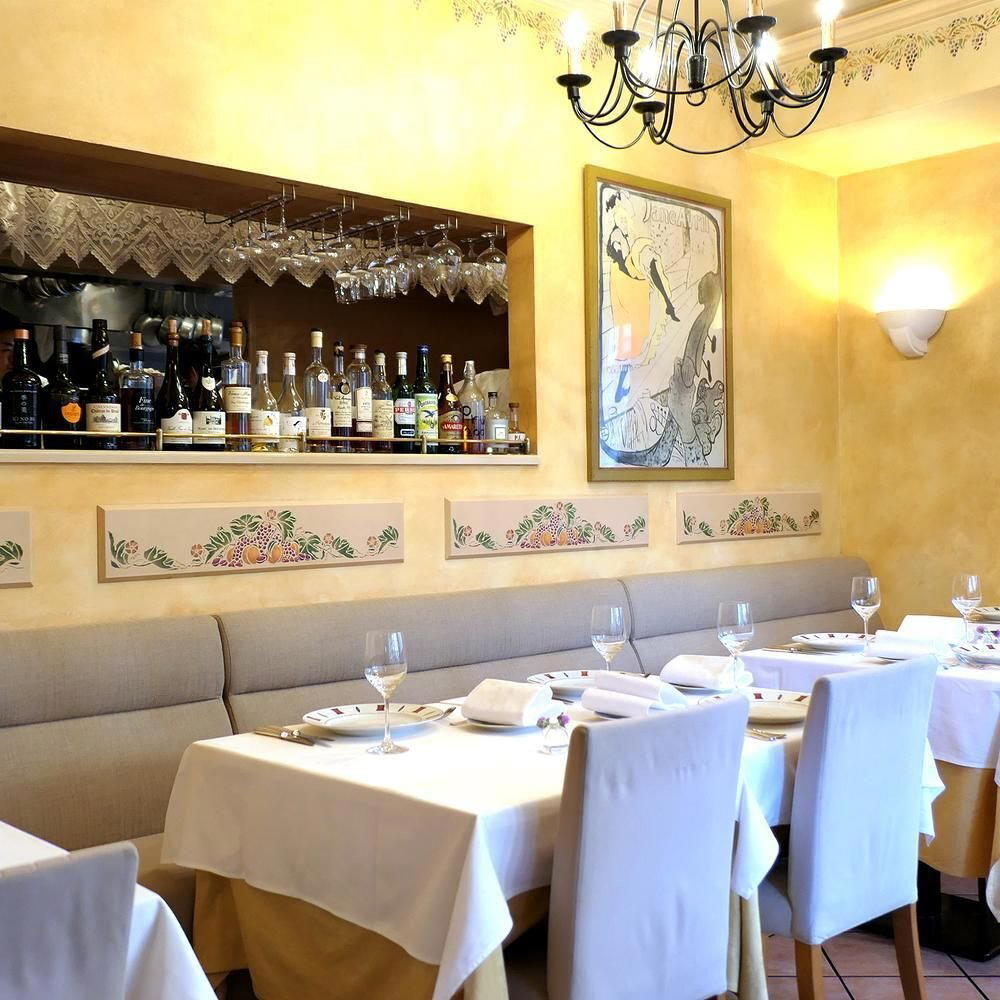
Cozy and warm interior evoking a French cottage in Burgundy, with light, airy decor, seasonal accents, and a relaxing atmosphere well-suited for intimate meals.