Our verdict
A Nepali-inflected café in Kyoto's Kamigyo Ward, Kyoto Mo:Mo Pasal sits at an address that signals neighbourhood over destination, a different frequency from the kaiseki corridors of Gion or Higashiyama. For visitors moving between Kyoto's ceremonial dining tier and its quieter residential character, this spot occupies the less-documented middle ground worth understanding before you go.

Pearl is the En Primeur Club membership app, where members save venues, book tables and use the concierge.
The menu
What to order
- Stay Home Set
- Chicken Tikka
- Cheese Naan
Kamigyo Ward and the Case for Neighbourhood Dining in Kyoto
Kyoto's dining conversation defaults quickly to kaiseki. The city's Michelin footprint is dense with multi-course Japanese haute cuisine: Gion Sasaki, Hyotei, Kikunoi Honten, and Mizai occupy the upper tier, pricing accordingly and booking months in advance. That circuit is well-documented. What receives less coverage is the residential dining character of wards like Kamigyo, where the north of the city opens up into a lower-key, locally-oriented rhythm that most international visitors skip entirely in favour of southern temple routes.
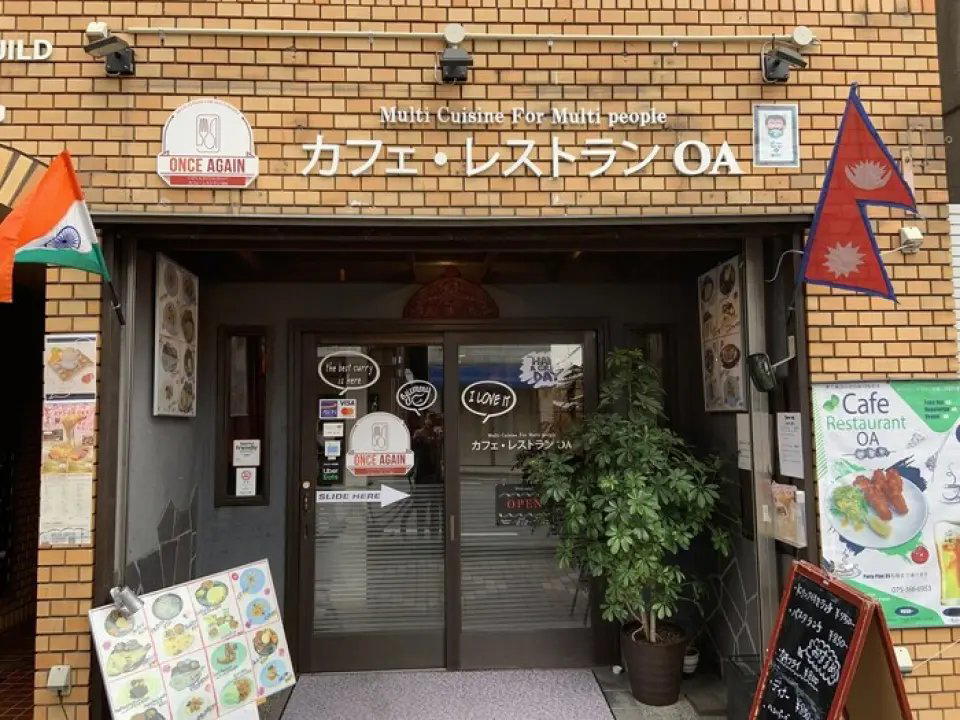
Kyoto Mo:Mo Pasal, trading as Café Restaurant OA, sits in Kamigyo Ward at 890 Koyamacho, an address in a neighbourhood whose dining identity is shaped by proximity to Doshisha University and the quiet streetscapes of the city's upper grid. The surrounding area does not position itself as a tourist corridor. That fact alone shapes what kind of experience to expect and, more practically, how to approach the logistics of a visit.
What the Booking Experience Actually Looks Like
For venues at this tier and neighbourhood position in Kyoto, the planning reality is different from the high-stakes omakase chase that characterises the city's most-discussed restaurants. The kaiseki counters at places like Isshisoden Nakamura operate on strict reservation windows and frequently require advance contact weeks or months out. Neighbourhood café-restaurants in Kamigyo generally do not function on that model.
That distinction matters for how you allocate planning energy. Visitors who have spent weeks securing seats at HAJIME in Osaka or Harutaka in Tokyo sometimes carry the same advance-booking anxiety into neighbourhood dining contexts where it is unnecessary. The challenge at a Kamigyo café is less about securing a reservation and more about knowing where to find it. The Sakizo Building address is on a residential stretch; navigation apps may resolve it accurately, but the building itself does not announce its tenants with the kind of signage common in tourist-facing districts.
No website or phone number is publicly indexed for Kyoto Mo:Mo Pasal at the time of writing, which places it in a category of Kyoto venues that operate primarily through word-of-mouth, Google Maps discovery, or foot traffic. For international visitors, the practical implication is direct: confirm the location via maps before travel, and plan your visit as a walk-in rather than a pre-booked reservation. Arriving during standard lunch or early dinner windows in Japan, roughly 11:30 to 14:00 and 17:30 to 20:30, is the most reliable approach when formal hours are not published.
The Mo:Mo Pasal Name and What It Signals
The name Mo:Mo Pasal warrants attention. In Nepali, 'mo:mo' refers to the dumpling tradition carried across the Himalayan region, Tibet, Nepal, Bhutan, and the Indian northeastern states all have versions, and 'pasal' translates roughly as 'shop' or 'place.' The dual branding alongside Café Restaurant OA suggests a venue that has layered identities, possibly a Nepali food focus operating within a broader café format. This kind of hybrid positioning is not unusual in Japanese cities with small but established South Asian resident communities, particularly in university neighbourhoods where the customer base supports culinary variety outside the Japanese mainstream.
Japan's Nepali restaurant count has grown steadily since the 2010s, concentrated in Tokyo but with outposts in Kyoto, Osaka, and university towns. The cuisine typically centres on momo dumplings, dal bhat, and curry preparations, often adapted in seasoning to Japanese palates. How closely Kyoto Mo:Mo Pasal tracks that template or diverges from it is not verifiable from available data. What the name does confirm is a non-Japanese culinary reference point in a city where the dominant dining discourse is almost entirely focused on Japanese tradition.
This places it in an interesting comparative position. Kyoto's internationally-inflected dining options tend to cluster toward Italian and French formats, venues like our full Kyoto restaurants guide covers the range, but South Asian cooking at the café level represents a quieter niche. For context on how Japanese cities handle non-native culinary traditions at a serious level, akordu in Nara and Goh in Fukuoka offer different but instructive examples of how individual operators interpret non-Japanese frameworks within a Japanese dining environment.
Seasonal Timing and the Kamigyo Context
Kamigyo Ward sits north of central Kyoto, adjacent to the imperial palace grounds and a short distance from Kinkakuji. The ward sees seasonal tourist spikes in April during cherry blossom season and in November during autumn foliage, when accommodation and dining in the southern wards becomes heavily pressured. During those windows, the neighbourhood around Koyamacho offers a lower-density alternative for daytime eating, with shorter transit from the northern temple circuit than from Gion or Higashiyama.
Outside peak season, the area operates at a pace closer to its residential character. Visiting between January and early March, or in the quieter stretches of June before summer heat intensifies, means fewer crowds on the surrounding streets and a more accurate read of how the neighbourhood actually functions day-to-day. For visitors already planning around Kyoto's kaiseki tier, the ¥¥¥¥ bracket that includes Mizai and peers, a Kamigyo lunch stop provides a different register for roughly the same part of the city without competing for the same booking windows.
The broader Japan context for this kind of venue is worth anchoring against regional comparisons. In smaller cities and regional centres, venues operating at the neighbourhood café level with international culinary identities have carved consistent local followings, as seen in places like Bistro Ange in Toyohashi or Birdland in Sakai, where the value is proximity and regularity rather than destination-level prestige.
Planning Your Visit
The venue is located at 890 Koyamacho, Kamigyo Ward, within the ground floor of the Sakizo Building. No phone or web reservation channel is confirmed publicly. Walk-in access during daytime hours is the most reliable approach. The address is accessible by Kyoto City Bus from the main Kyoto Station bus terminal, with the Koyamacho area served by several north-bound routes; the journey from central Kyoto typically runs 20 to 35 minutes depending on route and traffic. Subway access via the Karasuma Line to Kuramaguchi Station places the venue within a short walking distance to the south.
For visitors structuring a Kyoto itinerary around both the city's ceremonial dining tier and its residential character, this part of Kamigyo rewards a half-day that takes in the area on foot. Pair it with a morning at the imperial palace grounds or the nearby Nishiki market visit for a more complete read of the city's daily rhythm outside the main tourist corridors. If kaiseki is on the agenda for the same trip, the contrast between a Kamigyo café lunch and an evening counter at Gion Sasaki or Hyotei captures the full range of what Kyoto's dining scene actually contains.
Frequently asked questions
Is Kyoto Mo:Mo Pasal /Café Restaurant OA good for families?
The ground-floor café format at 890 Koyamacho, Kamigyo Ward suggests an accessible, informal setting rather than an intimate counter or multi-course dining room. A neighbourhood café in this position typically accommodates varied group sizes, making it a practical option for families who want to eat outside Kyoto's kaiseki circuit. No specific family policy is confirmed in available venue records, so contacting the venue directly before visiting with young children is advisable.
Is Kyoto Mo:Mo Pasal /Café Restaurant OA formal or casual?
The venue identifies as a café restaurant, operating from the ground floor of the Sakizo Building in Kamigyo Ward, a residential area north of central Kyoto rather than a high-profile dining corridor. That positioning, combined with the café designation, points firmly toward casual dress and a relaxed atmosphere.
Where exactly is Mo:Mo Pasal located in Kyoto, and how does its Kamigyo Ward address affect a visit?
The venue sits at 890 Koyamacho, Kamigyo Ward, on the ground floor of the Sakizo Building, a northern Kyoto neighbourhood adjacent to the imperial palace grounds and within reach of Kinkakuji. Unlike Gion or Nakagyo, Kamigyo sees lighter tourist density outside cherry blossom and autumn foliage seasons, which tends to ease the planning pressure common at central Kyoto venues. No confirmed web or phone reservation channel is listed, so arriving with some flexibility on timing is prudent.
What's the signature dish at Kyoto Mo:Mo Pasal /Café Restaurant OA?
The name Mo:Mo Pasal is a direct reference to the momo dumpling tradition native to Nepal and the broader Himalayan region, including Tibet and Bhutan, which anchors the venue's culinary identity. Visitors seeking kaiseki or washoku will need to look elsewhere in Kyoto.
Peers You’d Cross-Shop
Comparable venues nearby, for context on price, style, and recognition.
| Venue | Cuisine | Price | Awards | Notes |
|---|---|---|---|---|
| Kyoto Mo:Mo Pasal /Café Restaurant OAThis venue (the venue you are viewing) | Nepalese & Indian Curry | $10–20 | Not listed | Not listed |
| Kamal (カマル) | Indian & Thai Curry Fusion | $10–20 | Tabelog 100 #49 | Sanjo |
| Mughal | Authentic Indian Curry House | $20–30 | Not listed | Nakagyō |
| セクションドール | Tandoori Chicken Specialist | $20–30 | Tabelog 100 #46 | Okazaki |
| SPICE CHAMBER | Spicy Keema Curry House | $10–20 | Tabelog 100 #87 | Shimogyō |
| Com Ngon (コムゴン) | Authentic Vietnamese | $10–20 | Not listed | Nakagyo-ku |