Tabelog Silver #55
Our verdict
An eight-seat kaiseki counter in Kagurazaka, Kimoto has held Tabelog Silver consecutively from 2020 through 2026 and carries a score of 4.38, placing it among the most consistently rated Japanese cuisine addresses in Tokyo. Ranked 37th on Opinionated About Dining's Japan list in 2023 and 52nd in 2024, it operates at a dinner price point of JPY 80,000–99,999, reservation-only, with evening sittings from 5:30 pm.

Pearl is the En Primeur Club membership app, where members save venues, book tables and use the concierge.
The menu
What to order
- Taiza Crab Dishes
- Beef Chateaubriand Rice
- Isei Lobster with Awabi & Gingko
Kagurazaka and the Counter Kaiseki Tradition
Kagurazaka occupies a particular position in Tokyo's dining geography. Once the city's pre-eminent geisha district, its narrow stone lanes and preserved machiya townhouses attracted a generation of serious Japanese cuisine chefs who wanted proximity to old Tokyo's hospitality culture without the institutional weight of Ginza or the tourist volume of Asakusa. The neighbourhood's kaiseki addresses now sit in a mid-sized but concentrated peer group: intimate, reservation-only, counter-format rooms where the absence of a large brigade and a short menu are deliberate constraints rather than limitations.
Counter kaiseki in Tokyo has evolved differently from its Kyoto counterpart. Where Kyoto-style kaiseki, see Ifuki and Ankyu for that tradition, tends to foreground seasonal ritual and the procession of named courses, Tokyo's leading counters have increasingly shifted emphasis toward ingredient sourcing and direct producer relationships. The question, at rooms like Kimoto, is less about whether the format follows classical structure and more about whether the raw materials justify the price tier. At JPY 80,000–99,999 per dinner, the answer had better be yes.
What the Counter Format Demands
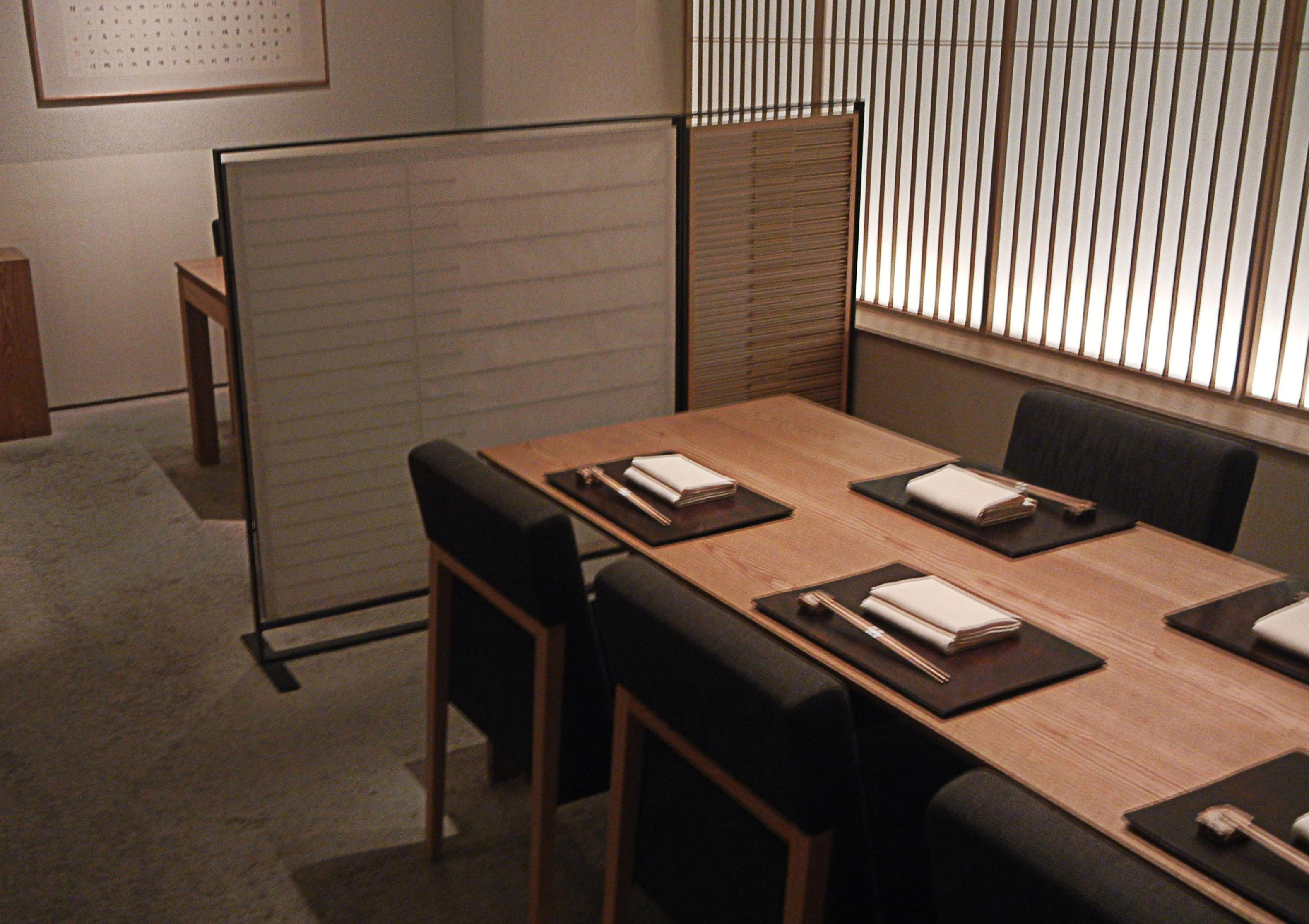
Eight seats. That is Kimoto's entire dining room: a counter of eight, no private rooms, no secondary dining space. In practical terms, this means Chef Yasuya Kimoto controls the pacing, sourcing, and execution of every cover in service. The format is common among Tokyo's most awarded Japanese cuisine addresses, Hirosaku and Ajihiro operate in a broadly comparable counter-kaiseki register, but the eight-seat constraint places Kimoto at the more restrictive end of the spectrum.
That constraint has a direct relationship to ingredient quality. When a kitchen serves eight covers rather than forty, it can commit to produce obtained in quantities that larger restaurants cannot prioritise: single-farm vegetables, fish sourced from specific boats at specific ports, dashi drawn from carefully selected kombu and katsuobushi. This is the logic that underpins the ingredient-forward school of Japanese cuisine that has gained traction across Tokyo's top tier, and it is the framework within which Kimoto's Tabelog score of 4.38 carries most meaning.
Sustained Recognition Across Seven Award Cycles
Consistency at this level is harder than initial recognition. Kimoto has held Tabelog Silver continuously from 2020 through 2026, seven consecutive annual awards on a platform where Japanese diners, notably thorough and unsparing in their reviews, determine rankings through accumulated visit scores rather than critic judgment alone. Tabelog Silver at a 4.38 score positions the restaurant within a narrow band: Silver covers a range but the combination of score, format, and price tier indicates a room that is being judged against the most demanding expectations in the category.
The Tabelog 100 selection for Japanese Cuisine in Tokyo, awarded in 2021, 2023, and 2025, adds a further layer of context. This list covers the one hundred most recognised Japanese cuisine restaurants in the city across all subcategories, making repeated selection a signal that Kimoto is not just holding its standing within a small counter niche but competing credibly in a much wider field. For comparison, Tokyo's broader kaiseki peer group includes Michelin three-star rooms like RyuGin and the long-established Kikunoi Tokyo. Kimoto operates without Michelin recognition in its public record, but the Opinionated About Dining rankings, 37th in Japan in 2023, 52nd in 2024, confirm a consistent position among the country's most respected Japanese cuisine addresses by a separate and credible critical measure.
Ingredient Logic at the JPY 80,000–99,999 Tier
Tokyo's kaiseki price tiers have stratified sharply over the past decade. The entry point for a serious evening course has risen, while the top tier has moved well above JPY 50,000 per person. Kimoto's dinner band of JPY 80,000–99,999 places it in the upper bracket of the city's non-Michelin Japanese cuisine rooms and within the same price range as several starred contemporaries. That pricing is a statement about ingredient cost as much as about ambition.
At this level, the sourcing conversation becomes central. The kaiseki tradition in Japan has always been seasonal by definition, the procession of courses maps the calendar with a specificity that makes ingredient provenance inseparable from the cooking itself. What distinguishes the current generation of Tokyo counter kaiseki from older formal kaiseki is the degree to which the sourcing relationships are made visible: the named producer, the specific prefecture, the variety of vegetable grown for a particular climate. Rooms like Akasaka Ogino and Aoyama Jin operate in adjacent parts of this wider scene, each with its own sourcing emphasis and format register.
The dashi question sits at the centre of any serious kaiseki assessment. Japanese cuisine at this price point is judged substantially on the depth and clarity of its dashi, the foundational stock from which soups, sauces, and simmered preparations are built. There is no shortcut at this level, the quality of kombu, the grade of bonito, and the timing of extraction are all visible in the result, and experienced diners at eight-seat counters are there specifically to taste that difference.
The Kagurazaka Location
The address at 5-5 Higashigokencho in Shinjuku City places Kimoto in the quieter eastern reaches of Kagurazaka, approximately 570 metres from Kagurazaka Station. The neighbourhood's character, low-rise, dense with small restaurants, bars, and French bistros that arrived in the postwar period, provides an unusual context for a room at this price tier. Unlike Ginza or Roppongi, Kagurazaka does not signal luxury through its streetscape. The restaurants that have built serious reputations here have done so almost entirely through word of mouth and platform recognition rather than location prestige.
That dynamic suits a counter format. The eight-seat room does not need foot traffic or window appeal; it needs to fill eight specific seats on each of its operating evenings. The combination of a 4.38 Tabelog score and seven years of Silver recognition has established that pull without requiring the address to do any work independently. For diners approaching from outside Tokyo or from other Japanese cities, the contrast between the unassuming neighbourhood and the quality of what is served inside is part of what makes the room interesting, a pattern shared by a number of the country's most discussed addresses, including Gion Sasaki in Kyoto and Goh in Fukuoka.
Japan's broader fine dining geography rewards this kind of distributed excellence. Rooms of comparable ambition operate across the country, from HAJIME in Osaka to akordu in Nara, 1000 in Yokohama, and 6 in Okinawa, each reflecting a regional ingredient logic that national platforms like Tabelog and Opinionated About Dining now map with enough granularity to make meaningful comparison possible.
Planning a Visit
Kimoto operates Tuesday through Thursday from 5:30 pm to 1 am, Friday from 5:30 pm to 3 am, Saturday from 1 pm to 4 am, and Sunday from 1 pm to 1 am. Monday is closed, along with the first and third Sundays of each month. The Saturday and Sunday afternoon sittings represent the room's lunch-adjacent service; the core dinner experience runs across the evening sittings. All seatings are reservation-only, with no walk-in availability at a counter of this size and recognition level. Credit cards are accepted; electronic money and QR code payments are not. The room is non-smoking throughout, and there are no private rooms. The entire space can be reserved for private use. Children are welcome if they are eating the same course as adults.
For a full view of where Kimoto sits within Tokyo's dining options, see our full Tokyo restaurants guide. For further reading on where to stay, drink, and explore in the city, see our Tokyo hotels guide, our Tokyo bars guide, our Tokyo wineries guide, and our Tokyo experiences guide.
Quick reference: 5-5 Higashigokencho, Shinjuku City, Tokyo. Reservation-only. Dinner JPY 80,000–99,999. Eight counter seats. Tuesday–Sunday (closed Monday and first/third Sundays). Credit cards accepted.
Frequently asked questions
How would you describe the cuisine at Kimoto?
Has Kimoto won any awards?
Kimoto has received recognition including:
What do people recommend at Kimoto?
Kimoto is a kaiseki counter with no à la carte menu: the kitchen sets the course, so there is nothing to order or request in the conventional sense. What Tabelog reviewers consistently respond to, reflected in a 4.38 score and seven consecutive Silver awards from 2020 through 2026, is the coherence of the progression across eight counter seats with no private rooms to dilute the experience. At JPY 80,000–99,999 per person for dinner, the expectation is that every element of the course reflects Chef Yasuya Kimoto's judgment about what is in season and at its peak that evening.
What time does Kimoto open and close?
Hours at Kimoto: Hours: Monday Closed Tuesday 5:30 pm–1 am Wednesday 5:30 pm–1 am Thursday 5:30 pm–1 am Friday 5:30 pm–3 am Saturday 1 pm–4 am Sunday 1 pm–1 am.
Where It Fits
Comparable venues nearby, for context on price, style, and recognition.
| Venue | Cuisine | Price | Awards | Notes |
|---|---|---|---|---|
| KimotoThis venue (the venue you are viewing) | Modern Kaiseki | $500+ | Tabelog Silver #55 | Not listed |
| Sushi Ryusuke | Modern Edomae Omakase | $200–300 | Tabelog 100 #86 | Chūō |
| Sushi Iwa | Traditional Japanese Omakase Sushi | $200–300 | Not listed | Chūō |
| Shimazu | Edomae Sushi Omakase | $200–300 | Tabelog Gold #27 | Minato |
| Kioicho Mitani | Modern Sushi Omakase with Wine Pairing | $300–500 | Tabelog Bronze #179 | Chiyoda |
| Raimon | Premium Yakiniku | $200–300 | Tabelog Gold #22 | Minato |
Recognition history
Dated appearances from independent guides and award organizations, with the underlying list record or original source where available.
Opinionated About Dining Top Restaurants in Japan Ranked #63
Opinionated About Dining
Tabelog Silver #55
Tabelog
Full recognition history (6 entries)
Tabelog Silver
Tabelog
Tabelog 100 #17 · No. 17
Tabelog · Tabelog 100 - Japanese cuisine - TOKYO - 2025
Opinionated About Dining Top Restaurants in Japan Ranked #52
Opinionated About Dining
Opinionated About Dining Top Restaurants in Japan Ranked #37
Opinionated About Dining