HUmmUs
On Prins Hendrikstraat, HUmmUs brings the Eastern Mediterranean tradition of chickpea-centred cooking into The Hague's mid-range dining conversation. The format is casual and the focus is narrow: hummus as a serious subject, not a side dish. For a city that skews toward French-inflected bistros and seasonal tasting menus, this kind of ingredient-first simplicity occupies a distinct position.
- Address
- Prins Hendrikstraat 60, 2518 HT Den Haag, Netherlands
- Phone
- +31708881546
- Website
- ilovehummus.nl
- Directions
- Get directions
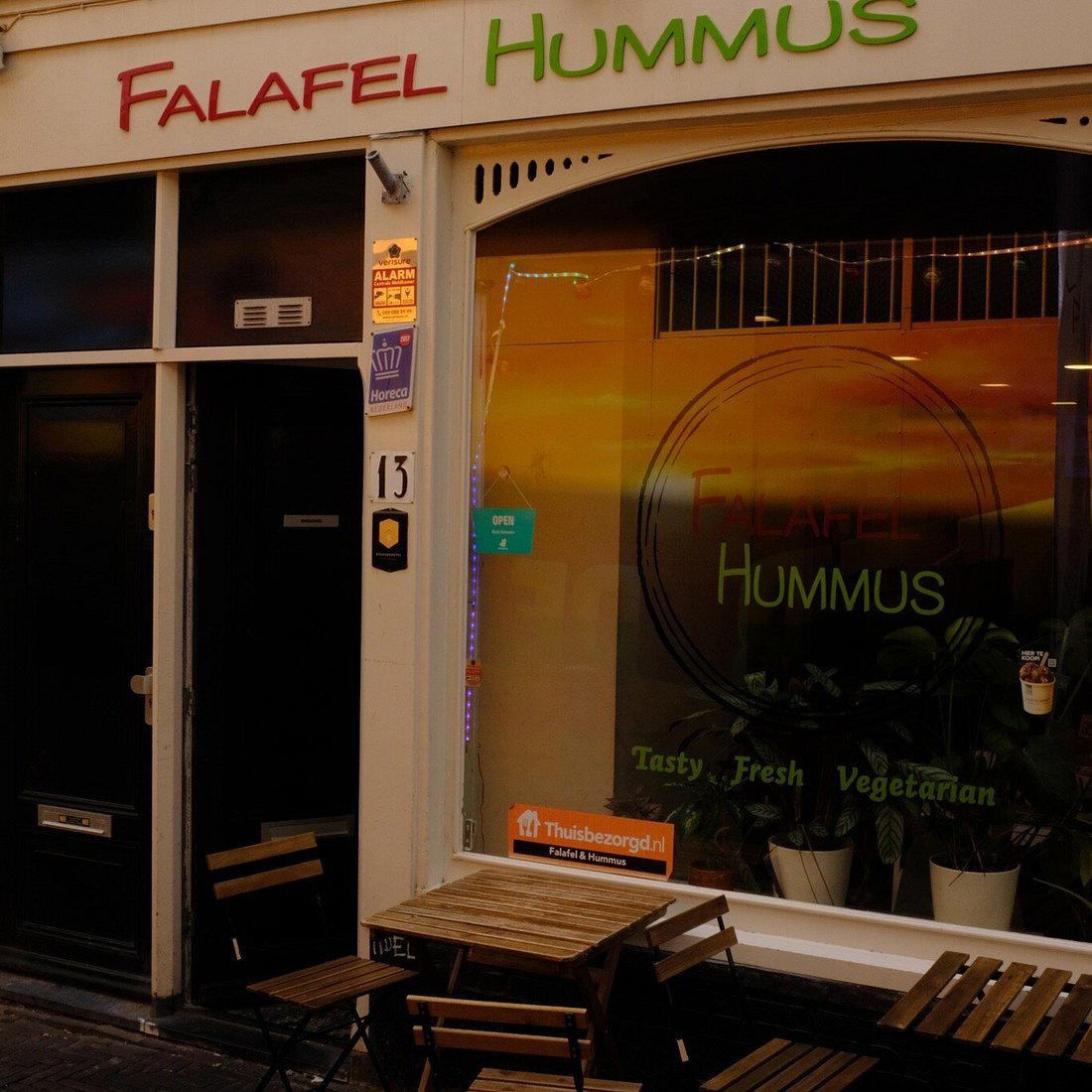
Where The Hague's Ingredient-First Dining Finds Its Simplest Form
HUmmUs is a vegetarian Middle Eastern restaurant in The Hague, Netherlands, with casual dress and recommended reservations. The Hague's restaurant scene has spent the better part of a decade consolidating around two poles: the tasting-menu end, where venues like Calla's (€€€€ · Creative French) and 6&24 (€€€ · Modern Cuisine) compete on technique and curation, and a more grounded tier where the argument is about produce honesty rather than kitchen complexity. HUmmUs on Prins Hendrikstraat 60 belongs to that second conversation. The premise is narrow by design: chickpeas, sourced and prepared with the kind of attention that most kitchens reserve for protein, presented as the main event rather than an accompaniment.
That narrowness is not a limitation. Across the Eastern Mediterranean and Levantine traditions from which hummus originates, the dish is evaluated on the quality of its base ingredients, dried chickpeas versus canned, the grade and origin of tahini, the freshness of lemon, the quantity and quality of olive oil. A kitchen that centres hummus is making a claim about sourcing before it makes any claim about technique, because poor-quality chickpeas cannot be rescued by skill. The logic runs parallel to what Basaal (€€ · Seasonal Cuisine) does with Dutch seasonal produce, strip the format back, then let the ingredient quality carry the argument.
Hummus as Subject, Not Condiment
In the Levantine canon, hummus bi tahini is a morning food as often as an evening one, eaten fresh and warm from the pot, not cold from a refrigerator shelf. The leading versions in Tel Aviv, Beirut, and Haifa share a common characteristic: the chickpeas are cooked to a specific softness, then blended while still hot, creating an emulsion that cools into something entirely different from what comes out of a commercial tub. The ratio of tahini to chickpea, and the quality of both, is where the real argument lives.
A venue that takes that tradition seriously in The Hague is doing something the city's dining scene does not have in abundance. The broader Dutch restaurant landscape tends toward either Northern European austerity or international eclecticism; the focused Levantine counter format, where a small menu built around one or two foundational dishes is the entire offer, sits closer to the specialist end of the mid-market. It is the same kind of category discipline that defines the better falafel and shawarma specialists across Amsterdam and Rotterdam, but those cities have deeper pools of that tradition to draw from. In The Hague, a focused Levantine hummus spot occupies a narrower niche.
For broader context on what else is happening across The Hague's dining tiers, from the neighbourhood bistros to the more ambitious tasting-menu rooms, the full The Hague restaurants guide maps the current field. Elsewhere in the Netherlands, De Nieuwe Winkel in Nijmegen represents the far end of ingredient-sourcing discipline at the fine-dining level, while De Librije in Zwolle and Aan de Poel in Amstelveen show what regional-produce commitments look like when applied to higher price points and more complex formats.
The Address and What to Expect Around It
Prins Hendrikstraat sits in a residential and small-business belt that connects several of The Hague's inner neighbourhoods without being anchored to any single one. It is not a destination strip in the way that Denneweg or the area around the Grote Markt operate; foot traffic is local and deliberate rather than tourist-heavy. A venue at this address is likely drawing a regular neighbourhood clientele alongside people who have sought it out specifically. That dynamic tends to suit a specialist format better than a generalist one: the offer needs to be clear enough to travel by word of mouth.
Practically, Prins Hendrikstraat 60 is accessible from the city centre without difficulty. Public transport connections run through the surrounding streets, and the area does not present the parking complexity of The Hague's denser central zones. For planning purposes, visiting earlier in the day or on a weekday reduces the risk of a closed door.
Where This Sits in The Hague's Mid-Market
The Hague's accessible dining tier includes venues like Bistro Veen and Botanica, which operate in a French-influenced or plant-forward register. HUmmUs cuts a different angle: the Eastern Mediterranean framework it draws from is neither French-adjacent nor Nordic-seasonal, and the price point implied by a hummus-focused format places it at the accessible end of The Hague's mid-market, comparable in spend to a casual lunch at Basaal rather than an evening at Calla's.
That positioning matters because The Hague's affordable dining options are more varied in provenance than they were a decade ago, but focused Levantine formats remain a smaller part of the picture than in Amsterdam. Internationally, the hummus-as-serious-food argument has been made convincingly at different price points: at the counter level in Israeli cities, and at the composed-dish level in places like New York, where restaurants such as Atomix in New York City demonstrate how fermentation and ingredient sourcing can anchor a high-concept format, and Le Bernardin in New York City shows what ingredient-first philosophy looks like when applied with maximum technical resource. HUmmUs is not making that kind of claim, the format is simpler and the price point lower, but the underlying logic of building a menu around sourcing rather than technique complexity connects across those registers.
For readers interested in what the Netherlands' more decorated kitchens are doing with similar ingredient-first philosophies at different scales, 't Nonnetje in Harderwijk, Ciel Bleu in Amsterdam, De Bokkedoorns in Overveen, Brut172 in Reijmerstok, De Groene Lantaarn in Staphorst, De Lindehof in Nuenen, and De Lindenhof in Giethoorn each illustrate different points on that spectrum.
Planning Your Visit
HUmmUs is at Prins Hendrikstraat 60, 2518 HT Den Haag. The format and address suggest a casual, counter-style or small-room experience, and reservations are recommended.
Comparison Snapshot
Comparable venues nearby, for context on price, style, and recognition.
| Venue | Cuisine | Price | Notes |
|---|---|---|---|
| HUmmUsThis venue — the venue you are viewing | Vegetarian Middle Eastern | $$ | Not listed |
| Glaswerk | Modern Seafood & Dutch Small Plates | $$ | Binckhorst |
| Oker | Asian-inspired Fusion Small Plates | $$ | Voorhout |
| The Gyros Club | Greek Gyros and Cocktails | $$ | City Center |
| Bouzy | Wine Bistro with Small Plates | $$ | Voorhout |
| Kalun | Authentic Cantonese Chinese | $$ | Chinatown |
Continue exploring
More in The Hague
Restaurants in The Hague
Browse all →
Bars in The Hague
Browse all →
Hotels in The Hague
Browse all →
Wineries in The Hague
Browse all →
At a Glance
- Cozy
- Trendy
- Date Night
- Casual Hangout
- Organic
Lively and cozy atmosphere with warm hospitality.