Ciel Bleu








Ciel Bleu holds two Michelin stars and a La Liste score of 94 points (2026), operating from the 23rd floor of Hotel Okura Amsterdam South. Chef Arjan Speelman leads a creative menu weighted toward crab, lobster, fish, and meat, with vegetables treated with precision if not yet full parity. Star Wine List ranked it #1 in 2025. Open Tuesday through Saturday from 6:30 pm.
Pearl is the En Primeur Club membership app — saves, bookings, and concierge access live there. Same editors, same standards.
- Address
- Ferdinand Bolstraat 333, 1072 PG Amsterdam, Netherlands
- Phone
- +31 20 678 7450
- Website
- cielbleu.nl
- Directions
- Get directions
 Saves & bookings on Pearl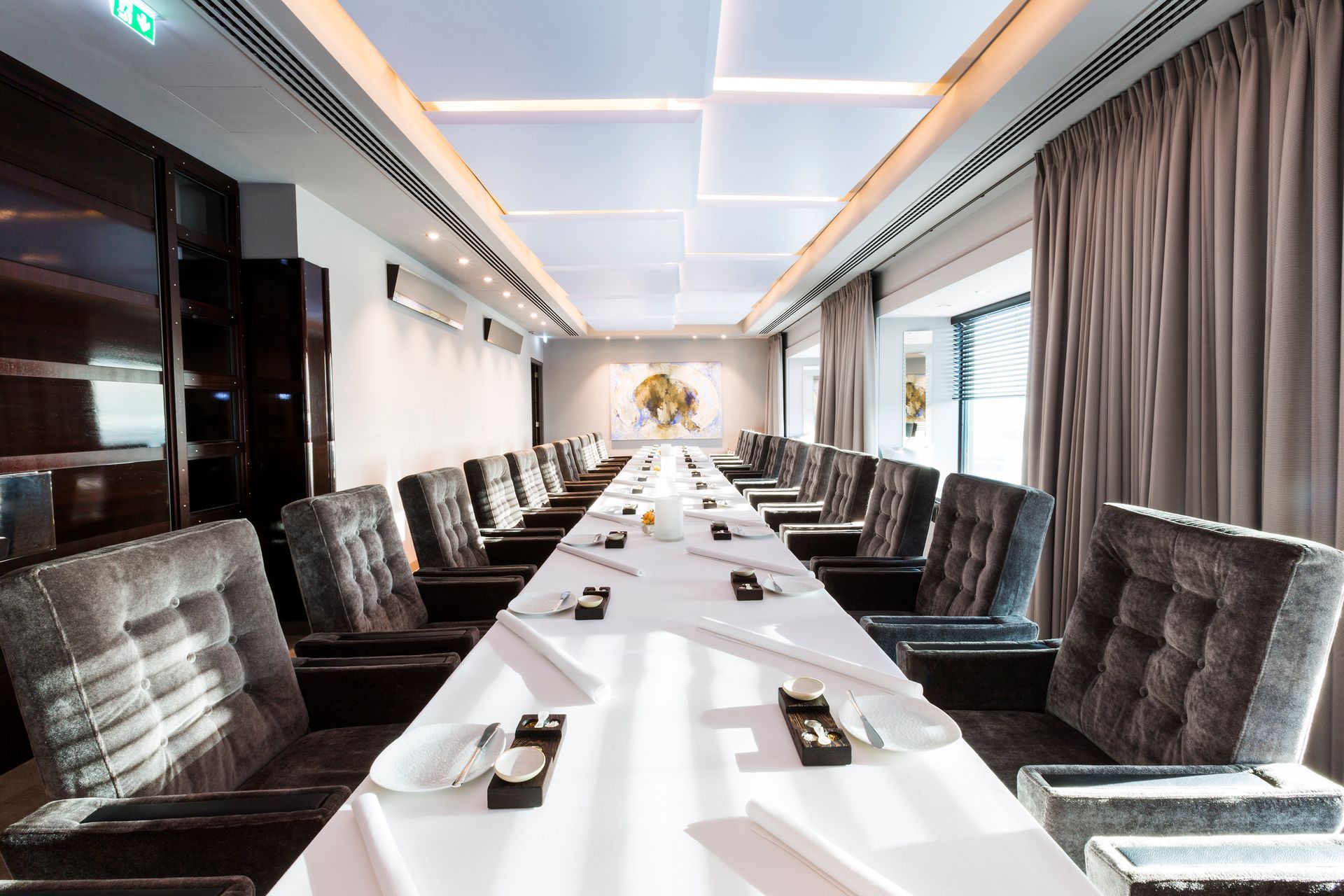
Above the Roofline: Amsterdam's High-Altitude Fine Dining Tier
Amsterdam's fine dining circuit sits at an unusual intersection: a city with genuine gastronomic ambition, a deep Dutch tradition of classical technique, and a relatively compact premium tier where two Michelin stars represents the ceiling. Ciel Bleu, on the 23rd floor of Hotel Okura at Ferdinand Bolstraat 333, occupies that ceiling. Spectrum and Vinkeles operate in the same price bracket and with comparable recognition, but neither offers the physical drama of a glass-walled room suspended over Amsterdam's southern districts. The view is not incidental to the experience; it is part of the proposition.
The Weight of a Succession
Understanding Ciel Bleu's current direction requires understanding what it was before. For years, the kitchen was defined by Onno Kokmeijer, a chef whose tenure gave the restaurant its classical foundations and its Michelin double-star status. Successions at this level in European fine dining are rarely clean. When a kitchen is built around a named figure with a clear culinary identity, the transition to a new generation carries both institutional weight and genuine uncertainty.
Arjan Speelman and Jelle Conijn inherited that weight. Opinionated About Dining placed Ciel Bleu at #58 in Europe in 2025. That downward movement in a competitive ranking does not necessarily signal decline; the European classical tier is not a static pool. But it does reflect the reality that a kitchen in post-succession consolidation faces a different critical calculus than one at the height of an established chef's run. The two Michelin stars have held through both the 2024 and 2025 guides, which is the more significant data point. La Liste awarded 94 points in 2026.
the cooking radiates class and the succession appears assured, but the menu remains weighted toward crab, lobster, fish, and meat. Vegetables are handled with precision but appear less frequently and with less ambition than the protein-led dishes. Whether that reflects a deliberate choice or an area of ongoing development depends on where the kitchen goes in the next cycle of recognition. For now, it reads as the honest state of a restaurant that has secured its identity without yet fully expanding it.
The Room at 23 Floors
Hotel Okura Amsterdam is a Japanese-owned luxury property, and that ownership shapes Ciel Bleu in ways that go beyond branding. The building's architecture, the service register, and the attention to material precision all carry traces of the Japanese hospitality approach that treats technical discipline as a baseline rather than a differentiator. The 23rd-floor dining room works in that context: the space is formal without being stiff, and the panoramic view over Amsterdam South provides a physical sense of occasion that few city restaurants anywhere can match through design alone.
This kind of refined hotel dining has a specific logic. The kitchen operates at a remove from the street-level energy of Amsterdam's restaurant neighbourhoods, which creates a different relationship between guest and setting. You are not embedded in a neighbourhood; you are looking down at one. That distinction matters for the type of experience the restaurant offers. It is a destination in the classical sense: planned, occasion-led, and largely insulated from the ambient character of the surrounding city. For some diners, that is precisely the point. For those seeking something with more neighbourhood texture, Daalder or RIJKS® operate in a different register entirely.
Where the Wine Stands
Star Wine List ranked the restaurant #1 in the Netherlands in 2025. In a country where wine programs at this level are typically strong by default, topping that list signals something beyond adequate depth. Hotel restaurants with serious cellar investment often benefit from the infrastructure that standalone restaurants cannot justify: storage, capital for allocation purchases, and the sommelier-to-cover ratios that make guided pairings genuinely useful rather than perfunctory. For a restaurant in the €€€€ bracket, a wine program of this calibre is a structural advantage, not just an amenity. Diners who treat the pairing as an optional add-on are underselling the visit.
For context within the Dutch fine dining tier, the wine programs at two-star level properties like De Librije in Zwolle and Aan de Poel in Amstelveen are also held in high regard, which makes the restaurant's #1 placement meaningful rather than incidental. The broader Dutch creative tier, represented elsewhere by venues like De Bokkedoorns in Overveen, De Groene Lantaarn in Staphorst, and De Lindehof in Nuenen, offers useful comparison points for anyone building a broader understanding of where Dutch fine dining is going.
The Current Direction
The editorial angle here is the restaurant's current phase of evolution. The more interesting question is what phase of its evolution the restaurant is currently in. Post-succession kitchens at this level tend to follow a recognisable pattern: an initial consolidation period where the inherited identity is maintained, followed by a phase where the new kitchen heads begin to assert their own priorities. La Liste's upward movement from 93.5 to 94 points year-on-year suggests the consolidation phase is largely complete. The OAD ranking's gradual descent, by contrast, may reflect that the classical European specialist audience has not yet seen the assertion phase clearly enough to recalibrate.
That tension is not unusual, and it is one interesting place to observe a restaurant. The restaurant is not coasting; the two-star hold and the wine list recognition are active achievements. But it is also not yet the version of itself that Speelman and Conijn will ultimately be judged against. The next two to three years, as they consolidate their identity rather than their inherited one, will define whether the OAD ranking stabilises or resumes its upward trajectory.
For comparison within Amsterdam's creative fine dining bracket, 212 operates with a different format and a more deliberately unconventional approach. The two restaurants are not direct competitors, but together they illustrate the range within a single city's premium tier. Further afield in the creative €€€€ category, Platán Gourmet in Tata and Brut172 in Reijmerstok offer regional European reference points for how the creative classical format is evolving outside capital cities.
Know Before You Go
- Address: Ferdinand Bolstraat 333, 1072 PG Amsterdam
- Location: 23rd floor, Hotel Okura Amsterdam South
- Hours: Tuesday to Saturday, 6:30 pm to 8 pm. Closed Sunday and Monday.
- Price tier: €€€€
- Awards: Michelin 2 Stars (2024 & 2025); La Liste 94pts (2026); Star Wine List #1 Netherlands (2025); OAD Classical Europe #58 (2025) 7 from 453 reviews
- Cuisine: Creative, protein-led with classical European technique
- Booking: Reservations are required; reserve well in advance for weekend tables
Price Lens
Comparable venues nearby, for context on price, style, and recognition.
| Venue | Cuisine | Price | Awards | Notes |
|---|---|---|---|---|
| Ciel BleuThis venue — the venue you are viewing | Creative | $$$$ | Michelin 2 Star | Not listed |
| Flore | Not listed | $$$$ | Michelin 2 Star | BG-terrein e.o., Conscious Fine Dining – Plant-Forward & Sustainable European |
| Vinkeles | Not listed | $$$$ | Michelin 2 Star | Felix Meritisbuurt, Modern French Fine Dining |
| Spectrum | Not listed | $$$$ | Michelin 2 Star | Amstelveldbuurt, Modern Dutch Fine Dining |
| The Supper Club | Not listed | $$$$ | World's 50 Best #43 | Leidsegracht Zuid, International Tasting Menu with Entertainment |
| 212 | Rembrandtpleinbuurt, Modern Fine Dining | $$$$ | Michelin 2 Star | Not listed |
Recognition history
Dated appearances from independent guides and award organizations, with the underlying list record or original source where available.
Falstaff Restaurant - 97 Falstaff Points
Falstaff
La Liste Top Restaurants
La Liste
Opinionated About Dining Classical in Europe Ranked #66
Opinionated About Dining
Wine Spectator Best of Award of Excellence
Wine Spectator
La Liste Top Restaurants
La Liste
Michelin 2 Stars
Michelin
Opinionated About Dining Classical in Europe Ranked #58
Opinionated About Dining
Star Wine List
Star Wine List
The Best Chef One Knife
The Best Chef
We're Smart World 2 Radishes
We're Smart World
Michelin 2 Stars
Michelin
Opinionated About Dining Classical in Europe Ranked #47
Opinionated About Dining
Opinionated About Dining Classical in Europe Ranked #27
Opinionated About Dining
Continue exploring
More in Amsterdam
Restaurants in Amsterdam
Browse all →
Bars in Amsterdam
Browse all →
Hotels in Amsterdam
Browse all →
Wineries in Amsterdam
Browse all →
At a Glance
- Elegant
- Sophisticated
- Modern
- Intimate
- Special Occasion
- Date Night
- Celebration
- Rooftop
- Panoramic View
- Hotel Restaurant
- Chefs Counter
- Private Dining
- Extensive Wine List
- Sommelier Led
- Skyline
Current opening hours
- Monday
- Closed
- Tuesday
- 6:30–8 PM
- Wednesday
- 6:30–8 PM
- Thursday
- 6:30–8 PM
- Friday
- 6:30–8 PM
- Saturday
- 6:30–8 PM
- Sunday
- Closed
Hours can change for holidays and private events. Last verified .
Plush neutral palette with modern elegance, calm atmosphere, and soft lighting enhanced by dramatic cityscape vistas.