1 Michelin Star
Our verdict
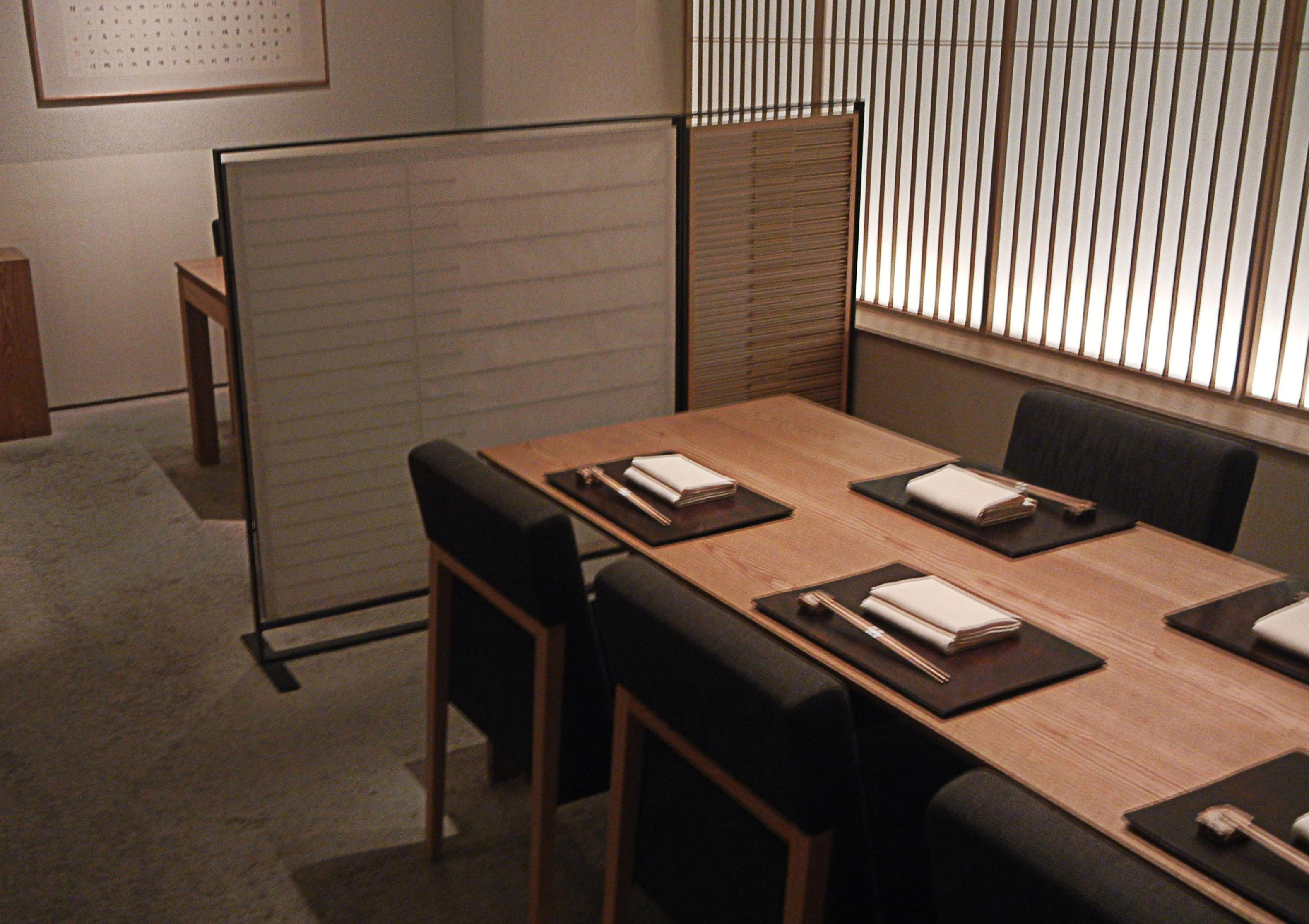
On a quiet lane in Kagurazaka, FUSHIKINO holds a 2024 Michelin star for its reinterpretation of familiar Japanese dishes through a framework it calls the trinity of food, sake, and utensils. The menu reads conventionally, recognisable Japanese staples, but the details diverge sharply: aged ponzu, onion soy sauce, and sake pairings served in cups made by contemporary ceramic artists.

Pearl is the En Primeur Club membership app, where members save venues, book tables and use the concierge.
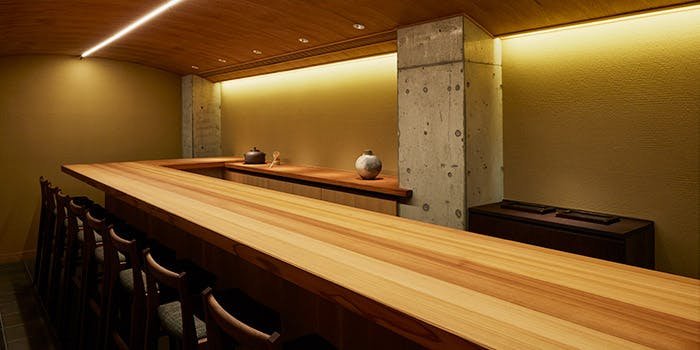
A Neighbourhood That Shapes the Cooking
Kagurazaka occupies a particular position in Tokyo's dining order. Once the city's geisha district, its cobbled alleys and low-rise machiya shopfronts have quietly accumulated some of the capital's most considered Japanese restaurants, sitting at a remove from the Ginza prestige circuit and the Roppongi expense-account tier. The neighbourhood rewards walking: restaurants here tend to earn their audiences through word of mouth and repeat visits rather than hotel concierge recommendations. FUSHIKINO sits on Hommoku Yokocho, a lane dense with small restaurants, on the second floor of a modest terrace building. The address is understated by design, consistent with a style of Tokyo dining where the room is incidental to what happens inside it.
That positioning matters when reading what FUSHIKINO is attempting. The restaurant's name fuses two Japanese concepts: one drawn from Zen philosophy, one meaning mysterious. The combination points toward something that has not previously existed. For a country where culinary tradition operates within tightly observed boundaries, that is a specific and consequential claim.
The Philosophy Behind the Menu
Japanese multi-course cooking in the kaiseki tradition is built on a set of aesthetic principles that predate any individual chef or restaurant: seasonality, restraint, the harmony of vessel and ingredient, the idea that a meal progresses like a composition rather than a sequence of dishes. What distinguishes the more experimental end of that tradition is not rejection of those principles but pressure applied to them, finding where the logic leads if you follow it further than convention allows.
FUSHIKINO works within that pressure zone. The menu lists items recognisable to anyone familiar with Japanese cuisine. The departure comes in the details, which the restaurant treats as the actual subject of the meal. Onion soy sauce and aged ponzu are not exotic ingredients; they are transformations of foundational Japanese condiments through processes that change their character in time. The approach places FUSHIKINO in a cohort of Tokyo restaurants, including Den at the same price tier, where innovation operates through subtlety rather than spectacle. Den holds two Michelin stars and similarly works Japanese fundamentals from an unconventional angle; FUSHIKINO's single star (2024) places it one tier below in Michelin's hierarchy but within the same conceptual neighbourhood.
The third element of FUSHIKINO's stated framework, utensils, is where the kaiseki aesthetic principle of vessel harmony becomes most explicit. Sake cups produced by contemporary ceramic artists accompany each course's drink pairing, one cup per dish. This is not decoration. In kaiseki thinking, the weight, texture, and visual character of a vessel changes the perception of what it holds. Using artist-made cups rather than production ware makes that relationship active rather than assumed, and it introduces a craft dimension that most restaurants in this category leave entirely to the kitchen.
Sake as a Structural Element
Tokyo's more considered Japanese restaurants have largely moved past the wine-only or wine-primary pairing model. The city's sake culture is sophisticated enough that a restaurant offering a structured sake pairing, calibrated course by course, is making a statement about how it understands Japanese gastronomy rather than simply offering an alternative to wine. Kagurazaka's density of Japanese restaurants has made the neighbourhood a reliable testing ground for sake-forward menus, and FUSHIKINO's one-cup-per-dish format takes that integration seriously.
For comparison, Kagurazaka Ishikawa, which holds three Michelin stars and is one of the anchor references for kaiseki in this neighbourhood, treats sake as a serious pairing option alongside wine. FUSHIKINO's approach is more prescriptive: the pairing is designed into the menu rather than offered as an alternative. That reflects the restaurant's position within what it calls a trinity, where the drink component is not subordinate to the food but co-equal with it.
Where FUSHIKINO Sits in Tokyo's Kaiseki Tier
Tokyo's Michelin-starred Japanese restaurants span an enormous range of price, format, and ambition. At the upper end, three-star kaiseki operations like Azabu Kadowaki and RyuGin (three stars, kaiseki-Japanese, ¥¥¥¥) represent the most formally demanding end of the category, with price points and booking lead times that reflect their position in global rankings. FUSHIKINO operates at ¥¥¥, which places it in a tier that includes some of Tokyo's most interesting cooking: ambitious enough to hold a Michelin star, priced to admit a broader range of diners than the ¥¥¥¥ bracket.
That price position is significant. The ¥¥¥ bracket in Tokyo can be the most productive zone for finding restaurants that are still developing a proposition rather than consolidating a reputation. FUSHIKINO's 2024 Michelin recognition is recent enough that the restaurant has not yet accumulated the booking backlog of establishments with multi-year star histories. That may shift. Restaurants like Jingumae Higuchi and Myojaku followed a comparable trajectory: early star, growing profile, progressively tighter availability. For those planning a trip to Tokyo in the near term, the window for relatively direct reservations at FUSHIKINO is probably narrower than it looks.
That consistency matters in a category where the gap between exceptional and merely correct is often invisible to guests but decisive for critics.
Kagurazaka in the Context of Tokyo Dining
Any serious engagement with Tokyo's Japanese restaurant scene benefits from understanding that the city's dining is geographically organised by character as much as by quality. Ginza concentrates prestige sushi, with counters like Ginza Fukuju drawing international audiences. Azabu and Hiroo lean toward French and international fine dining. Kagurazaka functions differently: its restaurants are primarily Japanese in format and ingredient, and they draw a local clientele that returns frequently rather than a transient audience seeking marquee names.
That local character shapes what restaurants here choose to do. Experimentation in Kagurazaka tends to be incremental and ingredient-focused rather than theatrical. FUSHIKINO's approach, adjusting foundational sauces through aging and substitution rather than introducing foreign techniques, fits that temperament. For context on how Japanese multi-course cooking translates across different Japanese cities, Gion Sasaki in Kyoto and HAJIME in Osaka represent parallel tracks in their respective food cultures, each working within a distinct regional logic.
For those building a broader Japan itinerary beyond Tokyo, akordu in Nara, Goh in Fukuoka, 1000 in Yokohama, and 6 in Okinawa each illuminate how Japanese fine dining adapts to regional ingredient sets and cultural expectations. Within Kyoto's kaiseki tradition specifically, Isshisoden Nakamura and Kashiwaya Osaka Senriyama in Osaka offer reference points for how the multi-course Japanese format operates at its most traditional.
Planning a Visit
| Detail | FUSHIKINO | Kagurazaka Ishikawa | Den | RyuGin |
|---|---|---|---|---|
| Michelin Stars | 3 | 2 | 3 | |
| Price Range | ¥¥¥ | ¥¥¥¥ | ¥¥¥ | ¥¥¥¥ |
| Cuisine Style | Japanese / Innovative | Kaiseki | Innovative Japanese | Kaiseki |
| Neighbourhood | Kagurazaka | Kagurazaka | Jimbocho | Roppongi |
| Booking Difficulty | Moderate (post-2024 star) | High | High | High |
Reservations are advisable well in advance, particularly since the 2024 Michelin star brought wider attention to the restaurant. Kagurazaka is accessible from Kagurazaka Station on the Tokyo Metro Tozai Line and from Iidabashi Station, which serves four lines including the JR Sobu. The second-floor address on Hommoku Yokocho requires some attention on arrival; the lane is not always well-signed for first-time visitors.
For further context on Tokyo's broader dining, hotel, and cultural offer, see our full Tokyo restaurants guide, our full Tokyo hotels guide, our full Tokyo bars guide, our full Tokyo wineries guide, and our full Tokyo experiences guide.
Questions Visitors Ask
What dish is FUSHIKINO known for?
The restaurant does not trade on a single signature item. Its identity is built around transformations of familiar Japanese staples: onion soy sauce and aged ponzu are cited as examples of how foundational condiments are reworked through time-dependent processes. The ceramic sake cups, made by contemporary artists and paired one per dish, function as part of the meal's character rather than as decoration. Guests who have visited consistently note the coherence of the food-sake-vessel framework rather than isolating a single preparation.
How difficult is it to get a table at FUSHIKINO?
If you are booking in the period immediately following the 2024 Michelin star announcement, expect lead times longer than the restaurant's pre-recognition baseline. Single-star Tokyo restaurants at the ¥¥¥ price point tend to see booking pressure spike significantly in the twelve months after Michelin recognition, particularly from international visitors combining the star with Kagurazaka's broader restaurant density. If this restaurant follows the pattern of comparable Tokyo recipients, a two-to-four-week advance booking minimum is likely during peak travel seasons, with longer waits becoming standard as the star embeds into the wider consciousness.
What has FUSHIKINO built its reputation on?
The name itself, a fusion of a Zen philosophical reference and the word for mysterious, signals an intention to create something outside established categories. That positioning, combined with a ¥¥¥ price point that keeps it accessible relative to the three-star kaiseki tier, has established FUSHIKINO as a notable address for diners seeking Japanese fine dining that is rigorous without being conventionally reverential.
Frequently asked questions
What does dinner at FUSHIKINO typically cost?
Pricing at FUSHIKINO is listed as ¥¥¥.
How would you describe the cuisine at FUSHIKINO?
What kind of recognition has FUSHIKINO received?
FUSHIKINO has received recognition including: ‘Fushikino’ is a mashup of two words, one referring to a Zen phrase, and the other meaning ‘mysterious’. Together, they suggest things that never before existed. The restaurant’s aim is to create something unprecedented, an unexpected culin….
What dish is FUSHIKINO famous for?
FUSHIKINO does not trade on a single dish. Its identity rests on transforming familiar Japanese staples through unconventional details: onion soy sauce, aged ponzu, and drink pairings served one cup per course in sake vessels made by contemporary artists. The 2024 Michelin star recognises this approach rather than any single plate.
Where do I go for FUSHIKINO?
FUSHIKINO is located at Japan, 〒162-0825 Tokyo, Shinjuku City, Kagurazaka, 4 Chome−3-11 つなしょうテラス 2階(本多横丁, Tokyo.
How hard is it to get a table at FUSHIKINO?
Following the 2024 Michelin star announcement, lead times at one-star Tokyo restaurants in residential neighbourhoods like Kagurazaka typically stretch to six to ten weeks for prime seatings. Book as far ahead as possible; walk-in availability after recognition at this level is uncommon.
What has FUSHIKINO built its reputation on?
The restaurant's name draws on a Zen phrase and a word meaning 'mysterious', signalling an explicit ambition to create dishes and pairings that have no direct precedent.
| Venue | Cuisine | Price | Awards | Notes |
|---|---|---|---|---|
| FUSHIKINOThis venue (the venue you are viewing) | Kyoto-style Kaiseki with Sake Pairing | $300–500 | 1 Michelin Star | Not listed |
| Harutaka | Edo-Style Omakase Sushi | $200–300 | 3 Michelin Stars · World's 50 Best #76 | Sushi |
| RyuGin | Modern Kaiseki | $500+ | 3 Michelin Stars · World's 50 Best #41 | Kaiseki, Japanese |
| L'Effervescence | Modern French with Japanese Influences | $200–300 | 3 Michelin Stars · World's 50 Best #69 | French |
| HOMMAGE | Modern French with Japanese Influences | $150–200 | 2 Michelin Stars · World's 50 Best #78 | Innovtive French, French |
| MAZ | Innovative Peruvian-Japanese Fusion | $150–200 | 2 Michelin Stars · World's 50 Best #28 | Innovative |
Recognition history
Dated appearances from independent guides and award organizations, with the underlying list record or original source where available.
Michelin 1 Star
Michelin
Full recognition history (2 entries)
Michelin 1 Star
Michelin