

Michelin Plate
Our verdict
Duck de Chine occupies a converted courtyard house in Jinbao Street's Jinbao Place mall, staging imperial Peking duck against a backdrop of terracotta soldiers, painted beams, and red pillars. The kitchen roasts a Cherry Valley and local white duck crossbreed over date wood, a method that has earned consecutive Opinionated About Dining Asia rankings in 2023 and 2024. For visitors measuring Beijing's duck institutions against each other, this is the upscale, theatrically presented option in the Dongcheng tier.

Pearl is the En Primeur Club membership app, where members save venues, book tables and use the concierge.
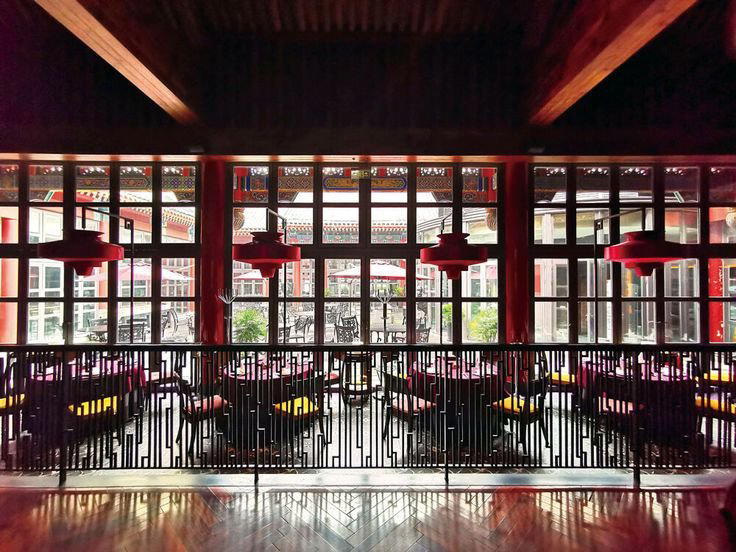
Where Imperial Theatre Meets a Very Specific Bird
The approach to Duck de Chine begins in the atrium of Jinbao Place, a luxury retail complex on Jinbao Street in Dongcheng, which is not the most obvious setting for a temple to imperial cooking. But the moment you reach the fifth floor, the register shifts. Life-size terracotta soldiers stand guard at the entrance; painted beams and red pillars frame the dining room; the arrival of the duck is announced by a gong. The staging is deliberate and unapologetic, drawing directly from the visual language of dynastic China rather than the studied minimalism that has come to define much of Beijing's premium restaurant scene.
That theatrical framework is not merely decorative. It positions the cooking within a tradition of imperial banqueting, a context in which Peking duck was never a casual meal but a ceremonial one, prepared with precision, served with ritual, and calibrated to signal occasion. The terracotta soldiers, painted beams, and gong service collectively argue that the food arriving at the table carries the same weight.
The Bird, the Wood, and the Breed
Peking duck's reputation rests on a surprisingly narrow set of technical variables: the breed of bird, the drying method, the fuel used in the oven, and the speed and angle of the carving. Adjust any one of these and the result changes materially. Duck de Chine's kitchen works with a crossbreed of Cherry Valley and local white duck, a hybrid that sits between the leaner Cherry Valley line, developed commercially in England and widely adopted across Chinese poultry farming in the twentieth century, and the traditional Beijing white duck that defined the imperial-era recipe. The crossbreed is an attempt to recover some of the fat distribution and skin texture of the older local bird without sacrificing the yield consistency of the commercial strain.
The roasting fuel is date wood, which burns at a different temperature profile and imparts a lighter, subtler smoke than the fruit woods used at some competing kitchens. This is the intersection of indigenous product and imported or hybridised method that characterises much of what has happened to Beijing duck over the past three decades: local tradition maintained in principle, but refined through deliberate crossbreeding and controlled combustion. The same pattern appears, in different form, at addresses like Da Dong, where the kitchen has applied technical analysis to fat reduction, and at Liqun Roast Duck, where a courtyard-house setting preserves older methods with minimal intervention. Duck de Chine sits between those two poles: technically attentive but also consciously theatrical.
Before the Duck Arrives
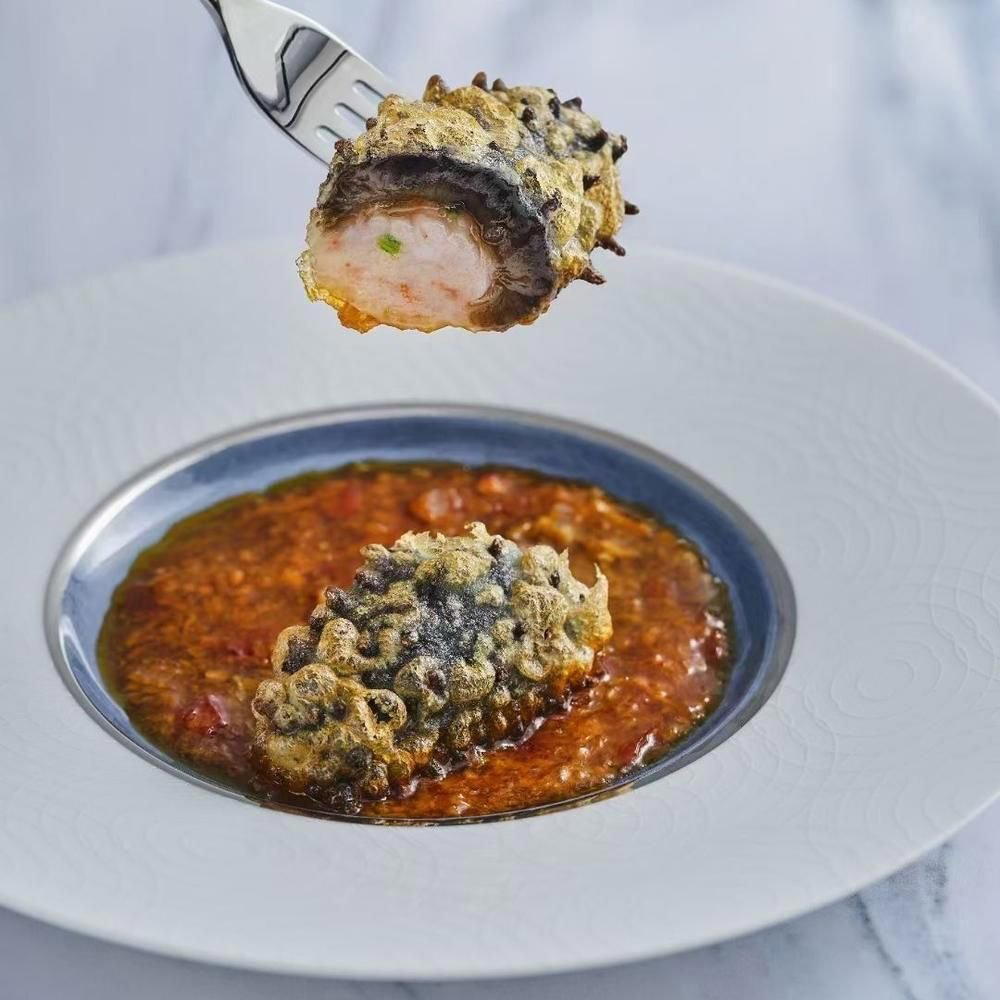
Waiting for duck from a date-wood oven is an exercise in patience, and Duck de Chine fills that interval with dishes that prepare rather than distract. Deep-fried king oyster mushrooms offer a textural counterpoint, and mustard duck web brings the broader bird into the meal before the roasted centrepiece. Both are standard components of the pre-duck sequence at serious Beijing duck houses, but the mushroom choice in particular reflects a broader shift in premium Chinese kitchens toward elevating vegetable and fungi courses beyond the supporting-cast role they once occupied.
The wider menu, as with most restaurants in this category, extends into northern Chinese staples and more elaborate banquet dishes. The kitchen is run by a rotating team rather than a single named chef, a model common among large-format Chinese restaurant groups, where consistency across service periods takes priority over the auteur-kitchen model that dominates European fine dining. For context on how Beijing's fine-dining Chinese restaurants handle the question of culinary identity, Family Li Imperial Cuisine and Made in China each represent different answers to the same question.
Where Duck de Chine Sits in the Rankings
Opinionated About Dining, which surveys professional diners and industry insiders across Asia, ranked Duck de Chine at 116th among Asia's leading restaurants in 2023, rising to 146th in 2024. The directional movement is a reminder that rankings in this region are competitive and volatile: the 2023 position represented a stronger relative showing against an expanding field. The OAD list is not Michelin and does not operate on the same rubric, but its rankings carry weight among the cohort most likely to be comparing duck houses across cities.
For comparison within Beijing's premium tier, Xin Rong Ji on Xinyuan South Road holds three Michelin stars for its Taizhou cooking at a ¥¥¥¥ price point, placing it above Duck de Chine's ¥¥¥ bracket in both cost and Michelin recognition. Duck de Chine occupies the premium-accessible tier: serious enough to attract informed visitors, priced to remain accessible relative to Beijing's most decorated rooms.
Visitors comparing duck institutions specifically will find that the Beijing market has segmented: Da Dong courts precision and modernity, Liqun trades on heritage atmosphere, and Duck de Chine holds a position defined by theatrical scale and breed-specific technique. None of these is a lesser version of the others, they represent genuinely different interpretations of the same tradition, aimed at different expectations.
How Duck de Chine Compares Across Chinese Cities
The question of how Beijing's imperial cooking tradition translates beyond the capital is worth considering for anyone building a broader itinerary. 102 House in Shanghai and Chef Tam's Seasons in Macau both represent the fine-dining Chinese register at the regional level, while Ru Yuan in Hangzhou, Xin Rong Ji in Chengdu, and Imperial Treasure Fine Chinese Cuisine in Guangzhou show how regional Chinese kitchens are developing their own frameworks for serious cooking. For Cantonese comparisons specifically, Dai Yuet Heen in Nanjing offers an interesting counterpoint. Outside mainland China, Restaurant Tim Raue in Berlin and Mister Jiu's in San Francisco illustrate how Chinese culinary vocabulary is being reframed for Western audiences, though these are fundamentally different projects from what Duck de Chine is doing.
Planning a Visit
Duck de Chine is on the fifth floor of Jinbao Place at 88 Jinbao Street, Dongcheng. The mall location makes it accessible from Wangfujing and the surrounding hutong area, and the neighbourhood sits within reach of several of the city's major historic sites, making it a natural anchor for a day in central Beijing. The ¥¥¥ price range positions a meal here below Beijing's most expensive rooms but above the hutong duck houses that compete on heritage rather than service polish. Booking is advisable for weekend evenings, particularly for groups, given the format's popularity among both local business diners and visiting travelers. For a broader picture of where to eat, sleep, drink, and explore in the capital, see our full Beijing restaurants guide, our full Beijing hotels guide, our full Beijing bars guide, our full Beijing wineries guide, and our full Beijing experiences guide.
Frequently asked questions
Who runs the kitchen at Duck de Chine?
The chef associated with Duck de Chine is Various.
What do people recommend at Duck de Chine?
The roasted Peking duck is the central draw, prepared from a Cherry Valley and local white duck crossbreed and roasted over date wood, a fuel choice that shapes the skin texture and smoke profile. Before the duck arrives, deep-fried king oyster mushrooms and mustard duck web are worth ordering. Duck de Chine ranked 116th in Asia on the Opinionated About Dining survey in 2023, rising to 146th in 2024, placing it among the most consistently reviewed Peking duck venues in the city.
What's the pricing like at Duck de Chine?
Pricing at Duck de Chine is listed as ¥¥¥.
Comparable Spots, Quickly
A short peer table to compare basics side-by-side.
| Venue | Cuisine | Price | Awards | Notes |
|---|---|---|---|---|
| Duck de ChineThis venue (the venue you are viewing) | Modern Peking Duck | $50–100 | Michelin Plate | Not listed |
| Jing | Modern French with Asian Influences | $300–500 | 1 Michelin Star · Black Pearl 1 Diamond | French Contemporary |
| Xin Rong Ji (Xinyuan South Road) | Taizhou Chinese Fine Dining | $300–500 | 3 Michelin Stars · World's 50 Best #84 | Taizhou |
| Chao Shang Chao (Chaoyang) | Modern Teochew (Chaoshan) Fine Dining | $200–300 | Michelin Plate · La Liste Top Restaurants | Chao Zhou |
| Lamdre | Modern Plant-Based Chinese Vegetarian | Not listed | 2 Michelin Stars · World's 50 Best #17 | Vegetarian |
| Jingji | Imperial Beijing Royal Cuisine | $200–300 | 2 Michelin Stars · La Liste Top Restaurants | Beijing Cuisine |
Recognition history
Dated appearances from independent guides and award organizations, with the underlying list record or original source where available.
Michelin Plate
Michelin
Opinionated About Dining Top Restaurants in Asia Highly Recommended
Opinionated About Dining
Full recognition history (4 entries)
Opinionated About Dining Top Restaurants in Asia Ranked #146
Opinionated About Dining
Opinionated About Dining Top Restaurants in Asia Ranked #116
Opinionated About Dining
Continue exploring
More in Beijing
Restaurants in Beijing
All restaurants in Beijing →
Bars in Beijing
All bars in Beijing →
Details
- Elegant
- Romantic
- Sophisticated
- Cozy
- Well Known
- Date Night
- Business Dinner
- Special Occasion
- Celebration
- Courtyard
- Historic Building
- Extensive Wine List
- A La Carte
- Vegetarian Friendly
- Gluten Free Options
Current opening hours
- Monday
- 11 AM–10 PM
- Tuesday
- 11 AM–10 PM
- Wednesday
- 11 AM–10 PM
- Thursday
- 11 AM–10 PM
- Friday
- 11 AM–10 PM
- Saturday
- 11 AM–10 PM
- Sunday
- 11 AM–10 PM
Hours can change for holidays and private events. Hours as of .
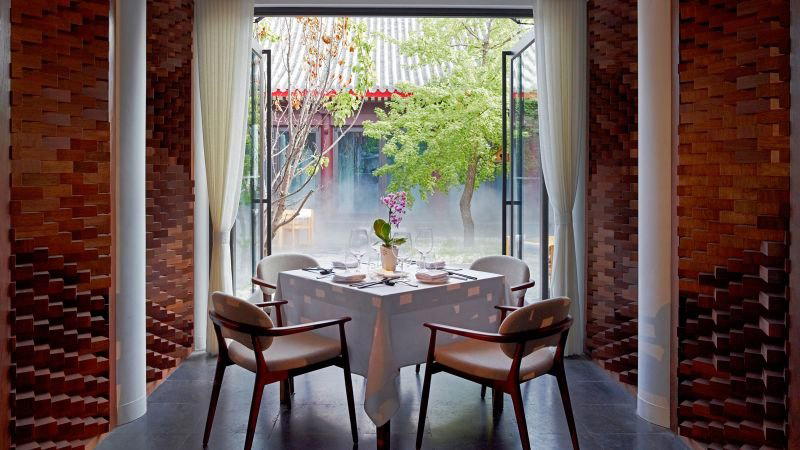
Majestic courtyard with terracotta soldiers, painted beams, red pillars, and elegant lighting creating an imperial yet modern atmosphere.