
Michelin Plate · Tatler Listed in Best Restaurants Asia-Pacific · Black Pearl 1 Diamond
Our verdict
A Michelin Plate and Black Pearl 1 Diamond recipient in consecutive years, Qu Lang Yuan occupies a Dongcheng hutong address and operates within Beijing's emerging tier of innovative Chinese restaurants. Priced at ¥¥¥, it sits one band below the city's most expensive fine-dining counters, offering a point of entry into the capital's creative Chinese cooking conversation without the full premium of its heavier-awarded neighbours.

Pearl is the En Primeur Club membership app, where members save venues, book tables and use the concierge.
The menu
What to order
- Foie liver truffle rice
- Stove roast lamb chops
- Tea beef
A Hutong Setting and the Weight of Dongcheng's Dining History
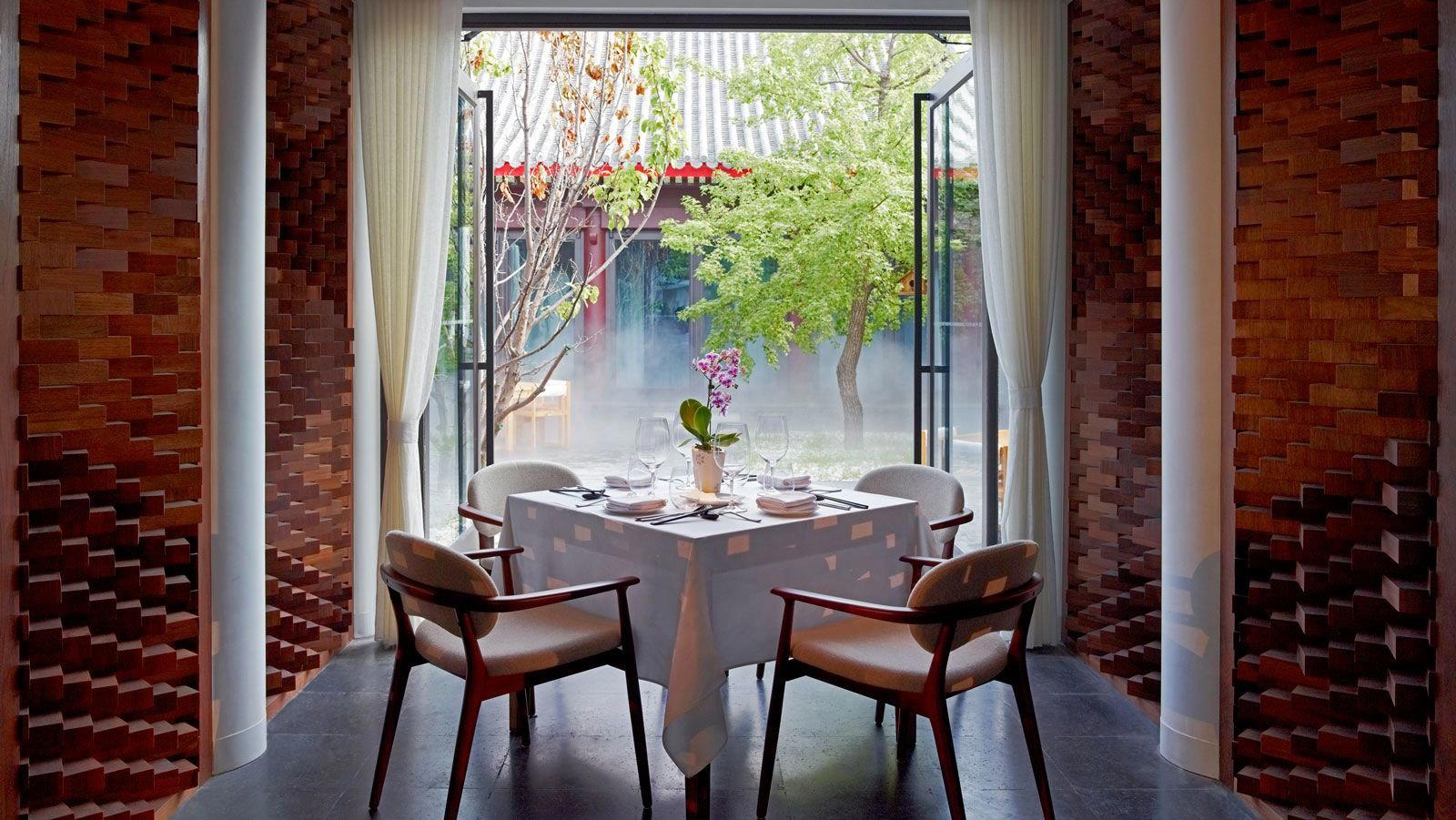
Dongcheng's hutong corridors have long operated as a counterpoint to Beijing's newer commercial dining districts. Where Chaoyang concentrates international hotel restaurants and high-volume banquet halls, the alleyways east of the Drum Tower and around Dongsishiyi Alley shelter a quieter, more considered tier of cooking. That geography matters: restaurants here tend to earn their audience through reputation and repeat custom rather than foot traffic, and the physical setting, narrow lanes, grey-brick courtyard transitions, the absence of illuminated signage competing for attention, exerts its own discipline on what happens inside.
Qu Lang Yuan sits at 25 Dongsishiyi Alley within that Dongcheng fabric. The address alone places it in a neighbourhood where the expectation, from a returning Beijing diner at least, is that the cooking will do the talking. The city's innovative Chinese restaurants have been quietly consolidating in exactly these kinds of locations over the past decade, as chefs working outside the classical Shandong or Cantonese canon found that hutong spaces allowed the kind of intimate, conversation-driven format their menus required.
The Innovative Chinese Category and What It Actually Means in Beijing
Beijing's restaurant awards scene has, for some years now, tracked a category that sits awkwardly in translation: innovative Chinese. In practice, it covers a broad and sometimes contradictory range, from restaurants applying European technique to native ingredients, to kitchens rereading classical imperial recipes through a modern lens, to chefs who reject inherited grammar almost entirely and build dishes from first principles. What unites them is a departure from the strict regional orthodoxies that govern most of the capital's serious dining.
That departure is harder to sustain in Beijing than in, say, Shanghai, where 102 House operates in a city more accustomed to culinary experimentation, or Hangzhou, where Ru Yuan can draw on Zhejiang's ingredient abundance and a dining culture with more appetite for novelty. Beijing's food identity is anchored to specific traditions, imperial court cooking, the Shandong backbone of northern Chinese cuisine, the roast duck institution, and restaurants that step outside those traditions carry a higher explanatory burden with local diners. The ones that earn sustained recognition tend to have found a coherent internal logic that Beijing audiences can follow even when the format is unfamiliar.
Two Years of Recognition and What the Awards Signal
Qu Lang Yuan received a Michelin Plate in both 2024 and 2025, with the Black Pearl 1 Diamond added in 2025. That combination is worth reading carefully. The Michelin Plate, awarded to restaurants with good cooking that fall below the star threshold, signals consistent quality without the complexity ceiling that star designation implies. The Black Pearl guide, operated by Meituan and calibrated specifically to Chinese dining contexts, applies different criteria, it weights Chinese culinary heritage and ingredient sourcing more explicitly than Michelin's framework. Receiving both in the same cycle suggests a restaurant that satisfies evaluators working from different starting assumptions, which is a harder outcome than it sounds.
For context within Beijing's innovative tier, this dual recognition places Qu Lang Yuan in a similar bracket to restaurants that have found a way to communicate innovation without alienating the award committees that still value technical discipline and ingredient integrity. Across the wider region, comparable recognitions have attached to restaurants like Chef Tam's Seasons in Macau and Imperial Treasure Fine Chinese Cuisine in Guangzhou, though both operate at different price points and within different culinary traditions. In the innovative category specifically, peers in other Asian cities include alla prima in Seoul and MAZ in Tokyo, both of which demonstrate how this category plays differently depending on the city's culinary baseline.
Where It Sits in Beijing's Price Architecture
At ¥¥¥, Qu Lang Yuan prices one band below several of its most-decorated Beijing neighbours. Xin Rong Ji (Xinyuan South Road), Chao Shang Chao in Chaoyang, Lamdre, and Jingji all operate at ¥¥¥¥. The price differential is meaningful for how you plan a Beijing dining itinerary: Qu Lang Yuan represents a point where Michelin and Black Pearl recognition overlaps with a more accessible spend, which is a relatively narrow space in any major city's fine-dining market.
That positioning also affects who the restaurant is actually competing for at the table. The ¥¥¥ innovative Chinese diner in Beijing is a slightly different audience from the ¥¥¥¥ one, more likely to be a younger domestic diner building their reference set, or an international visitor prioritising variety over single-table commitment. It is a sensible place to anchor an evening if the itinerary already includes a higher-spend lunch or if the visit to King's Joy, with its vegetarian-focused Chinese cooking at ¥¥¥¥, is already confirmed. The comparable Dai Yuet Heen in Nanjing and Xin Rong Ji in Chengdu serve as useful calibration points for what the regional market assigns to the ¥¥¥ and ¥¥¥¥ thresholds respectively.
The Evolution Question: From Neighbourhood Restaurant to Award Circuit Entry
The trajectory that Qu Lang Yuan's award history describes is one seen across Beijing's mid-tier innovative dining scene over the past five years. Restaurants that began as serious but locally-known operations have moved into the guide conversation through consistent kitchen performance rather than event-driven publicity. The Black Pearl addition in 2025, alongside the second consecutive Michelin Plate, suggests a restaurant that has found its register and is executing within it reliably rather than chasing novelty cycles.
That reliability, in the innovative category, is actually the harder thing to maintain. Restaurants in this space risk losing the recognition that comes from novelty if they consolidate too early, but also risk losing the recognition that comes from consistency if they reinvent too aggressively. The ones that manage both tend to be operating with a clear culinary proposition that allows for evolution within a recognisable framework, something the back-to-back Plate recognitions at Qu Lang Yuan appear to reflect, even without visibility into specific menu changes between cycles.
Know Before You Go
- Address: 25 Dongsishiyi Alley, Dongcheng, Beijing, 100010
- Cuisine: Innovative Chinese
- Price range: ¥¥¥
- Awards: Michelin Plate 2024 and 2025; Black Pearl 1 Diamond 2025
- Booking: Contact details not publicly listed, check current platforms or walk-in availability
- Neighbourhood: Dongcheng hutong district, accessible from Zhangzizhonglu subway station
Frequently asked questions
What type of food is Qu Lang Yuan known for?
What's Qu Lang Yuan known for in terms of accolades?
Qu Lang Yuan has received recognition including: Michelin Plate (2025); Black Pearl 1 Diamond (2025); Michelin Plate (2024).
What dish is Qu Lang Yuan famous for?
No specific signature dish has been documented in Michelin or Black Pearl award records for Qu Lang Yuan. The restaurant's classification as innovative Chinese, a category that broadly describes contemporary reinterpretation of regional Chinese cooking, suggests the menu prioritises technique and seasonal composition over fixed set pieces. At ¥¥¥ pricing, the kitchen is likely operating within a format where the selection shifts rather than anchoring around a single calling-card dish.
What's the pricing like at Qu Lang Yuan?
Pricing at Qu Lang Yuan is listed as ¥¥¥.
How do I find Qu Lang Yuan?
Qu Lang Yuan is located at 25 Dongsishiyi Aly, 25, Dongcheng, Beijing, China, 100010, Beijing.
Recognition Snapshot
A quick peer reference to anchor this venue in its category.
| Venue | Cuisine | Price | Awards | Notes |
|---|---|---|---|---|
| Qu Lang YuanThis venue (the venue you are viewing) | Modern Chinese Fine Dining | $200–300 | Michelin Plate · Tatler Listed in Best Restaurants Asia-Pacific | Not listed |
| Jing | Modern French with Asian Influences | $300–500 | 1 Michelin Star · Black Pearl 1 Diamond | French Contemporary |
| Xin Rong Ji (Xinyuan South Road) | Taizhou Chinese Fine Dining | $300–500 | 3 Michelin Stars · World's 50 Best #84 | Taizhou |
| Chao Shang Chao (Chaoyang) | Modern Teochew (Chaoshan) Fine Dining | $200–300 | Michelin Plate · La Liste Top Restaurants | Chao Zhou |
| Lamdre | Modern Plant-Based Chinese Vegetarian | Not listed | 2 Michelin Stars · World's 50 Best #17 | Vegetarian |
| Jingji | Imperial Beijing Royal Cuisine | $200–300 | 2 Michelin Stars · La Liste Top Restaurants | Beijing Cuisine |
Recognition history
Dated appearances from independent guides and award organizations, with the underlying list record or original source where available.
Michelin Plate
Michelin
Black Pearl 1 Diamond
Black Pearl
Tatler Listed in Best Restaurants Asia-Pacific
Tatler
Full recognition history (4 entries)
Michelin Plate
Michelin