Our verdict
Chao Bamboo occupies a quiet address in Jingumae, Shibuya, where the Omotesando grid gives way to narrower residential lanes. The kitchen sits at the intersection Tokyo does with growing confidence: indigenous Japanese produce handled through technique borrowed from elsewhere. Booking details and fuller context follow below.

Pearl is the En Primeur Club membership app, where members save venues, book tables and use the concierge.
The menu
What to order
- Bai Kapao
- Green Curry
Jingumae, Where the Grid Softens
The stretch of Jingumae that runs south of Omotesando's main axis is a different register from the boulevard itself. The retail spectacle thins out, the signage drops to street level, and the buildings shrink to two and three storeys. It is in this quieter residential-commercial overlap that Chao Bamboo occupies its address at 神宮前6-1-5, Shibuya. The neighbourhood has become a reliable location for restaurants that want proximity to Omotesando's foot traffic without its rents or its visibility pressure. That positioning is itself an editorial signal: kitchens that set up here tend to be betting on return guests and word-of-mouth rather than walk-in volume.
Tokyo's dining map in this part of Shibuya has organised itself around contrast. A few minutes north, Sézanne operates at the top of the French-in-Tokyo tier, drawing on classical brigade structure and imported cellar depth. Closer to Roppongi, L'Effervescence works a lighter, more botanically driven French register. Crony sits further into innovative-French territory. The pattern across all three is a willingness to treat Tokyo not as a satellite of European dining but as a source of raw material that European technique can illuminate differently. Chao Bamboo addresses that same intersection from its own angle.
The Case for Local Ingredients, Imported Method
Tokyo's most considered kitchens in the past decade have moved away from a direct division between washoku tradition and Western import. The more interesting question now is what happens when a cook trained in one tradition applies that rigour to produce that the tradition was never designed for. This is the productive tension that runs through a category of Tokyo restaurants that includes, in its kaiseki form, RyuGin, and in its sushi form, Harutaka. Both apply a discipline of attention to Japanese produce that is specific to the tradition they work in. The question Chao Bamboo poses is what that same quality of attention looks like when the culinary grammar is drawn from elsewhere.
Japan's ingredient network is, by any structural measure, among the most developed in the world. Prefectural agricultural identity is taken seriously at the distribution level, not just in marketing copy. A kitchen with access to that network and the technical vocabulary to use it purposefully is working with a significant advantage over a kitchen that imports both its produce and its methods. The restaurants making the most of this in Tokyo tend to be smaller operations where the sourcing decision is personal rather than delegated to a purchasing department.
Where It Sits in the City's Wider Dining Structure
Tokyo is not a single dining market. It contains several overlapping ones, organised by cuisine type, price tier, neighbourhood character, and the specific expectations guests bring to each. Jingumae and the surrounding Shibuya wards are home to a range of formats, from counter omakase at significant price points to neighbourhood bistros that run on regulars. The venues that survive in the middle of that range tend to have a clear identity proposition: they offer something that the Michelin-tracked, internationally discussed tier does not, usually lower formality, a more direct relationship between kitchen and table, and pricing that permits repeat visits.
Across Japan, the pattern holds beyond Tokyo. HAJIME in Osaka operates at the high-concept end of innovative Japanese. Gion Sasaki in Kyoto works within kaiseki tradition at a different register. akordu in Nara applies European wine culture to a Japanese dining context. Further afield, Goh in Fukuoka and affetto akita in Akita demonstrate that the local-ingredients-global-technique model has spread well beyond the capital. In Tokyo itself, the appetite for this approach has not peaked. It has simply become more granular, with each neighbourhood developing its own version of the formula.
The international frame of reference matters here too. Technique-led restaurants that work with local produce are not a uniquely Japanese phenomenon. Le Bernardin in New York built its authority on the rigorous application of classical French method to North Atlantic seafood. Lazy Bear in San Francisco operates a collaborative dinner format built on seasonal Californian produce. What makes the Tokyo version distinctive is the depth of Japan's ingredient infrastructure and the density of skilled kitchens competing within a relatively compact geography. Chao Bamboo operates in that environment, which raises the bar for what counts as serious sourcing and serious technique.
For a fuller orientation to where this venue sits within the capital's dining structure, our full Tokyo restaurants guide maps the field by neighbourhood, cuisine, and price tier. Regional depth is available through individual guides for venues including Abon in Ashiya, Aji Arai in Oita, Ajidocoro in Yubari District, Akakichi in Imabari, and aki nagao in Sapporo.
Know Before You Go
Address: 神宮前6-1-5, 渋谷区, 東京都, 150-0001
Neighbourhood: Jingumae, Shibuya, Tokyo
Nearest station: Meiji-Jingumae (Harajuku) on the Tokyo Metro Chiyoda and Fukutoshin lines is the closest access point for this part of Jingumae; the walk is short.
Booking: Direct enquiry at the venue or through a hotel concierge with local relationships is the most reliable route.
Pricing: Given the neighbourhood and the venue's positioning, cross-referencing with similarly sized Jingumae operations before visiting is advisable.
Hours: Verify before travel.
Dress code: Not confirmed. Smart casual is a reasonable baseline for this part of Shibuya.
Questions Visitors Ask
- What is the signature dish at Chao Bamboo?
- The editorial angle suggested by the venue's address and positioning in Jingumae points toward a kitchen working with Japanese produce through a technique set drawn from outside the traditional washoku canon, but confirmed menu specifics require direct contact with the venue. For comparable kitchens with documented menus, Crony and L'Effervescence offer useful reference points for innovative and French-inflected cooking in Tokyo.
- Do I need a reservation for Chao Bamboo?
- In Tokyo generally, smaller Jingumae and Shibuya restaurants operating at this address scale tend to be reservation-preferred rather than walk-in venues, particularly for dinner. Given that no online booking platform is confirmed, direct contact or concierge assistance is the practical approach. Planning ahead by at least one to two weeks is a reasonable default in this part of the city.
- What is Chao Bamboo leading at?
- The venue's position in Jingumae places it in a neighbourhood that supports kitchens with a clear cuisine identity and a local-regular guest base. For Tokyo kitchens with documented and reviewed strengths in specific areas, Harutaka leads in sushi and RyuGin in kaiseki.
- Is Chao Bamboo allergy-friendly?
- In Tokyo more broadly, kitchens that work with set or tasting formats can often accommodate dietary requirements when given advance notice, but this varies by operation. Where no website or phone number is confirmed, a hotel concierge with local contacts is the most reliable channel for this kind of pre-visit clarification.
- How does Chao Bamboo fit into Tokyo's broader Asian-influenced dining scene, and what should a first-time visitor expect from the format?
- The name Chao Bamboo, with its Chinese phonetic reference alongside a Jingumae address, suggests a kitchen operating somewhere in the territory where Asian culinary traditions other than Japanese meet Tokyo's ingredient infrastructure. This is a distinct and growing register in the city, separate from both orthodox Japanese formats and the French-inflected fine dining tier. A first visit is leading approached with flexibility around format expectations: Tokyo restaurants in this neighbourhood that draw on broader Asian technique sets often operate in smaller rooms with shorter menus, and the experience rewards attention to the sourcing detail rather than a pre-set expectation of any single national cuisine.
Side-by-Side Snapshot
Comparable venues nearby, for context on price, style, and recognition.
| Venue | Cuisine | Price | Awards | Notes |
|---|---|---|---|---|
| Chao Bamboo (チャオバンブー)This venue (the venue you are viewing) | Authentic Thai Street Food | $10–20 | Not listed | Not listed |
| 泉州屋台 | Thai Street Food | $10–20 | Not listed | Shibakoen |
| Thai Gohan Sensyu Yatai | Authentic Thai Street Food | $10–20 | Not listed | Shibakoen |
| Hasu no Sato Shin okachimachi honten | Authentic Thai & Curry House | $30–50 | Tabelog 100 #88 | Taitō |
| ソムタムダー | Authentic Isan (Northeastern Thai) Cuisine | $20–30 | Not listed | Shibuya |
| ソムタムダー | Authentic Isan (Northeastern Thai) Cuisine | $20–30 | Not listed | Yoyogi, Shibuya-ku |
Continue exploring
More in Tokyo
Restaurants in Tokyo
All restaurants in Tokyo →



Bars in Tokyo
All bars in Tokyo →






Details
- Cozy
- Trendy
- Casual Hangout
- Date Night
- Open Kitchen
- Sake Program
- Street Scene
- A La Carte
- Beer Program
- Vegetarian Friendly
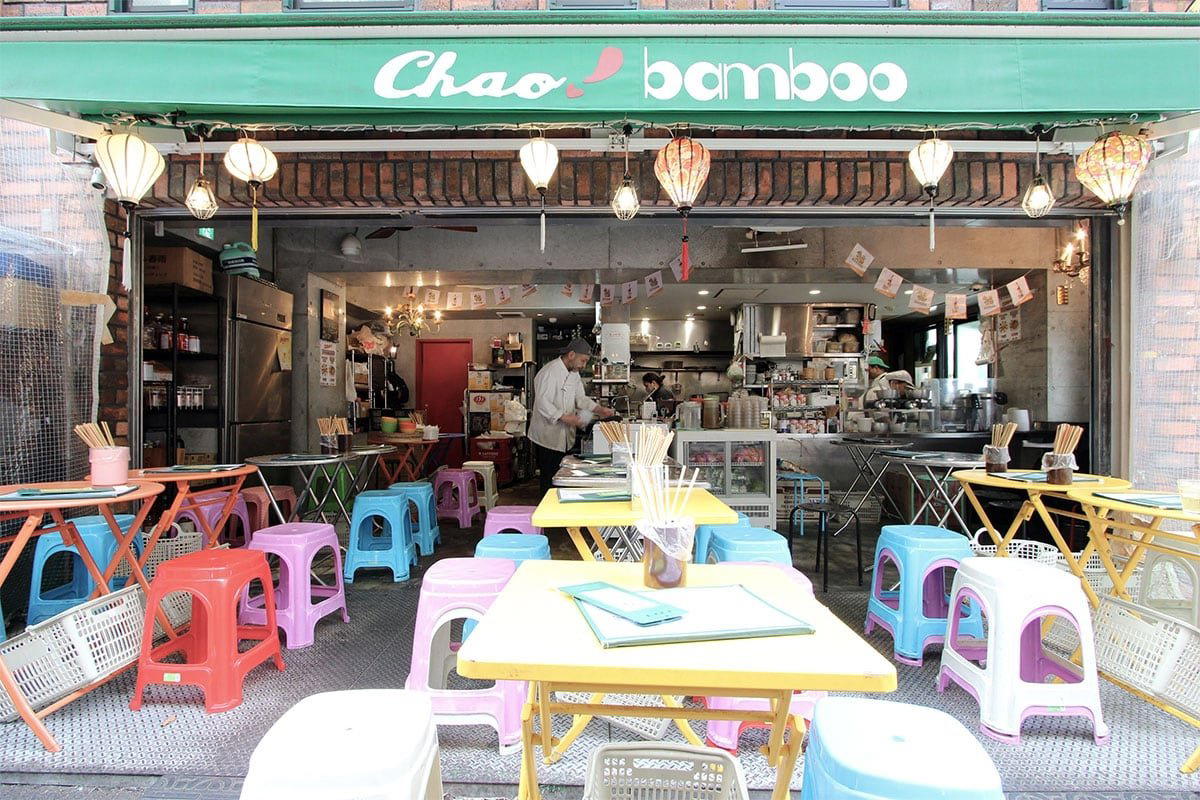
Casual, rugged street stall atmosphere with metal tables, mismatched furniture, and an open front to the street.