满饭记烤肉 sits on Ping'anli West Street in Beijing's Xicheng District, placing it in one of the capital's most historically layered neighbourhoods. The restaurant focuses on the live-fire tradition that has defined Beijing's meat-roasting culture for centuries. For visitors tracing the city's older culinary character, this address is a considered stop.
Pearl is the En Primeur Club membership app — saves, bookings, and concierge access live there. Same editors, same standards.
- Address
- Ping'anli W St, Xicheng District, Beijing, China, 100033
- Phone
- +861066126825
- Directions
- Get directions
 Saves & bookings on Pearl
Fire, Smoke, and the Weight of Xicheng's Streets
Ping'anli West Street does not announce itself the way Sanlitun or the hutong clusters around Nanluoguxiang do. It moves at a different pace: broader, quieter in a civic rather than residential sense, carrying the administrative and historical gravity that defines much of Xicheng District. Walking this stretch in autumn or early winter, when Beijing's dry cold sharpens the air and coal smoke still drifts from older courtyard buildings nearby, you understand why live-fire cooking took such a hold in this city. The smell of charcoal and rendered fat is not incidental here, it is part of a sensory register that Beijing has maintained for generations. 满饭记烤肉 occupies a position on this street that connects it to that longer tradition, whatever the specifics of its current format.
Beijing's Roast Meat Tradition and Where It Sits Today
Chinese barbecue in Beijing is not a single category. The city's roasting culture divides between the imperial-inflected whole-animal traditions, the Korean-influenced tabletop grilling that spread through the 1990s and 2000s, and the older northern Chinese style of 烤肉 (kǎoròu) that preceded both, where lamb or beef is cooked over iron grates above charcoal, often with scallion, cumin, and fermented sauces as the primary flavour architecture. That last tradition, rooted in Beijing's relationship with Inner Mongolian supply chains and northern steppe foodways, is the one most easily obscured by more photogenic or internationally legible formats. It is also the one with a direct claim on what Beijing's pre-restaurant food culture actually tasted like.
Within Beijing's current dining tier structure, the ¥¥¥¥ bracket occupied by nearby addresses like Xin Rong Ji (Xinyuan South Road), Chao Shang Chao (Chaoyang), and Lamdre reflects a formalized, often highly curated approach to Chinese dining. Roast meat venues tend to operate in a different register, less ceremony around plating, more attention to fire management, sourcing of the cut, and the temperature at which the meat arrives at the table. That informality is not a weakness in the category; it is the point. The leading roast meat in Beijing is judged by the quality of char on the exterior and the moisture retained in the interior, not by the refinement of its presentation.
The Sensory Logic of a Roast Meat Room
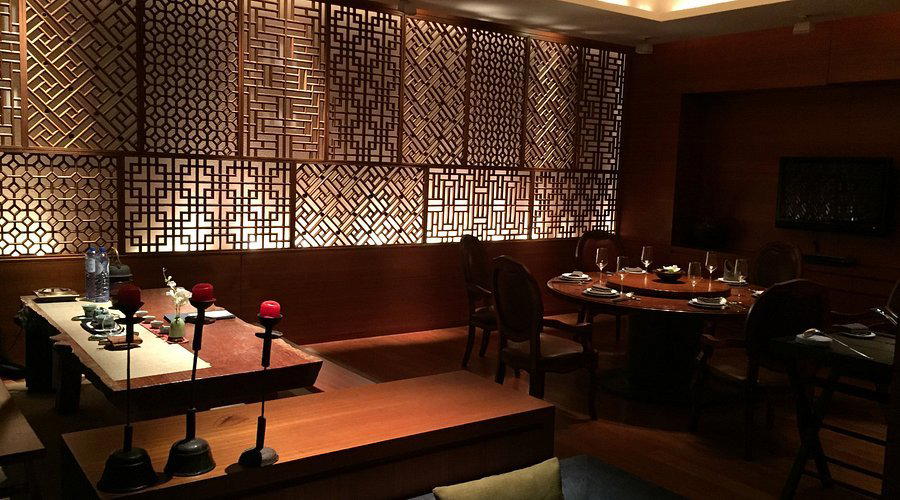
A serious 烤肉 room in Beijing has a specific atmosphere: ventilation hoods that hum above charcoal grates, the faint haze that settles at shoulder height as the evening progresses, the sound of fat hitting hot metal, and the particular rhythm of a table managing its own fire. This is participatory dining in the oldest Chinese sense, the cooking does not end in the kitchen. Diners rotate, press, and time cuts themselves, which means the skill of the diner becomes part of the outcome. That transfer of agency from kitchen to table is a defining characteristic of the format, and it explains why roast meat venues attract a loyal, repeat-heavy clientele rather than the one-time occasion crowd that gravitates toward formal tasting menus.
For context on how Beijing's more formal Chinese dining rooms approach atmosphere and sensory design, addresses like Jingji and King's Joy represent the quieter, more controlled end of the spectrum, spaces where sound is managed, smoke is absent, and the aesthetic is closer to a gallery than a grill. 满饭记烤肉 operates on the opposite axis, where the energy of the fire and the noise of a full room are features rather than drawbacks.
Xicheng District and the Case for Eating Here
Xicheng is Beijing's most intact historical district in an administrative sense, it contains the Drum Tower axis, the former imperial lakes at Shichahai, and the dense hutong grids that survived the broader demolitions of the late twentieth century. Dining in Xicheng carries a different cultural weight than eating in Chaoyang, where most of Beijing's internationally recognized fine dining has concentrated. The neighbourhood's resident population skews older and more rooted in Beijing's actual culinary habits, which means the restaurants that sustain themselves here tend to serve food that local diners return to weekly rather than food designed to impress a foreign press trip.
That dynamic shapes what Ping'anli West Street supports. The street's mix of neighbourhood staples and mid-range specialists reflects a dining culture that prioritizes consistency and value over spectacle. A roast meat address in this context is legible as a local institution rather than a destination concept, and that distinction matters when assessing what kind of experience to expect.
Roast Meat in the Wider Chinese Dining Picture
Beijing's roast meat tradition has counterparts across China's live-fire canon. The vegetable-centred fire disciplines at Fu He Hui in Shanghai and the refined Hangzhou approach at Ru Yuan in Hangzhou demonstrate how fire and heat are handled across regional traditions with different aesthetic goals. At the more ceremonial end, Chef Tam's Seasons in Macau shows how Cantonese roasting technique gets recalibrated for a high-formality context. None of those comparisons diminish the northern Chinese roast meat tradition, they clarify what is specific about it: directness, intensity, and the absence of mediation between fire and protein.
Further along the eastern seaboard, venues like Pingjiangsong in Suzhou, Wenru No.9 in Fuzhou, and Fleurs Et Festin in Xiamen illustrate how Chinese regional dining is formalizing across price tiers and presentation styles. Beijing's roast meat category sits largely outside that formalization trend, which is precisely what gives it cultural staying power. For visitors building a wider picture of China's dining scene, our full Beijing restaurants guide maps the city's categories against each other.
Planning Your Visit
Ping'anli West Street is accessible via the Ping'anli station on Line 19 or via the older Line 4 stop at Xinjiekou, a short walk west. The neighbourhood is best approached in the late afternoon and evening, when roast meat venues operate at full capacity and the street's character is most readable. Autumn and early winter are the seasons when this style of cooking works well in Beijing, cold air outside, charcoal heat at the table, and a menu built around the kinds of fat-marbled cuts that perform leading over high, direct heat. Spring visits are quieter and the neighbourhood is pleasant to walk before or after a meal, particularly around the Shichahai lake edges a few minutes north.
Given the sparse public data on 满饭记烤肉's specific hours, booking policy, and current menu, confirming current operating details directly before visiting is sensible. Roast meat venues in this part of Xicheng typically fill quickly on weekend evenings and can run shorter hours than their posted schedules suggest during public holidays.
Comparable Venues
Comparable venues nearby, for context on price, style, and recognition.
| Venue | Cuisine | Price | Notes |
|---|---|---|---|
| 满æè®°ç«éThis venue — the venue you are viewing | Chinese Fire Grill | $ | Not listed |
| 采逸轩 | chinese | $ | Sanlitun |
| Zhenziwei seafood restaurant | Hong Kong-Style Seafood Congee Hot Pot | $$ | Sanlitun |
| Kong Yiji | Traditional Zhejiang / Shaoxing Cuisine | $$ | Dianmen |
| FuRong Hu'nan Cuisine by Rong | Upscale Hunan cuisine by Xin Rong Ji | $$$ | Xicheng |
| Quanjude Roast Duck Restaurant | Traditional Peking Duck | $$$ | Wangfujing |

At a Glance
- Casual Hangout
- Open Kitchen
Cozy atmosphere focused on the grilling experience