


A three-Michelin-star kaiseki counter in Shimanouchi, Osaka, Taian operates on a philosophy that mirrors the tea ceremony: confined space, boundless depth. Chef Hitoshi Takahata's cooking earned 92 points from La Liste in 2025 and has held three stars since at least 2024. It sits in the same Japanese-tradition tier as Kashiwaya Osaka Senriyama, but at a lower price point than Koryu.
 Discover on Pearl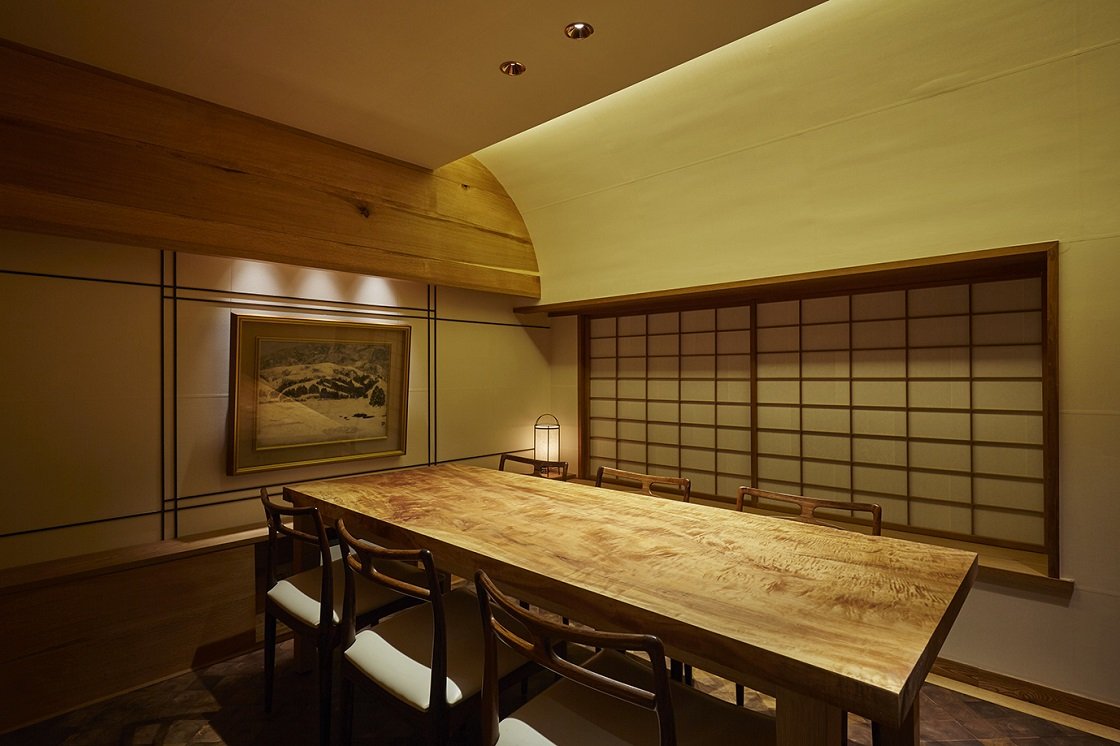
Small Room, Long Tradition
Osaka's three-Michelin-star restaurants fall into two distinct camps. The first is defined by French technique imported into Japanese ingredients: HAJIME (French, Innovative) and La Cime (French) both hold three stars and price at ¥¥¥¥. The second camp holds to classical Japanese form, where the discipline of kaiseki, not culinary cross-pollination, is the organizing principle. Taian belongs to that second group and prices at ¥¥¥, a tier below the French-influenced contingent and broadly aligned with Kashiwaya Osaka Senriyama (Japanese).
The address is Shimanouchi, a narrow pocket of Chuo Ward that sits between the commercial density of Namba and the quieter residential lanes running south. From the street, the building offers little announcement. The name on the facade, the modest scale of the entrance, and the ground-floor setting in an otherwise unremarkable structure all signal that nothing here is designed to impress before you walk through the door. That restraint is the first statement Taian makes, and it is a considered one.
The shortlist, unlocked.
Hard-to-book tables, cellar releases, and concierge-planned trips.
Get Exclusive Access →The name itself carries the meaning: taian translates roughly as "big hut," a deliberate invocation of the aesthetic logic behind the tea ceremony room, in which material reduction is understood to create rather than diminish space. La Liste, which awarded Taian 92 points in its 2025 rankings and 91 points in 2026, described this quality directly: "recalling the apparent paradox of the tea ceremony, in which a small, spare space is made to feel boundless."
Ingredients as Argument
Kaiseki in its classical form is not a showcase for technique alone. It is a discipline organized around seasonal raw materials, where the cook's primary obligation is to select produce, fish, and proteins at the precise moment of their leading expression and to apply only as much technique as each ingredient requires. The most skilled practitioners know when to hold back entirely.
This ingredient-forward logic runs through kaiseki at every price tier, but it becomes most legible in restaurants where the room is small and the menu is short enough that nothing can be hidden by abundance or distraction. Taian's format enforces that clarity. The cosy, clean interior described by La Liste places the food in a context where a single piece of produce or a precisely made dashi carries the full weight of the course.
Dashi is the structural element that most separates Japanese cooking from any tradition that tries to approximate it from outside. At the three-star level in Osaka and Kyoto, the quality of kombu sourced from Hokkaido, the grade of katsuobushi, and the ratio of cold-draw to hot-infuse are treated with the same precision a French kitchen applies to its fond. What arrives as broth at a kaiseki counter of this calibre is not background liquid; it is the argument the kitchen is making about the season.
Osaka's position within Japanese gastronomy has long been defined by its market culture. The Kuromon Ichiba market, a few minutes' walk from Shimanouchi, supplies some of the densest concentration of high-grade fish, produce, and tofu in the Kansai region. Proximity to that infrastructure is not incidental for restaurants working at this level. Access to suppliers who move daily product at volume and quality gives Osaka's kaiseki kitchens a logistical advantage that restaurants in smaller cities have to work harder to replicate.
Where Taian Sits in the Kaiseki Tier
Comparing kaiseki counters across Japan at the three-star level reveals a range of approaches. Hyotei in Kyoto operates within a centuries-old tradition and a very different spatial register. RyuGin in Tokyo has consistently applied more interpretive pressure to classical forms. Gion Sasaki in Kyoto represents another strand of Kansai kaiseki operating at the highest award level.
Within Osaka specifically, the kaiseki peer set includes Koryu and Masuda, both of which carry Michelin recognition and operate within the Kaiseki, Japanese category. Koryu prices at ¥¥¥¥, which places Taian in a different bracket despite their shared genre, making Taian the point of entry for three-star kaiseki in the city if budget is a planning factor.
Opinionated About Dining, which aggregates critical opinion through a different methodology than Michelin, ranked Taian at 204th in Japan in 2025 and 191st in 2024. In a country with the density of rated restaurants that Japan carries, a ranking in the top 200 nationally represents a specific position in a very competitive field. The slight downward movement between 2024 and 2025 in the OAD ranking, while Michelin held at three stars through both years, reflects the different weighting those two systems apply to frequency of critic visits, peer opinion, and the specific genre being evaluated.
Chef Hitoshi Takahata and the Kitchen's Stance
Chef Hitoshi Takahata's name appears consistently across Taian's award citations, but the editorial frame worth holding here is not the biography: it is what his kitchen's output implies about where the restaurant places itself on the spectrum between classical fidelity and personal expression. La Liste's description of cuisine that "crystallises skill and passion" while maintaining "contrast between outward appearance and inner content" suggests a kitchen that is not pursuing novelty. The cooking is in conversation with a tradition, not departing from it.
That stance places Taian in a specific peer group when thinking about kaiseki beyond Osaka. Goh in Fukuoka, akordu in Nara, and 1000 in Yokohama each represent different regional responses to the same question: what does high-level Japanese cooking look like when it is grounded in a specific place rather than aspiring to a universal standard? Taian's answer is rooted in Osaka, in Shimanouchi, in the particular discipline of the tea-ceremony aesthetic.
For comparison outside the Kansai region, Harutaka in Tokyo operates at a comparable award level in a different Japanese genre, which helps calibrate what three-star recognition means across format types. And 6 in Okinawa represents the furthest geographic edge of high-level Japanese dining, where ingredient sourcing takes on an entirely different character.
Planning Your Visit
Taian is open Tuesday through Sunday, with service from 5:30 pm to 10 pm. Monday is the weekly closure. The address places it in Shimanouchi, Chuo Ward, within walking distance of the Namba and Shinsaibashi areas and accessible via Osaka Metro's Midosuji and Sennichimae lines. Budget: ¥¥¥, which positions this as the more accessible of Osaka's three-star options relative to ¥¥¥¥-tier peers. Reservations: Booking method is not confirmed in available data; at this award level and with a small-room format, securing a table well in advance is standard practice across comparable Japanese counters. Hours: Tuesday to Sunday, 5:30–10 pm; closed Monday. Phone and website: not listed in current venue data; direct outreach via a hotel concierge or a specialist Japan dining reservation service is the most reliable path.
For the broader context of dining in Osaka, see our full Osaka restaurants guide. For accommodation planning, our full Osaka hotels guide covers the range from international-brand properties to smaller design hotels. Drinking and nightlife options are mapped in our full Osaka bars guide, and the city's broader experiential programming is covered in our full Osaka experiences guide. Wine-focused visitors can find relevant venues in our full Osaka wineries guide.
Japan, 〒542-0082 Osaka, Chuo Ward, Shimanouchi, 1 Chome−21−2 山本松ビル 1f 中央
+81 6-6120-0790
A Lean Comparison
A small peer set for context; details vary by what’s recorded in our database.
| Venue | Notes | Price |
|---|---|---|
| Taian | This venue | ¥¥¥ |
| HAJIME | French, Innovative, ¥¥¥¥ | ¥¥¥¥ |
| La Cime | French, ¥¥¥¥ | ¥¥¥¥ |
| Kashiwaya Osaka Senriyama | Japanese, ¥¥¥ | ¥¥¥ |
| Fujiya 1935 | Innovative, ¥¥¥¥ | ¥¥¥¥ |
| Koryu | Kaiseki, Japanese, ¥¥¥¥ | ¥¥¥¥ |
Need a table?
Our members enjoy priority alerts and concierge-led booking support for the world's most difficult tables.
Get Exclusive AccessThe shortlist, unlocked.
Hard-to-book tables, cellar releases, and concierge-planned trips.
Get Exclusive Access →