

Michelin Bib Gourmand · Wine Spectator Award of Excellence
Our verdict
Wilde Klosterküche brings farm-to-table cooking to the small Brandenburg town of Neuzelle, operating at the €€ price tier with a focus on seasonal, regionally sourced ingredients under chef Manuel Bunke. It represents a quieter, produce-driven strand of German dining that sits well outside the country's high-profile fine dining circuit.

Pearl is the En Primeur Club membership app, where members save venues, book tables and use the concierge.
The menu
What to order
- Beetroot with goat cheese
- Celery soup
- Corn poularde
A Monastery Town, a Farm Kitchen
Neuzelle is not a dining destination in the conventional sense. The small Brandenburg town, anchored by its Cistercian monastery complex, draws visitors for its Baroque architecture and the surrounding Oder lowlands rather than its restaurant scene. In a region where serious cooking is more likely to require a drive to Berlin or Cottbus, a kitchen working at this level of discipline draws attention for what it says about the broader shift in German provincial dining.
The farm-to-table format has become one of the more contested categories in European cooking over the past decade. At its worst, the label is marketing shorthand for a salad with a local cheese. At its most serious, it represents a genuine renegotiation of supply chains, seasonal constraints, and what a kitchen actually owes to the land around it. Wilde Klosterküche operates in the latter register, with chef Manuel Bunke shaping a menu around ingredients that reflect the agricultural character of the Oder-Neisse region rather than defaulting to the standardised produce networks that supply most mid-market European restaurants.
Where Bunke's Cooking Sits in the German Picture
Germany's fine dining tier has consolidated around a small number of intensely recognised addresses. CODA Dessert Dining in Berlin represents a further creative extreme within that category. Wilde Klosterküche is priced two tiers below those addresses, at €€, which in German restaurant terms suggests a two-course meal in the €40 to €65 range. That price point is not a compromise; it is a different proposition entirely, one where the value argument rests on ingredient sourcing and cooking clarity rather than on luxury product or theatrical presentation.
The farm-to-table strand of German cooking has a smaller but increasingly coherent peer group. BOK Restaurant Brust oder Keule in Münster and Clostermanns Le Gourmet in Niederkassel represent comparable efforts to anchor a kitchen's identity in regional supply and seasonal discipline. What distinguishes the Neuzelle example is its location: a town with fewer than 2,000 residents, where running a kitchen of this type requires either a very committed local audience or enough regional draw to pull visitors from Frankfurt an der Oder and beyond.
The Kitchen's Approach to Lunch and Dinner
Wilde Klosterküche serves both lunch and dinner, which in a town this size is itself a meaningful operational commitment. Farm-to-table kitchens in rural European contexts frequently operate on restricted schedules, either because supply logistics make daily service difficult or because the local population cannot sustain full-week covers. A kitchen running both meal services signals either a strong tourism contribution from the monastery complex or a level of local loyalty that has stabilised the business over time.
The Irish strand within a German kitchen is an unusual combination, one that points toward an interest in specific preparation traditions rather than a fusion approach. Irish cooking at its most disciplined centres on meat quality, root vegetables, and slow cooking methods that reward good primary ingredients. Applied to a Brandenburg context, where game, river fish, and late-summer produce are the natural materials, that approach has real internal logic.
The Wine List as a Planning Tool
The wine program at Wilde Klosterküche runs to 350 selections and 1,500 bottles in inventory, figures that are substantially larger than what the €€ price tier and the town's scale would lead most visitors to expect. The list's acknowledged strengths are France and Italy, and pricing is described as mid-range, with a range of options across price points. For a restaurant of this size in a rural Brandenburg setting, a list of this depth suggests a serious investment in the wine side of the operation, one that positions the venue as a destination for wine-oriented diners rather than simply a local dining option.
Eric Arens and Marcelo Grandin share sommelier responsibilities, which is another signal of operational seriousness. Dual sommelier coverage at the €€ tier in a small-town setting is uncommon, and it implies either a high volume of covers that requires the staffing, or a level of service ambition that exceeds what the price tier strictly demands. Either reading reflects well on the overall program. Guests looking to work through the French or Italian sections of the list would do well to book well in advance, particularly for weekend dinner service, as cover capacity in venues of this type tends to be limited.
Neuzelle as a Dining Context
Visitors to Neuzelle have limited options outside Wilde Klosterküche at this level of cooking. The town's draw is primarily cultural, centred on the Cistercian monastery, and most visitors arrive for a half-day or full day before returning to Frankfurt an der Oder or continuing along the Oder valley. A meal at Wilde Klosterküche extends a Neuzelle visit into a fuller day, and the lunch service in particular makes sense as part of a monastery visit itinerary. For those planning a longer stay in the region, our full Neuzelle hotels guide covers accommodation options nearby, and our Neuzelle bars guide covers where to continue an evening after dinner.
Brandenburg's dining scene, outside Berlin, remains relatively thin at the level Wilde Klosterküche is attempting. Visitors travelling through the eastern German corridor who want serious cooking outside the capital tend to route toward JAN in Munich or Restaurant Haerlin in Hamburg for higher-end options, or toward addresses like Schanz in Piesport, Waldhotel Sonnora in Dreis, Victor's Fine Dining by Christian Bau in Perl, Bagatelle in Trier, and ES:SENZ in Grassau for regional fine dining. Within that wider picture, Wilde Klosterküche is doing something different: placing serious cooking in a location that would not ordinarily support it, at a price point that keeps it accessible. For the full picture of what Neuzelle offers, our Neuzelle restaurants guide covers the broader options, and our Neuzelle experiences guide and wineries guide round out the planning picture for a regional visit.
Practical Details
Wilde Klosterküche is at Bahnhofstraße 18, 15898 Neuzelle. The restaurant is within walking distance of the Neuzelle railway station, which connects to Frankfurt an der Oder with regional rail services. The €€ price tier suggests a two-course meal in the €40 to €65 range before wine. The wine list's 1,500-bottle inventory and mid-range pricing structure make it a reasonable choice for wine-focused diners, with French and Italian selections as the recognised strengths of the program.
Frequently asked questions
Is Wilde Klosterküche good for families?
At the €€ price tier, a meal for a family of four will typically fall in the €160 to €260 range before wine, which is moderate by German restaurant standards. Neuzelle is a small, quiet town with a cultural draw that suits mixed-age groups, and a farm-to-table kitchen with European cooking tends to offer accessible flavours alongside more considered preparations. The combination of relaxed regional setting and mid-range pricing makes the venue a plausible choice for families visiting the monastery complex who want a proper sit-down meal rather than a café stop.
What is the atmosphere like at Wilde Klosterküche?
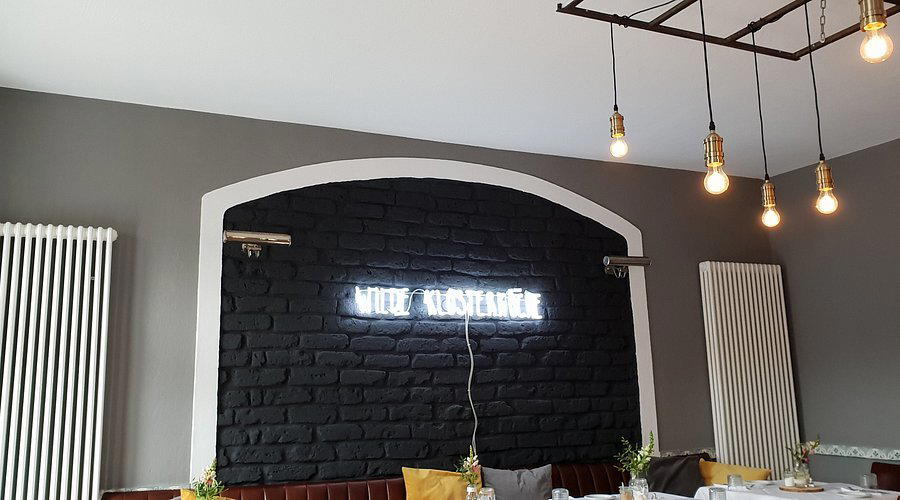
The venue's name, which translates roughly as Wild Monastery Kitchen, signals something about its character: a connection to the historic monastery setting of Neuzelle, combined with a farm-forward cooking approach that implies informal energy rather than stiff formality. The €€ price tier and regional location suggest a relaxed, ingredient-focused room rather than a formal dining environment.
at Wilde Klosterküche?
In practical terms, that points toward ordering whatever protein or vegetable preparation reflects the current season most directly. Visitors who engage with the sommelier team, Eric Arens and Marcelo Grandin, on wine pairing are likely to get more from the 350-selection list than those who order independently.
Quick Comparison
| Venue | Cuisine | Price | Awards | Notes |
|---|---|---|---|---|
| Wilde KlosterkücheThis venue (the venue you are viewing) | Modern German Farm-to-Table | $50–100 | Michelin Bib Gourmand · Wine Spectator Award of Excellence | Not listed |
| Schwarzwaldstube | Modern French Fine Dining | $150–200 | 3 Michelin Stars · World's 50 Best #47 | French, Classic French |
| Aqua | Contemporary German, Italian/Japanese, Creative | Not listed | Michelin 3 Star | Not listed |
| CODA Dessert Dining | Dessert-Inspired Fine Dining | $200–300 | 2 Michelin Stars · World's 50 Best #79 | Creative |
| Tantris | Modern French, French Contemporary | Not listed | Michelin 2 Star | Not listed |
| Vendôme | Modern German Haute Cuisine | $200–300 | 2 Michelin Stars · World's 50 Best #47 | Modern European, Creative |
Recognition history
Dated appearances from independent guides and award organizations, with the underlying list record or original source where available.
Michelin Bib Gourmand
Michelin
Wine Spectator Award of Excellence
Wine Spectator
Full recognition history (4 entries)
Michelin Bib Gourmand
Michelin
Michelin Plate
Michelin
Continue exploring
More in Neuzelle
Restaurants in Neuzelle
All restaurants in Neuzelle →
Wineries in Neuzelle
Browse all →
Wilde Klosterküche
The wine
Wilde Klosterküche holds the Wine Spectator Award of Excellence, which Wine Spectator gives to lists of usually 90 or more selections.
- Wine Spectator
- Wine Spectator Award of Excellence
- Selections
- 350
- Bottles in cellar
- 1,500
- List strengths
- France, Italy
- Craft cocktails
Details
- Cozy
- Elegant
- Rustic
- Modern
- Date Night
- Special Occasion
- Open Kitchen
- Terrace
- Historic Building
- Craft Cocktails
- Farm To Table
- Local Sourcing
- Set Menu
- A La Carte
- House Made Gin
- Vegetarian Friendly
- Vegan Options
Current opening hours
- Monday
- Closed
- Tuesday
- Closed
- Wednesday
- 5–10 PM
- Thursday
- 5–10 PM
- Friday
- 5–10 PM
- Saturday
- 5–10 PM
- Sunday
- Closed
Hours can change for holidays and private events. Hours as of .
Chic, modern, and laid-back decor with an open kitchen view and charming terrace.