Positioned on Schönhauser Allee in Berlin's Prenzlauer Berg district, Wen Cheng sits within a neighbourhood where the city's appetite for serious Asian dining has quietly grown.
Pearl is the En Primeur Club membership app — saves, bookings, and concierge access live there. Same editors, same standards.
- Address
- Schönhauser Allee 10, 10119 Berlin, Germany
- Website
- wenchengnoodles.de
- Directions
- Get directions
 Saves & bookings on Pearl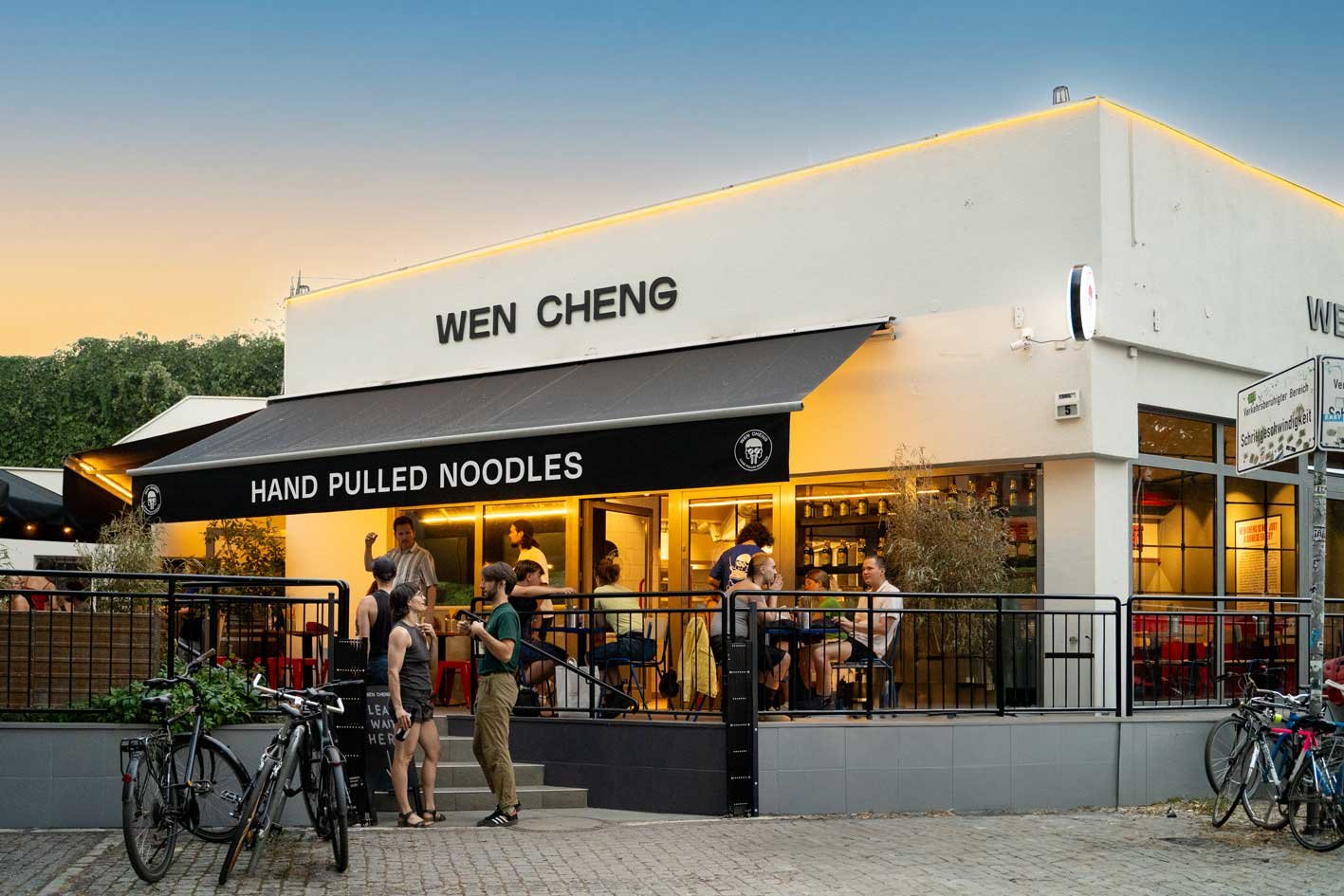
Prenzlauer Berg and the Quiet Growth of Serious Asian Dining in Berlin
Berlin's fine dining conversation has long centered on the Michelin-tracked German and European kitchens that cluster around Mitte and Kreuzberg: Rutz, Nobelhart & Schmutzig, FACIL, CODA Dessert Dining. These are the names that fill the shortlists and shape the plans of visitors arriving with serious intentions. What the same conversation underrepresents is the quieter tier of restaurants operating in residential neighbourhoods. Wen Cheng, at Schönhauser Allee 10 in Prenzlauer Berg, is a restaurant serving hand-pulled Chinese noodles.
Prenzlauer Berg is not a dining district in the way Mitte is. It is a residential area with a historically bohemian character, one that has gentrified substantially since reunification and now supports a dining scene that reflects the neighbourhood's demographic: international, food-aware, and broadly resistant to the kind of theatrical fine dining that earns column inches elsewhere. Restaurants here succeed on repeat local custom, which changes how they are positioned and how they operate. In a city where Restaurant Tim Raue has demonstrated that Asian-influenced kitchens can operate high on Berlin's culinary hierarchy, the space below that tier remains largely unmapped by the major guides.
What the Address Tells You Before You Arrive
Schönhauser Allee is one of Prenzlauer Berg's main arteries, running northeast from Rosa-Luxemburg-Platz through the heart of the district. It is a street of layered use: ground-floor retail and restaurants beneath residential blocks, with the U-Bahn tracks of the U2 line running overhead for part of its length. The built environment is distinctly East Berlin in character, with pre-war Gründerzeit facades sitting alongside post-war infill. Arriving here for dinner is not like arriving at a destination restaurant in a converted warehouse or a hotel dining room. The street is active and ordinary, and the experience of finding and entering a restaurant on it is scaled accordingly.
For a diner approaching Wen Cheng for the first time, that context matters. This is not a room that announces itself. The neighbourhood sets an expectation of local familiarity over visitor theatrics, which tends to attract a specific kind of guest: one who already knows where they are going and why. In Berlin's dining geography, that positioning places Wen Cheng in a different competitive frame than the hotel-anchored rooms or concept-driven tasting counters that court the destination diner.
Planning a Visit: What to Know Before You Go
The restaurant is walk-in friendly, and its hours are Mon: Closed; Tue to Fri: 5 to 10 PM; Sat and Sun: 12 to 3 PM and 5 to 10 PM. This is not unusual for smaller independent operators in Berlin, where a significant portion of the restaurant population relies on walk-in trade, word of mouth, or Google Maps as the primary discovery channel rather than traditional reservation infrastructure.
For the planning-oriented traveller, the absence of a confirmed online booking system is itself a logistical signal. In Berlin's award-tracked tier, restaurants such as Nobelhart & Schmutzig and Rutz operate formal reservation systems weeks or months in advance. The restaurant's operating model, as far as can be determined from available data, does not mirror that structure. The practical implication is that a visit is more likely to be secured by arriving in person than through a pre-booked table arranged weeks ahead.
Germany's broader dining scene spans a wide geographic range of serious kitchens: Aqua in Wolfsburg, Schwarzwaldstube in Baiersbronn, Vendôme in Bergisch Gladbach, ES:SENZ in Grassau, Victor's Fine Dining in Perl, Waldhotel Sonnora in Dreis, Restaurant Haerlin in Hamburg, Schanz in Piesport, Bagatelle in Trier, and JAN in Munich. What those restaurants share is a public-facing booking infrastructure that makes planning direct. The restaurant, by contrast, requires the visitor to close more gaps themselves. That is not necessarily a disadvantage: restaurants that operate outside the formal reservation economy often maintain a different relationship with their neighbourhood and their regulars.
How Wen Cheng Sits in Berlin's Current Dining Picture
Berlin's upper dining tier has expanded considerably in the past decade. The city now holds multiple Michelin-starred addresses and a growing number of internationally oriented kitchens operating at price points that would have been unusual here twenty years ago. The comparison set for Asian cuisine specifically has also shifted: Restaurant Tim Raue's two-star recognition established that Asian-rooted cooking could sit at the apex of Berlin's critical hierarchy. Below that apex, a broader middle tier of independently operated Asian restaurants serves a city that is increasingly food-literate and willing to seek out cooking that operates outside the European fine dining template.
What it does suggest is a neighbourhood-rooted operation with a low public profile, which in a city like Berlin can mean anything from a quietly serious kitchen to a well-loved local regular. Visiting with calibrated expectations, and treating the visit as an exploratory one rather than a guaranteed destination meal, is the appropriate posture.
Planning Details
Address: Schönhauser Allee 10, 10119 Berlin, Germany. Reservations: No confirmed online booking system available at time of writing; direct contact with the restaurant is advised before visiting. Budget: Price range not confirmed; treat as unknown until verified on the day or by direct inquiry. Getting there: Schönhauser Allee is served by U-Bahn lines U2 and U8, with Rosa-Luxemburg-Platz and Senefelderplatz as the closest stations depending on direction of travel.
Just the Basics
Comparable venues nearby, for context on price, style, and recognition.
| Venue | Cuisine | Price | Notes |
|---|---|---|---|
| Wen ChengThis venue — the venue you are viewing | Not listed | $$ | Not listed |
| LIU 成都味道面馆 Nudelhaus | Mitte, Authentic Sichuan Noodle House | $$ | Not listed |
| Zia Maria | Not listed | $$ | Prenzlauer Berg, Roman-Style Pizza al Taglio |
| Guten Dag | Prenzlauer Berg, Korean Fried Chicken | $$ | Not listed |
| Vino & Basilico | Mitte, Modern Italian | $$ | Not listed |
| Hugo & Notte | Mitte, Modern French-German Fusion | $$ | Not listed |
Continue exploring
More in Berlin
Restaurants in Berlin
Browse all →
Bars in Berlin
Browse all →
Hotels in Berlin
Browse all →
Wineries in Berlin
Browse all →
At a Glance
- Casual
- Cozy
- Casual Hangout
- Open Kitchen
Current opening hours
- Monday
- Closed
- Tuesday
- 5–10 PM
- Wednesday
- 5–10 PM
- Thursday
- 5–10 PM
- Friday
- 5–10 PM
- Saturday
- 12–3 PM, 5–10 PM
- Sunday
- 12–3 PM, 5–10 PM
Hours can change for holidays and private events. Last verified .
Casual and unassuming decor with a comfortable, relaxed atmosphere.