Ukai Toriyama occupies a historic garden estate in the Takao foothills west of central Tokyo, where the kaiseki-influenced chicken cuisine draws on birds raised under controlled conditions and served in a setting that has defined the Hachioji dining experience for decades. The journey from the city takes roughly an hour, and the contrast with urban Tokyo is the point.
Pearl is the En Primeur Club membership app — saves, bookings, and concierge access live there. Same editors, same standards.
- Address
- 3426 Minamiasakawamachi, Hachioji, Tokyo 193-0846, Japan
- Phone
- +81426610739
- Website
- ukai.co.jp
 Saves & bookings on Pearl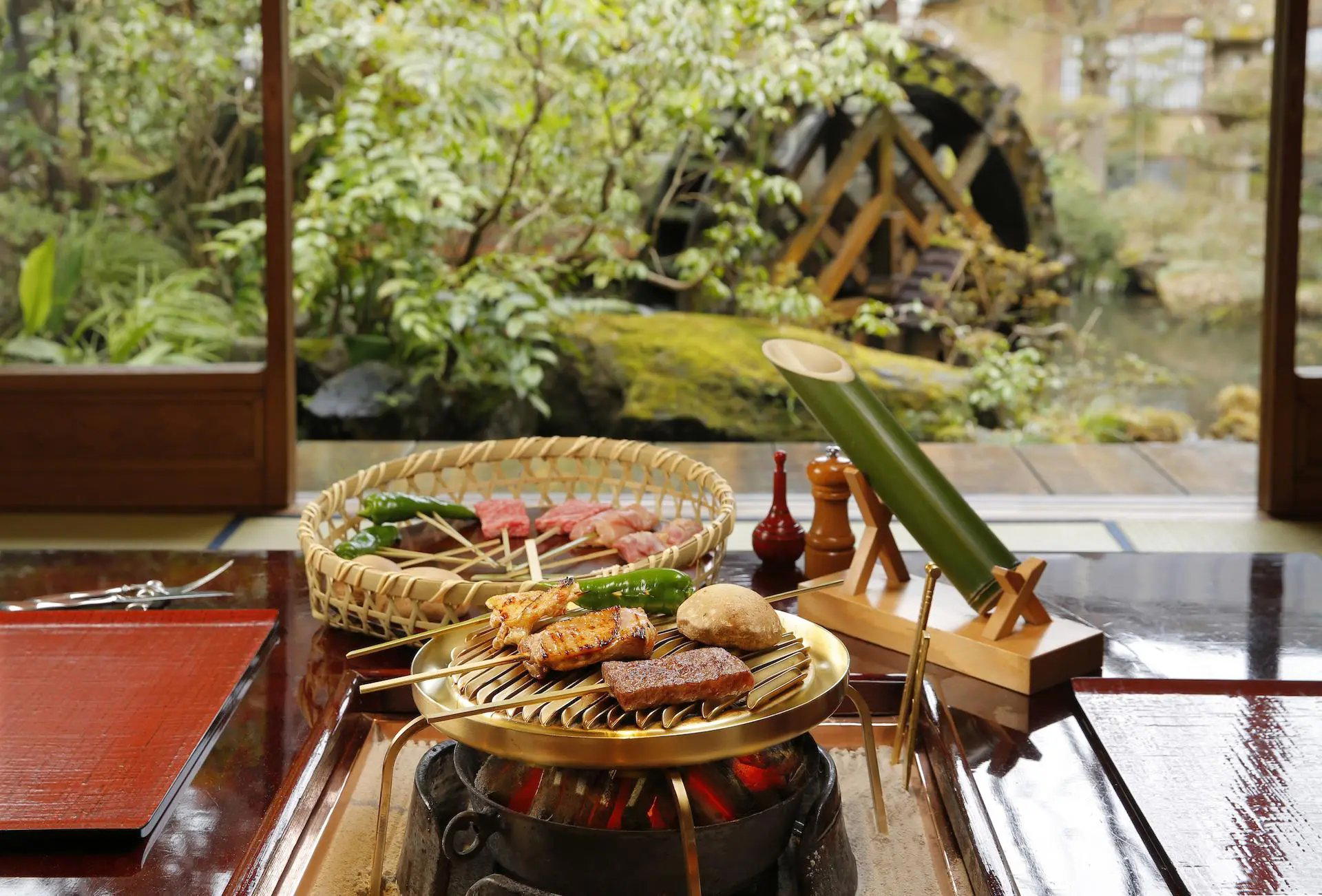
Where the City Stops and the Garden Begins
The western edge of Tokyo's administrative boundary contains a version of the capital that most visitors never reach. In the Takao foothills, past the last suburban train stations and into a corridor of cedar and river stone, the built environment thins out and the landscape shifts register entirely. Ukai Toriyama sits at address 3426 Minamiasakawamachi in Hachioji, far enough from Shinjuku that the journey functions as a decompression, an hour by rail and road that arrives somewhere that feels genuinely removed from the city's pressure. For a guide to what else this area offers, see our full Hachioji restaurants guide.
The estate format, traditional garden, water features, multiple private dining structures, belongs to a distinctly Japanese hospitality tradition in which the physical setting carries as much weight as the food. This is not a restaurant that happens to have a garden. The garden came first. Arriving guests move through it to reach their room, which means the approach itself is part of the experience: lanterns along stone paths, the sound of running water, wood-and-paper architecture that makes the city forty kilometers east feel like a different country. Hachiōji Ukai-tei, the group's European-style counterpart in the same city, operates on entirely different aesthetic terms, which makes the comparison instructive: even within a single hospitality brand, the distinction between formal Western and traditional Japanese formats remains sharp in Japan's premium dining culture.
The Ingredient Logic Behind Jidori Chicken
Japan's premium chicken tradition rests on a category distinction that takes some unpacking for visitors accustomed to Western fine dining hierarchies. Jidori, the designation applied to heritage breeds raised according to regulated standards, sits at the summit of the domestic chicken market. The criteria involve breed lineage, a minimum free-range period, and a cap on flock density, producing birds with a firmer texture and more pronounced flavor than factory-raised alternatives. This is the ingredient foundation at Ukai Toriyama, and it shapes the entire culinary logic of the menu.
The importance of sourcing at this level of Japanese dining cannot be overstated. Across the kaiseki tradition, from Gion Sasaki in Kyoto to the market-driven seasonal programs at places like HAJIME in Osaka, the premise is that notable primary ingredients require less intervention, not more. Chicken in this model is treated with the same sourcing seriousness applied to wagyu or tuna at the summit end of Japanese dining. The preparation format at Ukai Toriyama centers on charcoal-grilled chicken, a method that respects the bird's inherent character rather than masking it under sauce or technique. Charcoal grilling in the Japanese tradition is a skill category of its own, with heat management and distance from the flame producing results that are difficult to replicate on gas or electric equipment.
This ingredient-first approach connects Ukai Toriyama to a broader philosophy that runs through Japan's premium restaurant culture: the chef's role is to source correctly and not interfere excessively. Compare this to the maximalist technical ambition at Harutaka in Tokyo or the course-based innovation at akordu in Nara, and the contrast clarifies what the restaurant model is doing: restraint in technique, investment in provenance.
Private Rooms and the Architecture of a Japanese Meal
The private dining room format dominates at this type of estate restaurant, and for good reason. A shared dining room would undercut the effect the garden architecture is working to produce. Guests are placed in individual structures or rooms that open onto the garden, which means each group has its own sightline, its own ambient quiet, and its own pace. This format is expensive to operate and relatively rare outside Japan, it requires significant land, significant maintenance, and a staffing model built around small-group service rather than table-turn efficiency.
The kaiseki-adjacent structure of the meal, multiple small courses, seasonal produce, a progression that moves from light to substantial, is a format that rewards slowness. A meal at this category of restaurant is not measured in ninety-minute windows. That pacing is part of the proposition, and it connects to a dining culture in which the meal itself is the activity for the evening, not the precursor to something else.
For reference points at the other end of the Japanese fine dining spectrum, the high-concentration urban counter model at venues like Goh in Fukuoka or the technically ambitious kaiseki programs in regional cities offer a useful contrast. Estate dining in the Ukai model trades urban access and critical density for space, quiet, and a deliberate journey. Neither is superior; they serve different needs within the same broad category of serious Japanese dining.
Getting There and Planning the Visit
Hachioji is accessible from central Tokyo via the JR Chuo Line, a journey of roughly fifty to sixty minutes from Shinjuku depending on the service. From Hachioji station, the estate requires an additional transfer, and visitors should confirm transport arrangements when booking, as the address in Minamiasakawamachi sits outside easy walking distance of the main station. Advance reservations are standard at this category of restaurant in Japan, and the private-room format means capacity is limited by design, arriving without a booking is not a workable strategy.
Seasonal timing matters here more than at most urban restaurants. The garden changes dramatically across the year, with autumn foliage and spring new growth producing notably different visual contexts for the same meal. Dinner service places the illuminated garden against darkness, which changes the atmosphere relative to lunch. Both are worth considering as distinct experiences rather than interchangeable time slots.
The Ukai group's presence in Hachioji gives visitors a choice of format: the traditional Japanese estate experience at the restaurant or the European-style teppanyaki and French-influenced cooking at Hachiōji Ukai-tei. For visitors with a single evening in the area, the choice comes down to whether the Japanese garden-and-charcoal-chicken proposition or a more Western-coded luxury format better fits the trip's logic. Neither should be treated as a fallback for the other, they occupy genuinely different positions.
Readers planning Japan itineraries around serious dining may also want to cross-reference the regional programs at 三本木 石川製 in Nanao, 古仁屋山乃 in Sapporo, and 湖畔荘 in Takashima, all examples of estate-adjacent dining traditions that position regional Japan as a serious alternative to the concentration of Michelin attention in Tokyo and Kyoto. Additional reference points include 鳥羽屋 in Nishikawa Machi and, for those curious about chicken-specialist traditions elsewhere in Japan, Birdland in Sakai. For EP Club members cross-referencing against international benchmarks, Le Bernardin in New York City and Atomix in New York City represent the kind of sourcing-serious, technique-disciplined approach that translates across cuisines, even if the cultural register is entirely different.
How It Stacks Up
Comparable venues nearby, for context on price, style, and recognition.
| Venue | Cuisine | Price | Notes |
|---|---|---|---|
| Ukai ToriyamaThis venue — the venue you are viewing | Traditional Japanese Charcoal-Grilled Kaiseki | $$$$ | Not listed |
| 煮干鰮らーめん 圓 | Niboshi Iwashi Ramen | $$ | 横山町 |
| Hachiōji Ukai-tei | Teppanyaki Steakhouse | $$$$ | Akatsuki-cho |
| Kabuto (天然鰻 かぶと) | Traditional Unagi Nose-to-Tail | $$$$ | Ikebukuro |
| Bohemian Nishiazabu | Secret seasonal Japanese robata omakase | $$$$ | Nishiazabu |
| 日本料理 嘉助 | Seasonal Japanese Kaiseki | $$$$ | Karuizawa |
Continue exploring
More in Hachioji
Restaurants in Hachioji
Browse all →


Bars in Hachioji
Browse all →


Hotels in Hachioji
Browse all →


Wineries in Hachioji
Browse all →
At a Glance
- Scenic
- Elegant
- Rustic
- Romantic
- Sophisticated
- Special Occasion
- Date Night
- Celebration
- Family
- Garden
- Historic Building
- Private Dining
- Sake Program
- Local Sourcing
- Garden
- Mountain
Current opening hours
- Monday
- 11:30 AM–2:30 PM, 5–9 PM
- Tuesday
- Closed
- Wednesday
- 11:30 AM–2:30 PM, 5–9 PM
- Thursday
- 11:30 AM–2:30 PM, 5–9 PM
- Friday
- 11:30 AM–2:30 PM, 5–9 PM
- Saturday
- 11 AM–9 PM
- Sunday
- 11 AM–9 PM
Hours can change for holidays and private events. Last verified .
Serene and relaxing atmosphere in traditional Sukiya-zukuri and gassho-zukuri architecture surrounded by lush greenery, cherry blossoms, fireflies, and seasonal foliage.