Tmol Shilshom occupies a second-floor courtyard apartment on Yoel Moshe Salomon Street, in the heart of Jerusalem's Nahalat Shiva neighbourhood. A bookshop-café that has anchored the city's literary and intellectual life for decades, it operates as a meeting point between Hebrew literature, Israeli home cooking, and the unhurried pace of the Old City's western edge. For visitors wanting context alongside coffee, it delivers both.
Pearl is the En Primeur Club membership app — saves, bookings, and concierge access live there. Same editors, same standards.
- Address
- בחצר קומה שנייה, Yo'el Moshe Salomon St 5, Jerusalem, Israel
- Phone
- +97226232758
- Website
- tmol-shilshom.co.il
- Directions
- Get directions
 Saves & bookings on Pearl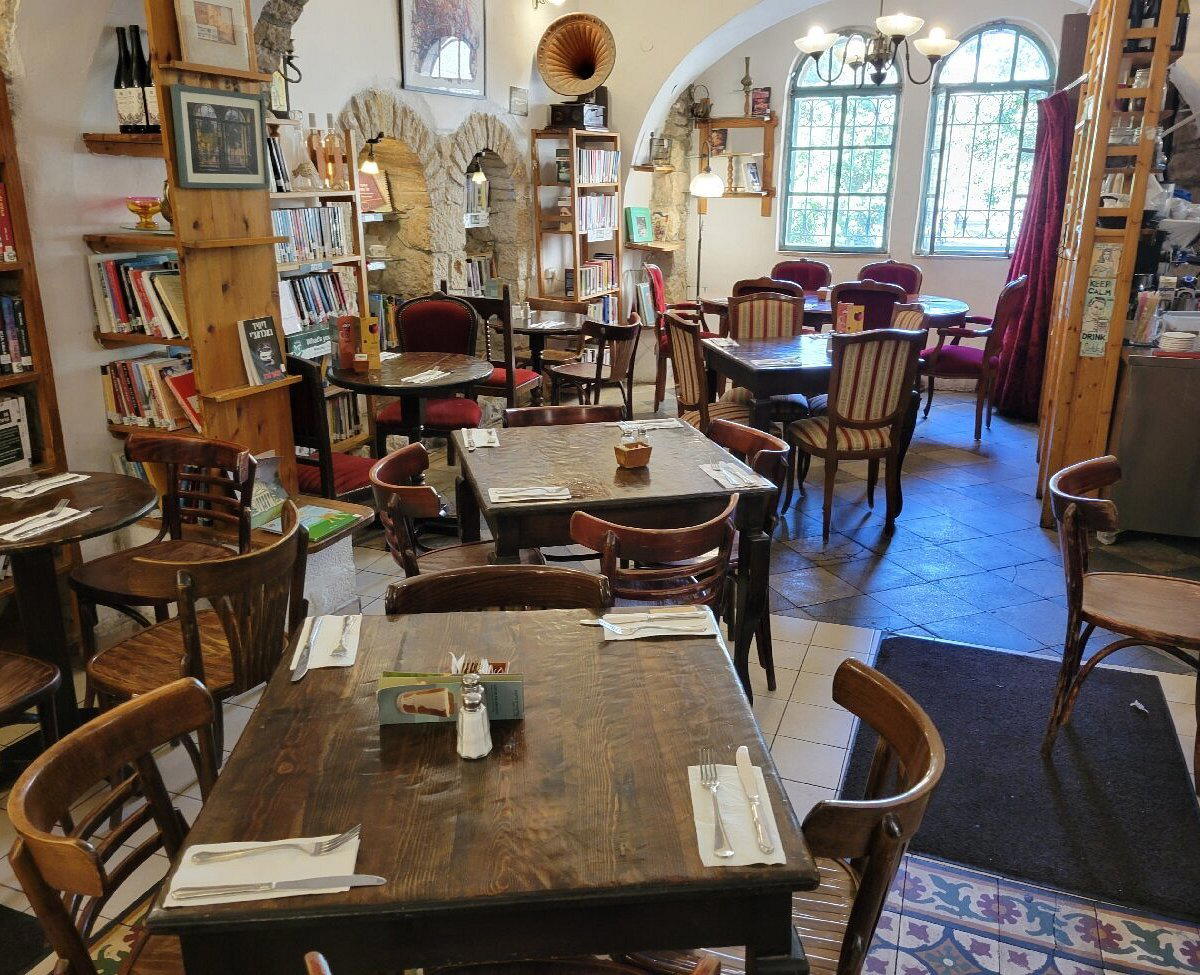
A Courtyard That Reads Like a Room
Tmol Shilshom is a Kosher Israeli Dairy Cafe in Jerusalem, priced around $20 per person. Arriving at Tmol Shilshom requires a small act of orientation. The entrance on Yoel Moshe Salomon Street, one of the oldest in Jerusalem's Nahalat Shiva neighbourhood, gives little away at street level. A staircase leads to a second-floor apartment, and the apartment opens onto a shaded courtyard where the boundaries between café, bookshop, and reading room dissolve. Shelves occupy every available wall. Tables are close together in the way that signals conversation is expected. The city noise below drops to a low frequency. This is not an accident of design; it is the deliberate architecture of a space that has spent decades positioning itself as somewhere to stay rather than somewhere to pass through.
Nahalat Shiva was Jerusalem's first residential neighbourhood built outside the Old City walls in the 1860s, and its narrow stone lanes have since become the connective tissue between the commercial centre and the Old City's western edge. The neighbourhood now concentrates a mix of independent cafés, small galleries, and evening restaurants. Tmol Shilshom sits at a specific register within that mix: daytime-anchored, literary in character, and serving a clientele that includes Hebrew University academics, secular Israelis, and culturally attentive tourists in roughly equal measure.
Menu Architecture: How the Food Reflects the Format
Israeli café culture has evolved considerably over the past two decades, and Tmol Shilshom's menu sits within a specific strand of that evolution: the literary café that takes food seriously without reframing itself as a restaurant. In cities like Tel Aviv, that strand has largely been absorbed by the all-day dining format, where breakfast bleeds into lunch and the menu signals ambition through portion complexity. Jerusalem's version has tended to remain more modest in culinary scope, more interested in the ritual of the meal than in the technical display of it.
At the restaurant, the menu is structured around Israeli home cooking in its broadest sense: dishes that draw on Ashkenazi, Mizrahi, and Levantine influences without declaring allegiance to any single tradition. That structural breadth is itself a statement about Jerusalem's food culture, which has always been more layered and less easily categorised than Tel Aviv's. The city's cooking reflects centuries of Jewish diaspora return and Palestinian culinary presence, a combination that produces dishes where the sourcing story and the recipe history are often inseparable. Venues like Azura take the Mizrahi end of that spectrum into dedicated territory; Machneyuda works the market-driven Israeli end with a higher-volume, higher-energy format. The restaurant occupies the quieter middle ground: familiar ingredients, approachable preparations, and a menu that functions as comfortable backdrop to the room's primary activity.
The breakfast and brunch offering typically anchors the menu's weight, with egg preparations, fresh cheese, salads, and bread representing the daily core. This is consistent with how serious Israeli cafés have long positioned themselves: breakfast as the meal that establishes credibility, lunch as extension rather than reinvention. For visitors accustomed to the broader sweep of Israeli restaurant formats, the register here reads as deliberately restrained. That restraint is the point.
The Bookshop as Context
What distinguishes the restaurant from the general category of café-with-books is the depth and seriousness of its literary programming. Hebrew literature has a particular relationship with Jerusalem that goes beyond setting; the city functions in Israeli literary culture as both subject and symbol. The venue takes its name from S.Y. Agnon's novel, the Nobel Prize-winning author lived and worked in Jerusalem and remains especially significant figure in modern Hebrew fiction. That reference is not decorative. It frames the space as belonging to a specific cultural lineage and signals to visitors that the bookshop component is curatorial rather than accessory.
Regular literary events, readings, and author talks use the space in the evenings, which shifts its character considerably from the daytime café mode. Jerusalem's literary and cultural calendar is dense for a city of its size, and the restaurant has maintained a consistent position within it for long enough that its programming is treated as a civic asset rather than a commercial exercise. This dual identity, café by day and cultural venue by evening, shapes how the food is positioned. The menu does not need to carry the room; the room carries itself.
Placing It in Jerusalem's Wider Scene
Jerusalem's restaurant scene operates differently from Tel Aviv's, and that difference matters for understanding what the restaurant is and is not. Tel Aviv has developed a dense, chef-driven restaurant culture with international visibility, venues like Kab Kem reflect that city's appetite for category-pushing formats. Jerusalem's dining culture has remained more tied to neighbourhood character, cultural institution, and local regulars. The comparisons that make most sense are internal: Menza for a different iteration of the all-day format, or venues further afield like Majda for Jewish-Arab culinary integration in a different register. Across Israel more broadly, the range runs from the seafood specificity of Uri Buri in Acre and Diana in Nazareth to the coastal positioning of Helena in Caesarea and the fine dining approach of Herbert Samuel in Herzliya. The restaurant is not in competition with any of those. It operates in a category defined more by cultural function than culinary ambition.
For visitors approaching Jerusalem from a wider Israel itinerary, the restaurant represents a fixed point in Jerusalem's intellectual life that happens to serve food. The meal is the pretext; the room is the reason.
Planning a Visit
The venue is on Yoel Moshe Salomon Street 5 in Nahalat Shiva, reachable on foot from most of Jerusalem's central hotels and a short walk from Zion Square. The second-floor location and courtyard setting make it worth arriving without a schedule. Morning and midday are when the café mode operates most fully; evenings shift toward programming. Checking the literary calendar in advance is worthwhile if that dimension is part of the interest. There is no phone number or website listed in public sources, so arrival or local enquiry is the reliable approach for current hours.
Standing Among Peers
Comparable venues nearby, for context on price, style, and recognition.
| Venue | Cuisine | Price | Notes |
|---|---|---|---|
| Tmol ShilshomThis venue — the venue you are viewing | Kosher Israeli Dairy Cafe | $$ | Not listed |
| Azura | Iraqi-Kurdish Home Cooking | $$ | Machane Yehuda |
| The Culinary Workshop | Modern French Grill with Israeli Fusion | $$$ | First Station |
| Machneyuda | Modern Middle Eastern Fusion | $$$ | Mahane Yehuda |
| Menza | Mediterranean Bistro | $$ | Bezalel Street, Downtown Jerusalem |
| Notre Dame Rooftop Restaurant | Mediterranean Fine Dining with Wine & Cheese | $$$ | Yemin Moshe |
Continue exploring
More in Jerusalem
Restaurants in Jerusalem
Browse all →
Bars in Jerusalem
Browse all →
At a Glance
- Cozy
- Intimate
- Bohemian
- Rustic
- Brunch
- Casual Hangout
- Solo
- Historic Building
Current opening hours
- Monday
- 9 AM–10:30 PM
- Tuesday
- 9 AM–10:30 PM
- Wednesday
- 9 AM–10:30 PM
- Thursday
- 9 AM–11 PM
- Friday
- 8:30 AM–2 PM
- Saturday
- Closed
- Sunday
- 9 AM–10:30 PM
Hours can change for holidays and private events. Last verified .
Cozy and inviting with bookshelves lining the walls, old wooden mismatched tables, stone floors, and a warm bohemian atmosphere evoking early 20th-century Paris coffee houses.