Our verdict
Sushi Inase occupies a quieter register of Shibuya's dining scene, where the counter format and measured pacing align it with Tokyo's mid-to-upper omakase tier rather than the headline Ginza rooms. For visitors working through Japan's sushi traditions, it offers an entry point into the Shibuya neighbourhood's less-documented dining depth, positioned some distance from the tourist circuit that gravitates toward Roppongi and Marunouchi.

Pearl is the En Primeur Club membership app, where members save venues, book tables and use the concierge.
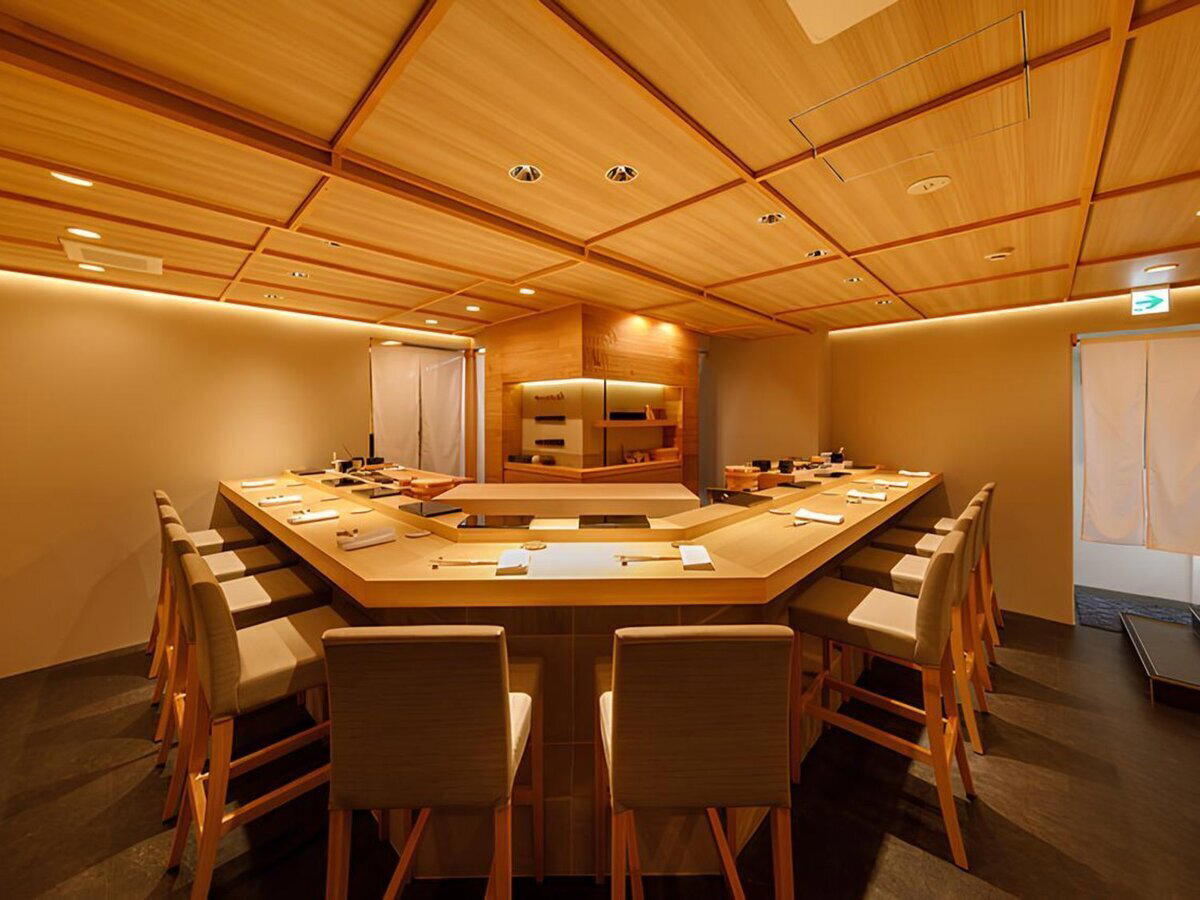
The Counter as Architecture: How Shibuya's Sushi Rooms Define Themselves
Tokyo's omakase counter is one of the most considered spatial arrangements in world dining. The wood, the seat height, the angle of the chef's workspace, the precise distance between guest and cutting board: these details are not incidental. In the city's established sushi rooms, every physical element has been calibrated over decades of use, and the room itself communicates what kind of experience to expect before a single piece of fish is prepared. Sushi Inase, located in Shibuya's 3-chome district, belongs to this tradition. The address places it in a part of the city that functions differently from Ginza's concentrated luxury belt, and that geographic fact shapes the character of the space and the pace of the meal.
Shibuya as a dining neighbourhood has been undergoing a quiet reconfiguration. The area is better known internationally for its scramble crossing and department-store basement food halls than for counter dining, but several serious sushi and kappo addresses have established themselves in the surrounding residential and commercial streets. This is not unusual in Tokyo, where precision dining appears in stairwell restaurants and unmarked basement rooms across all twenty-three wards. The city's premium restaurant distribution does not follow the logic of visible footfall; it follows the logic of the chef's preferred address and the landlord's rent. Shibuya's 3-chome sits close enough to Omotesando and Aoyama to draw a clientele comfortable with quiet, specialist dining, while retaining a neighbourhood quality that distinguishes it from the overtly formal rooms of Ginza.
Reading the Room: Spatial Codes in Tokyo's Omakase Tier
The physical container of a sushi counter communicates its own hierarchy. At the upper end, you encounter counters surfaced in aged hinoki cypress, kept at a consistent temperature and humidity, lit with enough warmth to show the colour of fish accurately without flattening the room's ambience. The seat count is always small: six, eight, ten at most. That constraint is not simply about exclusivity; it is a technical requirement. A chef working alone or with a single assistant can maintain quality and timing across a small counter in a way that simply does not scale. Rooms like Harutaka, which operates in Tokyo's top-tier omakase bracket, embody this spatial discipline absolutely: the counter, the chef, the silence, the sequence.
Sushi Inase's Shibuya positioning suggests a different register. Shibuya-based counters typically operate with a somewhat less formal spatial grammar than their Ginza counterparts, which tends to mean a slightly more conversational atmosphere without abandoning the underlying rigour of the omakase format. The distinction matters for how a first-time visitor should calibrate their expectations. This is not a room designed to intimidate; it is a room designed to deliver precision within a more accessible frame. The gap between Ginza's flagship counters and Shibuya's serious but less ceremonial rooms is partly spatial, partly reputational, and partly about the specific clientele each neighbourhood draws.
Tokyo's sushi scene, taken as a whole, runs from conveyor-belt chains through neighbourhood kaiten to neighbourhood omakase, through mid-tier counter dining, up to the Michelin-bearing rooms that compete on a different cost-and-booking axis entirely. The kaiseki tradition at places like RyuGin and the French-influenced precision of L'Effervescence or Sézanne represent adjacent tiers of the same broader commitment to technical rigour that underpins the city's dining reputation. Within the sushi segment specifically, the counter room is the dominant format at every serious price point, and the differences between venues are expressed through space as much as through fish.
The Shibuya Context: A Neighbourhood That Earns Its Reputation Quietly
The address at 3 Chome-15-5, Shibuya, places Sushi Inase within walking distance of Omotesando, which is itself one of Tokyo's more concentrated stretches of serious dining. The broader neighbourhood has produced a consistent supply of counter restaurants that attract a local professional clientele alongside international visitors who have moved past the obvious tourist itinerary. This is a pattern visible across Japan's major cities: HAJIME in Osaka, Gion Sasaki in Kyoto, and Goh in Fukuoka all demonstrate how serious precision dining establishes itself in neighbourhoods that are not obvious luxury destinations but that possess the residential and commercial depth to sustain a demanding clientele.
Shibuya's dining rooms tend to attract guests who already understand the omakase format, who are not visiting for the first time, and who are looking for a meal that delivers technical consistency without the social theatre of the most visible Ginza addresses. That dynamic is partly what gives Shibuya-based counters their specific character: the clientele is experienced, the expectations are high but unperformed, and the room can function at a pace that suits the food rather than the spectacle. For visitors making their way through Japan's wider dining geography, the contrast with destinations like akordu in Nara or the regional depth of 餐厅 in Nanao and 旧道山乃 in Sapporo underlines how varied Japan's precision dining map has become outside the capital's central wards.
Placing Sushi Inase in the Broader Tokyo Counter Tier
That ambiguity is itself informative. Tokyo contains dozens of serious counter sushi addresses that operate below or outside the Michelin selection, drawing regulars through word of mouth and neighbourhood reputation rather than through award listings. This is not a marginal position; some of the city's most technically consistent counters have never appeared in a formal guide and do not need to. The peer comparison is less with the three-star Ginza rooms and more with the mid-tier neighbourhood counters that have built durable reputations over years of consistent service.
Visitors arriving in Tokyo with limited time and high expectations are often better served by the broader EP Club Tokyo dining guide, which maps the city's full range of serious dining across sushi, kaiseki, and contemporary formats including Crony in the French-influenced innovative tier. The guide covers the full spectrum from Michelin-confirmed rooms through to the neighbourhood counters where Tokyo's most consistent sushi experiences are often found. For comparison outside Japan entirely, the disciplined tasting counter format shares structural logic with destination rooms like Le Bernardin in New York City and the Korean-influenced precision of Atomix, both of which demonstrate how the small-counter, chef-led format translates across culinary traditions.
Regional Japan also rewards attention. The dining depth visible in 湖畔荘 in Takashima, 庄羽屋 in Nishikawa Machi, Birdland in Sakai, and Bistro Ange in Toyohashi confirms that precision counter dining has dispersed well beyond Tokyo and the major urban centres. Sushi Inase, as a Shibuya address, sits in the capital's version of this more distributed, less visible tier.
Planning Your Visit
Sushi Inase is located at 3 Chome-15-5, Shibuya, Tokyo 150-0002. Shibuya Station, served by the JR Yamanote Line, multiple Tokyo Metro lines, and the Tokyu lines, provides the most direct public transport access. The specific block sits within a short walk of the station's quieter southern and western exits, away from the main scramble crossing pedestrian flow. Dress code expectations at mid-tier Tokyo sushi counters typically follow a smart-casual standard; overt formality is not required, but the counter setting calls for considered presentation.
Quick reference: Sushi Inase, 3 Chome-15-5, Shibuya, Tokyo 150-0002. Nearest station: Shibuya.
Frequently asked questions
Would Sushi Inase be comfortable with kids?
The omakase counter format at Sushi Inase, located in Shibuya, is not well-suited to young children. The meal unfolds at the chef's pace across multiple courses, requiring sustained attention and quiet at close quarters. Families with younger children would find the format a poor fit regardless of the venue itself.
How would you describe the vibe at Sushi Inase?
Shibuya sets a different register than Ginza's more ceremonial sushi addresses. The neighbourhood draws working Tokyo rather than visiting dignitaries, which tends to produce counters with less theatrical formality and more direct engagement between chef and guest. Expect focused, unhurried dining rather than high-gloss pageantry.
Is Sushi Inase a good option for a special occasion dinner in Tokyo?
The Shibuya address at 3 Chome-15-5 places Sushi Inase within a neighbourhood that runs quieter on the formal dining circuit than Ginza or Roppongi, which suits occasions where intimacy matters more than scene. Tokyo's omakase format is inherently occasion-oriented given the dedicated, course-by-course structure.
What's the signature dish at Sushi Inase?
No specific dishes or confirmed menu details are on the public record for Sushi Inase. Tokyo's counter sushi tradition operates on the omakase principle, meaning the sequence is determined by the chef based on seasonal availability rather than a fixed menu, so no single dish defines the meal.
Where do I go for Sushi Inase?
Sushi Inase is located at Japan, 〒150-0002 Tokyo, Shibuya, 3 Chome−15−5 地下1階, Tokyo.
A Tight Comparison
Comparable venues nearby, for context on price, style, and recognition.
| Venue | Cuisine | Price | Awards | Notes |
|---|---|---|---|---|
| Sushi InaseThis venue (the venue you are viewing) | Edomae Omakase Sushi | $100–150 | Not listed | Not listed |
| Matsugen (松玄 恵比寿) | Handmade Japanese Soba | $30–50 | Not listed | Ebisu, Handmade Soba Noodles |
| Togoshi Ginza Sushi Bando | Seasonal Edo-style Omakase Sushi | $100–150 | Tabelog 100 #68 | Shinagawa, Seasonal Edo-style Omakase Sushi |
| Yama no Chaya | Traditional Japanese Unagi Kaiseki | Not listed | Tabelog 100 #56 | Chiyoda, Traditional Japanese Unagi Kaiseki |
| Unagi Senmonten Aikawa | Traditional Unagi (eel) specialty restaurant | $50–100 | Tabelog 100 #21 | Shinjuku, Traditional Unagi (eel) specialty restaurant |
| HIGASHIYA GINZA | Modern Japanese Tea Salon & Wagashi | $50–100 | Not listed | Chūō, Modern Japanese Tea Salon & Wagashi |
Continue exploring
More in Tokyo
Restaurants in Tokyo
All restaurants in Tokyo →


Bars in Tokyo
All bars in Tokyo →






Details
- Intimate
- Elegant
- Sophisticated
- Cozy
- Date Night
- Special Occasion
- Solo
- Chefs Counter
- Sake Program
- Sustainable Seafood
- Omakase
- Counter Dining
- Sake Program
Current opening hours
- Monday
- 5:30–8 PM
- Tuesday
- 5:30–8 PM
- Wednesday
- 5:30–8 PM
- Thursday
- 5:30–8 PM
- Friday
- 5:30–8 PM
- Saturday
- 5:30–8 PM
- Sunday
- 5:30–8 PM
Hours can change for holidays and private events. Hours as of .
Intimate 10-seat counter setting with relaxed yet luxurious atmosphere, warm lighting, and personal chef interaction creating an elegant and welcoming vibe.