
Black Pearl 1 Diamond
Our verdict
Sushi Fujimoto holds a Black Pearl 1 Diamond (2025) and occupies a hutong address in Dongcheng, placing Beijing's Japanese counter dining inside one of the capital's most historically layered neighbourhoods. The restaurant represents a strand of the city's premium dining scene that looks outward, to Japanese sourcing traditions and omakase format discipline, while operating within a distinctly local context.

Pearl is the En Primeur Club membership app, where members save venues, book tables and use the concierge.
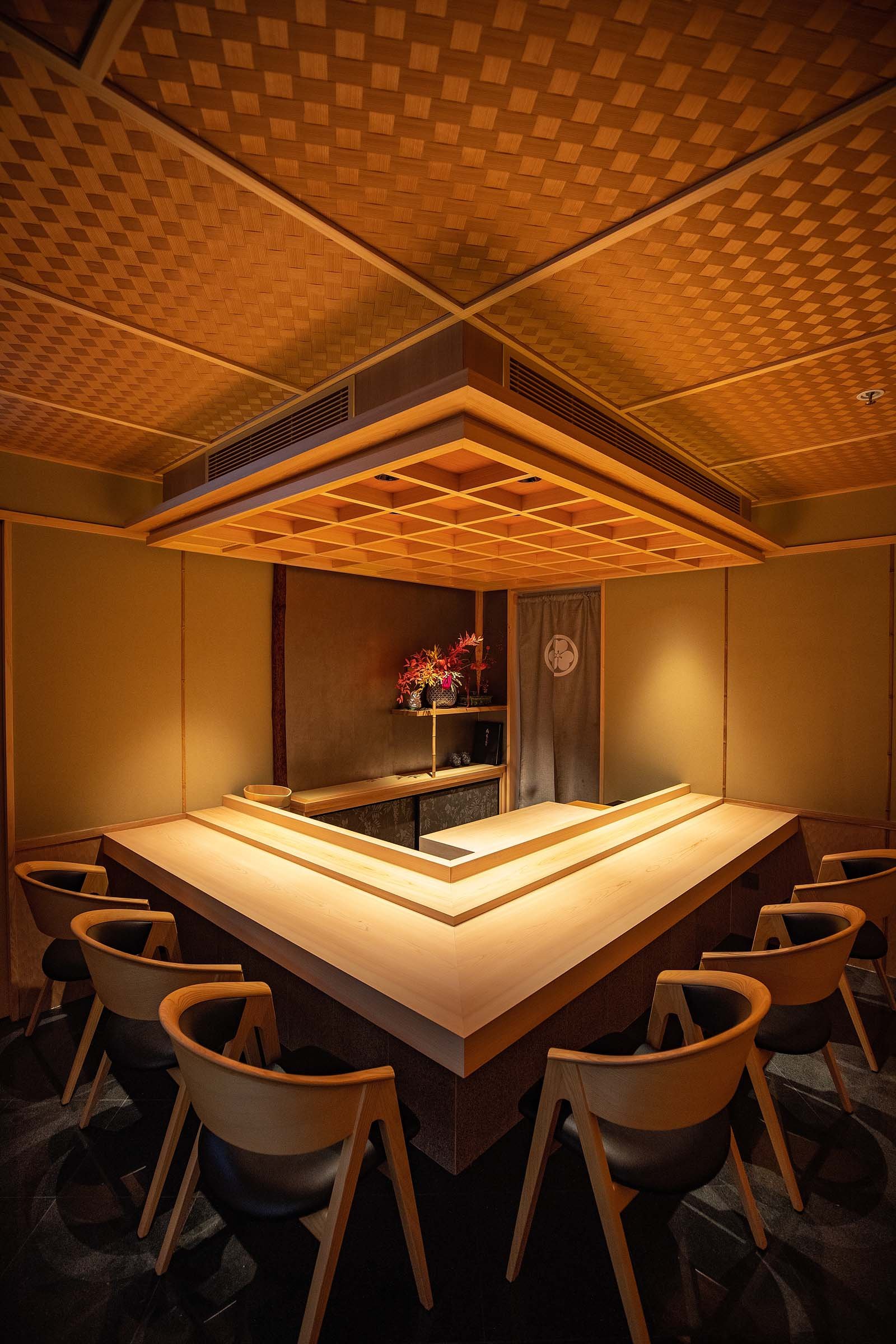
A Hutong Address, a Japanese Counter
Baochao Hutong runs through the older residential grain of Dongcheng, where grey-brick courtyard walls and bicycle-wide lanes have survived successive rounds of urban redevelopment. Premium dining has colonised these alleys steadily over the past decade, and the pattern is consistent: a discreet entrance, no signage visible from the street, and a dining room that only makes sense once you are inside. Sushi Fujimoto sits inside that pattern. The physical approach alone signals something about how serious counter dining operates in Beijing, it does not advertise itself to passing traffic. It relies on reputation, word of mouth, and the kind of pre-arrival research that marks out its intended audience.
That atmosphere is not incidental to the experience. In Tokyo, the geography of omakase counters, Ginza basements, Minami-Aoyama back streets, is considered part of the ritual. Beijing's finest Japanese counters have absorbed that logic, and the hutong setting at Fujimoto is as close as this city gets to replicating the sense of deliberate removal from the everyday urban noise that defines the leading Japanese counter experiences globally.
Where the Food Comes From, and Why That Question Matters
The central argument of serious sushi dining, anywhere outside Japan, is an ingredient-sourcing argument. The format exists to showcase fish and rice at peak condition. Everything else, the counter, the chef's movements, the sequential pacing, is infrastructure in service of that showcase. This makes the supply chain the most consequential variable in the quality equation for any Japanese counter operating in mainland China.
Beijing sits roughly 2,100 kilometres from Tokyo's Toyosu Market, the global benchmark for premium fish procurement. Top-tier counters in Shanghai, Guangzhou, and Hong Kong have historically had logistical advantages over their Beijing counterparts simply by virtue of proximity to coastal ports and air freight routes. The counters that have closed that gap in Beijing have done so through direct relationships with Japanese suppliers, dedicated cold-chain logistics, and in some cases the same overnight air freight networks used by Michelin-recognised counters in other Chinese cities.
The Black Pearl Guide, published by Meituan-Dianping, has become one of the more credible benchmarks for fine dining evaluation in mainland China. Its 2025 edition assessed restaurants across ingredient quality, technique, and overall experience. A 1 Diamond designation at the level Sushi Fujimoto holds places it among the city's recognised premium addresses without claiming equivalence with the two and three Diamond properties in the guide. In Beijing's Japanese counter category, that is a meaningful positioning signal.
Compare that to how ingredient sourcing shapes reputations elsewhere in the region. At Atomix in New York City, the Korean tasting menu format rests on a similar logic: sourcing precision as the foundation of the entire format. Le Bernardin in New York City has built decades of recognition almost entirely on the sourcing and handling of fish. The argument travels across formats and cuisines, what arrives at the counter matters more than what the chef does to it, because no technique recovers from a compromised primary ingredient.
Beijing's Premium Dining Mix, Where Japanese Counters Fit
Beijing's high-end restaurant scene in 2025 runs across several distinct tracks. There is the revived tradition of grand Chinese cooking, represented by addresses like Jingji (Beijing Cuisine), which works within the capital's own culinary inheritance. There is the coastal Chinese strand, with Xin Rong Ji (Xinyuan South Road) and Chao Shang Chao (Chaoyang) representing Taizhou and Chaozhou cooking respectively, both at the ¥¥¥¥ price tier. Vegetable-forward dining has also established a serious foothold, with Lamdre (Vegetarian) and King's Joy (Chinese, Vegetarian) drawing from Buddhist and Tibetan culinary traditions. Japanese counter dining occupies a different register from all of these, it imports both its ingredients and its format from outside China, making it an outlier in a city whose premium identity is predominantly rooted in Chinese culinary traditions.
That distinction cuts both ways. Japanese omakase in Beijing cannot claim the same cultural rootedness as Ru Yuan in Hangzhou or Xin Rong Ji in Chengdu. What it offers instead is a format with global legibility, one that appeals to a specific segment of the capital's dining audience: those who benchmark their experience against what they have eaten in Tokyo, Osaka, or at counters in other major Chinese cities. In that context, the reference points extend across the region, toward Chef Tam's Seasons in Macau, Imperial Treasure Fine Chinese Cuisine in Guangzhou, and Dai Yuet Heen in Nanjing, each of which operates within a city where the competitive fine dining tier draws from both local tradition and international formats. 102 House in Shanghai represents a similar dynamic in the Yangtze Delta, where imported fine dining formats sit alongside locally rooted addresses in the same premium tier.
Planning a Visit
Sushi Fujimoto is located at 74 Baochao Hutong, Dongcheng, Beijing. The hutong is accessible from Gulou Dajie and sits within walking distance of the Drum Tower area. Dongcheng is served by multiple metro lines, and the neighbourhood rewards arriving with time to walk the lanes before a reservation.
| Venue | Cuisine | Price Tier | Award (2025) |
|---|---|---|---|
| Sushi Fujimoto | Japanese (Sushi Counter) | Not published | Black Pearl 1 Diamond |
| Xin Rong Ji (Xinyuan South Road) | Taizhou | ¥¥¥¥ | Black Pearl recognised |
| Chao Shang Chao (Chaoyang) | Chao Zhou | ¥¥¥¥ | Black Pearl recognised |
| Lamdre | Vegetarian | ¥¥¥¥ | Black Pearl recognised |
| Jingji | Beijing Cuisine | ¥¥¥¥ | Black Pearl recognised |
For broader context on Beijing's premium dining scene, including full rankings and neighbourhood breakdowns, see our full Beijing restaurants guide. For where to stay, see our full Beijing hotels guide. Bar and drink programming is covered in our full Beijing bars guide, with further context available in our full Beijing wineries guide and our full Beijing experiences guide.
Frequently asked questions
Has Sushi Fujimoto won any awards?
Sushi Fujimoto has received recognition including: Black Pearl 1 Diamond (2025).
How do I find Sushi Fujimoto?
Sushi Fujimoto is located at 74 Baochao Hu Tong, Dongcheng, Beijing, China, 100009, Beijing.
What should I order at Sushi Fujimoto?
Sushi Fujimoto operates at the Black Pearl 1 Diamond tier, where omakase is the standard format, the chef sets the sequence, not the diner. Arriving with requests or substitutions runs against the logic of the format. Trust the counter.
Should I book Sushi Fujimoto in advance?
Yes. Black Pearl-recognised counter restaurants in Beijing run at low seat counts by design, and Baochao Hutong is not a walk-in destination. Securing a reservation well ahead, weeks rather than days, is the practical approach for a table at this level.
What's the defining dish or idea at Sushi Fujimoto?
The defining idea is sourcing as argument. At a stripped-back counter in a Dongcheng hutong, the only thing making the case for the food is ingredient quality: the fish, the rice, the temperature, the sequence. The 2025 Black Pearl 1 Diamond recognition reflects that the case holds.
A Quick Peer Check
Comparable venues nearby, for context on price, style, and recognition.
| Venue | Cuisine | Price | Awards | Notes |
|---|---|---|---|---|
| Sushi FujimotoThis venue (the venue you are viewing) | Edomae Sushi Omakase | $200–300 | Black Pearl 1 Diamond | Not listed |
| Jing.YUZU | Modern Japanese Izakaya with Yuzu Focus | $30–50 | Black Pearl 1 Diamond | Not listed |
| Baowu | Fine Japanese Sushi | $50–100 | Not listed | Gongrentiyuchang |
| Azur by Mauro Colagreco | French Riviera Fine Dining | $200–300 | Not listed | Zizhuyuan |
| Pure Lotus | Exquisite Modern Vegetarian Chinese | $50–100 | Not listed | Tuanjiehu |
| Yatang | Regional Chinese with Peking Duck | $30–50 | Not listed | Tuanjiehu |
Recognition history
Dated appearances from independent guides and award organizations, with the underlying list record or original source where available.
Black Pearl 1 Diamond
Black Pearl
Continue exploring
More in Beijing
Restaurants in Beijing
All restaurants in Beijing →
Bars in Beijing
All bars in Beijing →
Details
- Elegant
- Intimate
- Sophisticated
- Minimalist
- Date Night
- Special Occasion
- Business Dinner
- Chefs Counter
- Private Dining
- Open Kitchen
- Sake Program
- Corkage Allowed
- Sustainable Seafood
- Omakase
- Counter Dining
- Sake
- Wine
Current opening hours
- Monday
- 10 AM–9:30 PM
- Tuesday
- 10 AM–9:30 PM
- Wednesday
- 10 AM–9:30 PM
- Thursday
- 10 AM–9:30 PM
- Friday
- 10 AM–9:30 PM
- Saturday
- 10 AM–9:30 PM
- Sunday
- 10 AM–9:30 PM
Hours can change for holidays and private events. Hours as of .
Spare and refined with warm functional lighting focused on the counter, low unobtrusive music, and a calm intentional rhythm.