
A Michelin one-star kappo counter in Osaka's Tenma district, Sui Oya holds a ¥¥¥ price point while pushing against kaiseki convention through a menu that folds Western-inflected side dishes, crab cream croquettes, beef cutlet, into its Japanese framework. Sake pairings sit alongside a wine list, positioning it in a small cohort of Osaka kappo kitchens that think across culinary borders.
Pearl is the En Primeur Club membership app — saves, bookings, and concierge access live there. Same editors, same standards.
- Address
- Japan, 〒530-0043 Osaka, Kita Ward, Tenma, 3 Chome−1−2 TSビル 2F
- Phone
- +81 6-6358-7497
- Directions
- Get directions
 Saves & bookings on Pearl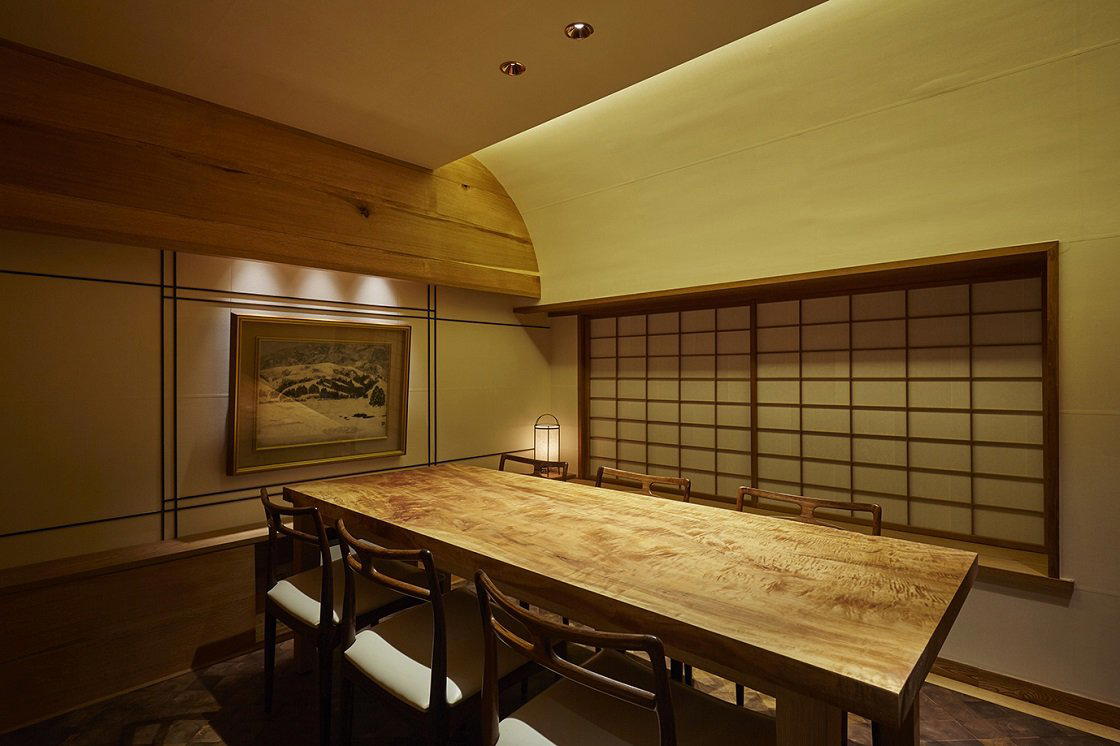
Tenma's Second Floor, and What It Says About Osaka Kappo
The second-floor address on a Tenma side street places Sui Oya firmly within a tradition Osaka does better than almost anywhere: the neighbourhood kappo counter, removed from the tourist circuits of Namba and Shinsaibashi, operating for a local clientele that knows exactly what it wants and books accordingly. Tenma itself sits north of the castle district in Kita Ward, a neighbourhood defined more by its covered market arcade and izakaya density than by fine-dining signage. That context matters because it shapes the register of the cooking inside: technically serious, but not ceremonially remote.
Kappo as a format sits between the strict sequencing of kaiseki and the informality of an izakaya omakase. The chef cooks in open view, portions arrive as individual courses rather than as a rigid multi-act structure, and there is generally more room for lateral thinking in what appears on the pass. Sui Oya takes that latitude and uses it deliberately. The menu does not treat Japanese cuisine as a closed system.
How the Menu Is Structured, and What That Structure Argues
The organising logic at Sui Oya is worth reading carefully before you arrive, because it is not the logic you encounter at, say, Kashiwaya Osaka Senriyama or Tenjimbashi Aoki, where the kaiseki vocabulary is more codified. The core sequence here follows a Japanese kappo progression, but guests are offered an optional side dish that breaks from that sequence entirely, crab cream croquettes or beef cutlet among the choices. These are yoshoku dishes, the Western-influenced Japanese cooking that became embedded in the culture through the Meiji and Taisho periods. Including them as an opt-in course rather than hiding them is an editorial statement about what this kitchen considers valid.
The distinction between a menu that quietly includes a Western-inflected dish and one that frames it as a genuine choice is not trivial. The latter requires the chef to believe the dish belongs, that it holds its own aesthetically and technically against everything else on the counter. Crab cream croquettes made with proper bechamel and good crab are not a concession; they are a demonstration that the kitchen's range is genuinely wide rather than theoretically so. The same logic applies to the beef cutlet. Both are fried preparations that require precise temperature control and timing, and their inclusion signals a kitchen confident in texture and fat as well as in the lighter preparations more typical of Japanese course cooking.
This structure places Sui Oya in a small cohort of Osaka kappo restaurants, alongside venues like Miyamoto and Yugen, where the chef's lineage is in classical Japanese cooking but the menu's range extends past it. The distinction from the ¥¥¥¥ tier in Osaka, where restaurants such as Hajime, La Cime, and Fujiya 1935 build their identities around French or innovative frameworks, is significant: the restaurant's identity remains rooted in kappo but refuses to treat that as a constraint.
The Drink Pairing Architecture
One of the more telling structural choices at the restaurant is the pairing programme. Sake is the default companion for Japanese counter dining at this level, and most kappo kitchens at the ¥¥¥ price point will offer a curated sake flight or a short sake list. Offering wine as a genuine pairing alternative, not as an afterthought for guests who do not drink sake, is a more substantive decision. It requires the kitchen to think about which courses pair credibly across both categories, and it implies that the Western-inflected menu components have been designed with that dual-track consideration in mind.
For comparison, Oimatsu Hisano and other traditional kappo counters in Osaka's northern wards tend to build their drink programmes around Japanese spirits and sake exclusively. The wine list at the restaurant broadens the accessible demographic considerably, guests whose reference points for pairing are European rather than Japanese can engage with the menu on those terms without compromise.
Where It Sits in the Osaka Japanese Restaurant Tier
Osaka's Michelin one-star Japanese restaurants at the ¥¥¥ price point occupy a distinct competitive position. They are not entry-level omakase or neighbourhood tasting menus; they are serious counters where the cooking reflects years of apprenticeship and considered menu development. The restaurant's Michelin one-star recognition in 2024 places it in a cohort that includes other kappo and kaiseki counters operating with similar cost structures, seasonal frameworks, and booking windows.
The chef's training under a Naniwa kappo mentor is relevant context here not as biography but as credential. Naniwa is Osaka's historical name, and kappo training under a Naniwa-style practitioner means grounding in the city's specific approach to the format: a tradition that prizes clean, high-intensity stock work, seasonal fish from Osaka Bay and the Seto Inland Sea, and a more interactive counter dynamic than the formal kaiseki tradition of Kyoto. That background makes the menu's lateral moves feel grounded rather than arbitrary, the classical technique is in place before the departures begin.
For readers planning a broader Kansai itinerary, the comparison set extends beyond Osaka. Gion Sasaki in Kyoto operates in a related but distinctly different register, and akordu in Nara approaches Japanese ingredients from a European fine-dining framework, a useful contrast point for understanding what the restaurant is doing by staying rooted in kappo while opening its menu outward. Readers building a national itinerary might also weigh Harutaka in Tokyo, Goh in Fukuoka, 1000 in Yokohama, 6 in Okinawa, Myojaku in Tokyo, and Azabu Kadowaki in Tokyo as reference points for understanding the breadth of Japanese counter dining nationally.
The Name as Programme
The restaurant's name, Sui, translates as green, chosen by the chef to anchor the venture to the season of its founding and his birth month, both falling in the period of fresh new leaves. The gesture is characteristic of a certain kind of Japanese naming culture, where the restaurant's identity is tied to natural cycles and personal continuity rather than to prestige or abstraction. It also quietly signals the seasonal orientation that runs through the menu: a kitchen attentive to what the calendar is doing will naturally update its programme as the year moves through its phases. For guests visiting at different points in the year, the experience will shift accordingly.
Planning a VisitThe Tenma area is accessible via Osaka Tenmangu Station on the Osaka Higashisen and Tanimachi Line, a short walk from the restaurant. As with most counters at this level in Osaka, reservations should be made well in advance; the 2024 Michelin star will have tightened availability.
For further context on dining, lodging, and nightlife in Osaka, see our full Osaka restaurants guide, our full Osaka hotels guide, our full Osaka bars guide, our full Osaka wineries guide, and our full Osaka experiences guide.
A Pricing-First Comparison
Comparable venues nearby, for context on price, style, and recognition.
| Venue | Cuisine | Price | Awards | Notes |
|---|---|---|---|---|
| Sui OyaThis venue — the venue you are viewing | Kita, Modern Osaka Kaiseki | $$$ | Michelin 1 Star | Not listed |
| Shinchi Yamamoto | Kita, Modern Japanese Kaiseki Omakase | $$$$ | Michelin 1 Star | Not listed |
| Yunagibashi Takoyasu | Not listed | $$$ | Michelin 1 Star | Minato, Traditional Fugu (Pufferfish) |
| Rakushin | Fukushima, Modern Kaiseki | $$$$ | Michelin 1 Star | Not listed |
| Higashichaya Nakamura | Kita, Kanazawa-Style Kaiseki | $$$$ | Michelin 1 Star | Not listed |
| Ajikitcho Horieten | Nishi, Traditional Kaiseki | $$$$ | Michelin 1 Star | Not listed |
Recognition history
Dated appearances from independent guides and award organizations, with the underlying list record or original source where available.
Michelin 1 Star
Michelin
Michelin 1 Star
Michelin
Continue exploring
More in Osaka
Restaurants in Osaka
Browse all →




Bars in Osaka
Browse all →

Hotels in Osaka
Browse all →




Wineries in Osaka
Browse all →
At a Glance
- Elegant
- Intimate
- Sophisticated
- Quiet
- Date Night
- Special Occasion
- Business Dinner
- Chefs Counter
- Open Kitchen
- Waterfront
- Sake Program
- Sommelier Led
- Organic
- Local Sourcing
- Farm To Table
- Waterfront
Current opening hours
- Monday
- 6–9 PM
- Tuesday
- 6–9 PM
- Wednesday
- 12–3 PM, 6–9 PM
- Thursday
- 6–9 PM
- Friday
- 6–9 PM
- Saturday
- 12–3 PM, 6–9 PM
- Sunday
- Closed
Hours can change for holidays and private events. Last verified .
Calm and contemplative with refined, sensory-focused atmosphere; soft lighting from antique and contemporary crockery; river views from large windows overlooking the Okawa River.