


Michelin Plate · Tabelog 100 #31
Our verdict
A Michelin-starred French restaurant in Daikanyama, Simplicité applies classical French technique to the full range of Japanese fish, treating each species as a distinct problem in texture, fat, and aroma. Chef Kaoru Aihara's 'Charcuterie of the Sea' positions the restaurant within a growing niche of Tokyo French that draws as much from the surrounding ocean as from European tradition. Ranked 372nd in Japan by Opinionated About Dining in 2025.

Pearl is the En Primeur Club membership app — saves, bookings, and concierge access live there. Same editors, same standards.
- Address
- Japan, 〒150-0021 Tokyo, Shibuya, Ebisunishi, 2 Chome−17−13 SOPHIAS代官山 1F
- Phone
- +81 3-6759-1096
- Hours
- Mon–Tue ClosedWed 6–10:30 PMThu–Sun 12–3 PM, 6–10:30 PM
- Website
- simplicite123.com
- Directions
- Get directions
- Booking
- Book on the venue's website
The menu
What to order
- Aged Fish
- White Asparagus with Oyster Sauce
- Clam
- Sardine
French Cuisine and the Sea: How Tokyo Rewrote the Rules
French cooking arrived in Japan through formal brigade kitchens and European-trained chefs, and for decades the conversation centred on how faithfully Japanese practitioners could replicate what they had learned in Lyon or Paris. That frame has gradually inverted. The more interesting question now, at the restaurants that have pushed the furthest, is what French technique can do when applied to the ingredients that Japan actually has in abundance: the fish, the shellfish, the seaweeds, the cold-water catch that moves through the archipelago's coastal markets every morning.
Simplicité, a Michelin-starred French restaurant in Daikanyama, occupies that second frame. It holds a one-star rating from the Michelin Guide (2024), ranked 372nd on the Opinionated About Dining Leading Restaurants in Japan list in 2025, up from 407th the year before, and it has built its identity around a single sustained idea: that the fish of Japan, read through the grammar of French culinary method, can yield results that neither tradition would reach alone.
The Evolution of a Singular Focus
Tokyo's French restaurant tier has always contained multitudes. At the formal end, houses like Château Restaurant Joël Robuchon anchor a style rooted in European luxury produce and classical service architecture. Further along the spectrum, restaurants like L'Effervescence and Sézanne have moved toward menus that treat Japan as a larder in its own right, pulling from domestic farms and producers. Simplicité belongs to this second current, but with a narrower, more methodical focus: the subject is fish, and the approach has been to deepen rather than broaden over time.
Chef Kaoru Aihara is described by the Michelin Guide as a veteran of fish cuisine with what they call an inquiring mind, and the trajectory of the restaurant reflects that characterisation. Rather than expanding its vocabulary into land-based proteins or more overtly fusion territory, Simplicité has compounded its investment in a single ingredient category. The Opinionated About Dining ranking movement between 2024 and 2025 (from 407th to 372nd) is a small but legible signal that this focused approach continues to gain traction with the critic community. In a city where novelty often drives recognition, sustained intensification of a single idea is its own form of reinvention.
That evolution places Simplicité in a different competitive conversation from peers like Florilège or ESqUISSE, both of which operate in the Tokyo French tier but with broader ingredient ranges and different structural philosophies.
The Approach: Fish as Raw Material for French Thinking
What Aihara does at Simplicité is not simply cook fish using French sauces. According to the Michelin Guide's own description, the work involves breaking apart fibres, transforming fish oils, adding umami, and increasing aromatic complexity depending on the species. This is French technique used analytically, applied to the specific structural properties of each fish rather than deployed as a generic overlay.
The 'Charcuterie of the Sea' appetiser is the clearest articulation of the restaurant's direction. Charcuterie as a French tradition is built on preserving, curing, and transforming animal proteins through time, salt, fat, and fermentation. Applying that logic to fish is not a simple substitution. It requires understanding how marine proteins behave differently from land animal proteins under the same processes, where the results will diverge, and which techniques need to be modified or invented. That the dish exists as a named programme, rather than a single plate, suggests that it functions as a kind of thesis statement: the restaurant is exploring a space of possibility, not executing a fixed recipe.
The geographic framing matters too. The Michelin description explicitly references Japan's ocean-surrounded geography, and the menu is understood as drawing from different coastal regions of the archipelago. This connects Simplicité to the same broader movement that runs through the leading French cooking in Japan's other major cities: that local geography is not an obstacle to European culinary tradition but the very material through which it becomes interesting. HAJIME in Osaka and Gion Sasaki in Kyoto each work through a comparable local-ingredient logic, though through Japanese rather than French frameworks.
Daikanyama as Context
Restaurant sits in the Ebisu-nishi area of Shibuya, on the edge of Daikanyama, a neighbourhood that has long operated as a quieter, more architecturally considered alternative to the denser commercial nodes of central Tokyo. Daikanyama draws a particular kind of restaurant: places where the setting is deliberate, the clientele tends toward the neighbourhood-regular rather than the tourist-circuit visitor, and the business model depends on a local following as much as on destination traffic.
This is not incidental to how Simplicité functions. A restaurant built around sustained inquiry into a narrow subject benefits from regulars who return across seasons and across years, and who can track the evolution of the approach rather than encountering it as a single meal. Daikanyama's character supports that dynamic in a way that a Ginza or Shinjuku address would not.
French in Tokyo: A Broader Perspective
Tokyo's French restaurant scene sits in an unusual global position. Michelin has awarded more stars to Tokyo than to any other city, and French cooking accounts for a substantial share of the city's fine-dining count. But the most consequential French restaurants in Tokyo are no longer interesting primarily because they replicate Paris. They are interesting because they have had decades to absorb French method deeply enough to put it to work on entirely different materials.
Internationally, the analogous conversation is playing out in Singapore, where Les Amis represents one approach to French cooking built for a Southeast Asian context. In Switzerland, Hotel de Ville Crissier anchors the original tradition. Simplicité's position on that spectrum is clear: it is a Japanese restaurant in the fullest sense, and a French restaurant in the fullest sense, and the tension between those two facts is the source of everything on the plate.
For readers planning a wider Japan trip, the same marine-ingredient focus appears, through different culinary frameworks, at restaurants like Goh in Fukuoka, akordu in Nara, 1000 in Yokohama, and 6 in Okinawa. Each handles the relationship between place, ingredient, and culinary tradition differently, and together they map a set of questions that the leading Japanese fine dining is currently asking.
Planning Your Visit
Reservations: The restaurant is closed Monday and Tuesday. Lunch service runs Thursday through Sunday, 12–3pm. Dinner runs Wednesday through Sunday, 6–10:30pm. Budget: Listed at ¥¥¥, which places it in the mid-to-upper tier of Tokyo French dining: more accessible than the ¥¥¥¥ brackets occupied by peers like L'Effervescence Getting there: The address is Ebisunishi, Shibuya, accessible from Daikanyama Station on the Tokyu Toyoko Line or from Ebisu Station on the JR Yamanote Line. Dress:
For broader Tokyo planning, see our full Tokyo restaurants guide, our full Tokyo hotels guide, our full Tokyo bars guide, our full Tokyo wineries guide, and our full Tokyo experiences guide.
Frequently asked questions
Where do I go for Simplicité?
Simplicité is located at Japan, 〒150-0021 Tokyo, Shibuya, Ebisunishi, 2 Chome−17−13 SOPHIAS代官山 1F, Tokyo.
Comparable Spots
| Venue | Cuisine | Price | Awards | Notes |
|---|---|---|---|---|
| SimplicitéThis venue — the venue you are viewing | Modern French Seafood Omakase | $150–200 | Michelin Plate · Tabelog 100 #31 | Not listed |
| Harutaka | Edo-Style Omakase Sushi | $200–300 | 3 Michelin Stars · World's 50 Best #76 | Sushi |
| RyuGin | Modern Kaiseki | $500+ | 3 Michelin Stars · World's 50 Best #41 | Kaiseki, Japanese |
| L'Effervescence | Modern French with Japanese Influences | $200–300 | 3 Michelin Stars · World's 50 Best #69 | French |
| HOMMAGE | Modern French with Japanese Influences | $150–200 | 2 Michelin Stars · World's 50 Best #78 | Innovtive French, French |
| MAZ | Innovative Peruvian-Japanese Fusion | $150–200 | 2 Michelin Stars · World's 50 Best #28 | Innovative |
Recognition history
Dated appearances from independent guides and award organizations, with the underlying list record or original source where available.
Michelin Plate
Michelin
Opinionated About Dining Top Restaurants in Japan Recommended
Opinionated About Dining
Tabelog 100 #31 · No. 31
Tabelog · Tabelog 100 - French - TOKYO - 2025
Full recognition history (6 entries)
Opinionated About Dining Top Restaurants in Japan Ranked #372
Opinionated About Dining
Michelin 1 Star
Michelin
Opinionated About Dining Top Restaurants in Japan Ranked #407
Opinionated About Dining













Details
- Intimate
- Elegant
- Sophisticated
- Minimalist
- Date Night
- Special Occasion
- Celebration
- Chefs Counter
- Open Kitchen
- Sake Program
- Local Sourcing
- Sustainable Seafood
- Omakase
- Counter Dining
- Set Menu
- Wine
- Sake
- Allergy Accommodating
- Pescatarian Friendly
Current opening hours
- Monday
- Closed
- Tuesday
- Closed
- Wednesday
- 6–10:30 PM
- Thursday
- 12–3 PM, 6–10:30 PM
- Friday
- 12–3 PM, 6–10:30 PM
- Saturday
- 12–3 PM, 6–10:30 PM
- Sunday
- 12–3 PM, 6–10:30 PM
Hours can change for holidays and private events. Last verified .
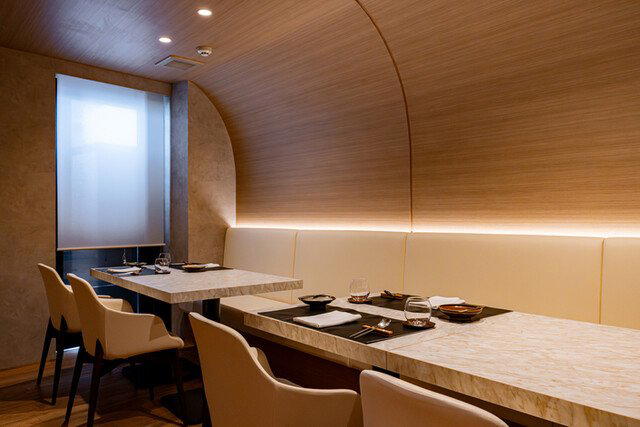
Intimate counter seating with an open kitchen where guests engage directly with the chef and staff in a warm, refined atmosphere with minimalist yet elegant presentation.