Simonis aan de Haven
Simonis aan de Haven occupies a working harbour address in Scheveningen, The Hague's seafront district, where the North Sea catch arrives within sight of the kitchen. The restaurant has operated at this location for decades, positioning itself at the intersection of Dutch coastal produce and classical technique. For visitors to The Hague with a serious interest in North Sea fish cookery, it remains a reference point on the Scheveningen waterfront.
Pearl is the En Primeur Club membership app — saves, bookings, and concierge access live there. Same editors, same standards.
- Address
- Visafslagweg 20, 2583 DM Den Haag, Netherlands
- Phone
- +31703500042
- Website
- simonisvis.nl
- Directions
- Get directions
 Saves & bookings on Pearl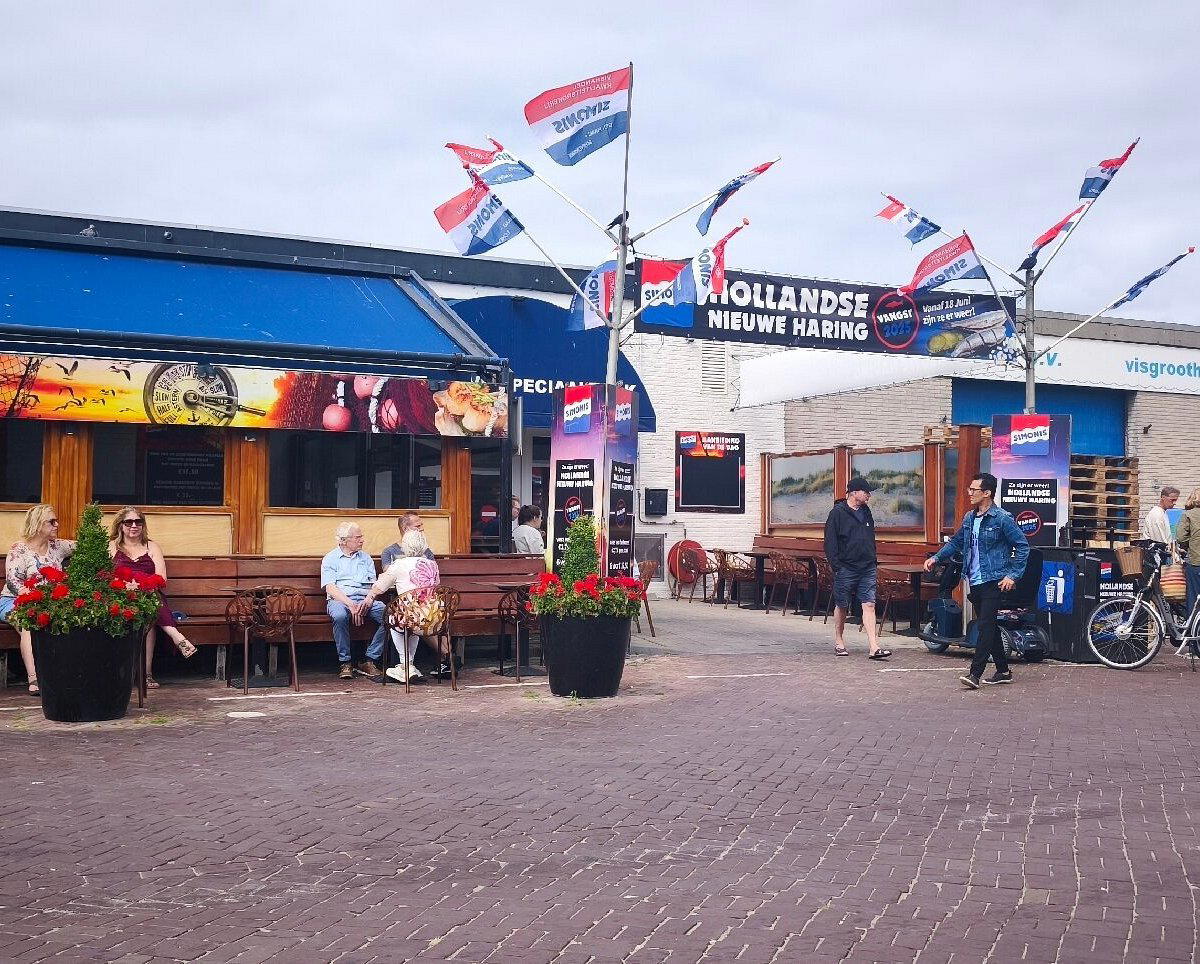
Where the North Sea Ends and the Kitchen Begins
Scheveningen's working fish harbour is not a designed dining destination in the way that many European waterfronts have been remade into. The quays at Visafslagweg still function as a commercial fishing operation, and the smell of brine and diesel is present long before any restaurant comes into view. Simonis aan de Haven sits at Visafslagweg 20, positioned close enough to the fish auction to make the provenance of its seafood a logistical fact rather than a marketing claim. That proximity to source, shared by only a handful of Dutch coastal restaurants, defines the category the kitchen operates in.
The wider Dutch seafood dining scene has fragmented over the past decade. At one end, destination restaurants such as Aan de Poel in Amstelveen and De Bokkedoorns in Overveen apply fine-dining architecture to coastal ingredients. At the other, direct fish cafés serve fried plaice and raw herring to tourists. Simonis historically occupies a middle register: harbour-facing, produce-driven, and operating with a seriousness about the fish itself that distinguishes it from the leisure trade along the seafront promenade.
North Sea Produce, Dutch Coastal Tradition
The editorial angle worth understanding here is not Simonis specifically but what the Scheveningen fish supply represents for the broader Dutch table. The North Sea is one of Europe's most productive cold-water fisheries, yielding sole, turbot, plaice, herring, mussels, and brown shrimp in quantities that make the Netherlands a net exporter of seafood. Much of that catch passes through Scheveningen before reaching restaurants across northern Europe. The irony that some of the leading North Sea fish is processed and shipped abroad while Dutch diners sometimes eat imported product is one that harbour-adjacent restaurants like Simonis are structurally positioned to correct.
Dutch coastal cooking has historically been less elaborated than its French or Scandinavian equivalents, favouring direct preparation over complex saucing. The influence of classical French technique arrived in Dutch professional kitchens primarily through the hotel and formal restaurant training circuit, and the tension between that inheritance and the directness of harbour cooking remains visible across the country's mid-to-upper seafood tier. Properties such as De Librije in Zwolle and 't Nonnetje in Harderwijk have navigated that tension toward Michelin recognition by anchoring local ingredients in technically precise formats. Simonis operates closer to the harbour tradition, where the quality of the raw material is expected to carry its weight without heavy interpretation.
For international reference, the operating philosophy at harbour-side institutions recalls the ethos of Le Bernardin in New York City, where the principle that the fish is the primary subject, not the sauce or the technique, governs every decision. That philosophy is harder to sustain without the sourcing advantage that a working harbour address provides.
The Hague's Dining Context
The Hague's restaurant scene has developed considerable range in recent years, though it remains less internationally publicised than Amsterdam's. The city's diplomatic and institutional population has historically supported formal dining formats, and that demand underpins venues such as Calla's at the leading creative-French tier and 6&24 in the modern cuisine bracket. Scheveningen, as The Hague's seaside district, operates somewhat separately from the city centre dining circuit. It draws a mix of locals, day visitors from Amsterdam and Rotterdam, and international guests staying along the Boulevard. The harbour end, where Simonis is located, is less touristically concentrated than the Pier area and attracts a clientele with a more specific interest in the fishing industry's output.
Across the city, the momentum in ingredient-led cooking is visible at places such as Basaal, which operates in the seasonal cuisine bracket, and Botanica, which applies a botanical lens to its sourcing. Bistro Veen represents the city's more informal register. None of these, however, share Simonis's specific geographic relationship to primary seafood supply. That singular positioning is what places it in a different competitive conversation from the city's other seafood-leaning venues.
For broader context on the Dutch fine-dining circuit away from The Hague, Ciel Bleu in Amsterdam, De Nieuwe Winkel in Nijmegen, De Groene Lantaarn in Staphorst, De Lindehof in Nuenen, De Lindenhof in Giethoorn, and Brut172 in Reijmerstok represent the breadth of what Dutch kitchens are producing at the upper tier. Atomix in New York City demonstrates, from a different culinary tradition, how local-ingredients-plus-refined-technique has become a dominant dining grammar globally, one that the better Dutch harbour restaurants are quietly participating in on their own terms.
Planning Your Visit
Simonis aan de Haven is located at Visafslagweg 20, 2583 DM Den Haag, in the working harbour section of Scheveningen rather than on the leisure-facing Boulevard. The address is best reached by tram from The Hague city centre, with the Scheveningen Haven stop a short walk from the restaurant. Visiting between autumn and early spring brings the advantage of peak North Sea sole and turbot season, when cold-water fish are at their densest and the harbour is at its most active. Summer draws the largest crowds to the broader Scheveningen area but may mean shorter menus as species availability shifts. Simonis aan de Haven is open daily from 10 AM to 8 PM and is walk-in friendly.
Peers You’d Cross-Shop
Comparable venues nearby, for context on price, style, and recognition.
| Venue | Cuisine | Price | Notes |
|---|---|---|---|
| Simonis aan de HavenThis venue — the venue you are viewing | Dutch Seafood | $$ | Not listed |
| Glaswerk | Modern Seafood & Dutch Small Plates | $$ | Binckhorst |
| Harpoon | Modern Seafood Bistro | $$ | Noordeinde |
| Café Nationaal | Modern Belgian Brasserie | $$ | Centrum |
| Waroeng Padang Lapek | Authentic Sumatran Padang Cuisine | $$ | The Hague Centre (Kortenbos) |
| Full Moon City | Authentic Cantonese Dim Sum | $$ | Chinatown |
Continue exploring
More in The Hague
Restaurants in The Hague
Browse all →
Bars in The Hague
Browse all →
Hotels in The Hague
Browse all →
Wineries in The Hague
Browse all →
At a Glance
- Lively
- Cozy
- Casual Hangout
- Waterfront
- Waterfront
Current opening hours
- Monday
- 10 AM–8 PM
- Tuesday
- 10 AM–8 PM
- Wednesday
- 10 AM–8 PM
- Thursday
- 10 AM–8 PM
- Friday
- 10 AM–8 PM
- Saturday
- 10 AM–8 PM
- Sunday
- 10 AM–8 PM
Hours can change for holidays and private events. Last verified .
Lively and lively atmosphere with colorful, garish nautical decor featuring fishing nets and marine theme.