
Tabelog Silver #125
Our verdict
A 12-seat counter in Asagaya's backstreets, Shunsuke holds Tabelog Silver status for 2026 (score 4.33) and has appeared in the Tabelog Sushi Tokyo Top 100 across multiple years. Operating on two evening shifts from Tuesday through Saturday, it prices dinner at JPY 20,000–29,999, below the Ginza omakase bracket but with a comparable awards profile. Reservations open at the start of each month and fill immediately.

Pearl is the En Primeur Club membership app, where members save venues, book tables and use the concierge.
The menu
What to order
- Monkfish liver ankimo
- Chutoro nigiri
- Spot prawn
- Black abalone
- Tamago
Twelve Seats in Asagaya: What the Booking Window Tells You
Twelve counter seats. Two evening shifts. Reservations accepted only from the beginning of each calendar month. This is the structural reality of dining at Shunsuke in Asagaya, and those three facts communicate more about the counter's standing than any award summary could. In Tokyo's omakase economy, seat count and booking friction are reliable proxies for demand, and Shunsuke's format sits at the stricter end of the mid-tier sushi scene, counters where the community of regulars is tight, the monthly opening window closes fast, and the room itself makes little concession to tourist logistics.
The venue sits in Suginami Ward, roughly two to three minutes on foot from Asagaya Station's south exit. That address alone sets a context. Asagaya is a residential neighbourhood on the Chuo Line, operating at a distance, physical and atmospheric, from the Ginza and Minami-Aoyama corridors where Tokyo's most photographed omakase counters concentrate. The sushi scene there, like the neighbourhood itself, skews toward local knowledge rather than international walk-in traffic.
Where Shunsuke Sits in Tokyo's Sushi Tier Structure
Tokyo's omakase market has stratified considerably over the past decade. At the leading sit counters in central Ginza and Minami-Aoyama where dinner runs JPY 50,000 and above, often with Michelin recognition and waiting lists measured in months or years. A tier below, a smaller and less discussed group of counters, most of them outside central Tokyo, operate at JPY 20,000–30,000, carry credible Tabelog scores, and draw a clientele that is predominantly Japanese. Shunsuke belongs to this second group.
Its Tabelog score of 4.33 in 2026, paired with a Silver award for the same year, places it among the better-regarded sushi counters in the city by that platform's peer-reviewed methodology. For reference, Tabelog Silver represents roughly the leading two to three percent of all rated restaurants on the platform. The counter has held Silver in 2018, 2019, 2024, 2025, and 2026, with Bronze in the intervening years, a track record that spans nearly a decade of consistent recognition. It has also been selected for the Tabelog Sushi Tokyo Top 100 in 2021, 2022, and 2025, a list that benchmarks the counter against the broader Tokyo sushi scene rather than just its immediate neighbourhood.
For comparison, the central-Tokyo omakase tier is well represented by counters like Harutaka in Ginza, which operates at a higher price point with corresponding Michelin recognition. Shunsuke's position in the Tabelog ranking system suggests it competes on quality within a different price and location bracket, not a lesser one, a distinction worth understanding before booking.
The Booking Mechanics
The reservation process at Shunsuke is the most practical piece of intelligence to hold before planning around it. Cancellations are accepted at the start of each month, which is the functional equivalent of saying that new availability opens monthly. The cancellation policy is firm: 100 percent charge for same-day cancellations and for cancellations made the day before. This is standard for counters of this demand level in Tokyo, but it means that speculative bookings, securing a date before confirming travel, carry real financial risk.
The counter runs two shifts: the first from 18:00 to 20:50, the second from 21:00 to midnight. For visitors from outside Japan, the first shift is the more accessible option, leaving time afterward in a neighbourhood with its own low-key bar and café culture along the Asagaya Pearl Center arcade. The second shift caters more naturally to regulars who have come straight from work or from earlier evening plans in the area.
Photography policy: quick, silent phone or camera shots of dishes are permitted; prolonged or large-format camera work is not. This is worth noting for those who habitually document their meals, as the policy is confirmed directly with the restaurant.
Format, Drink, and the Room
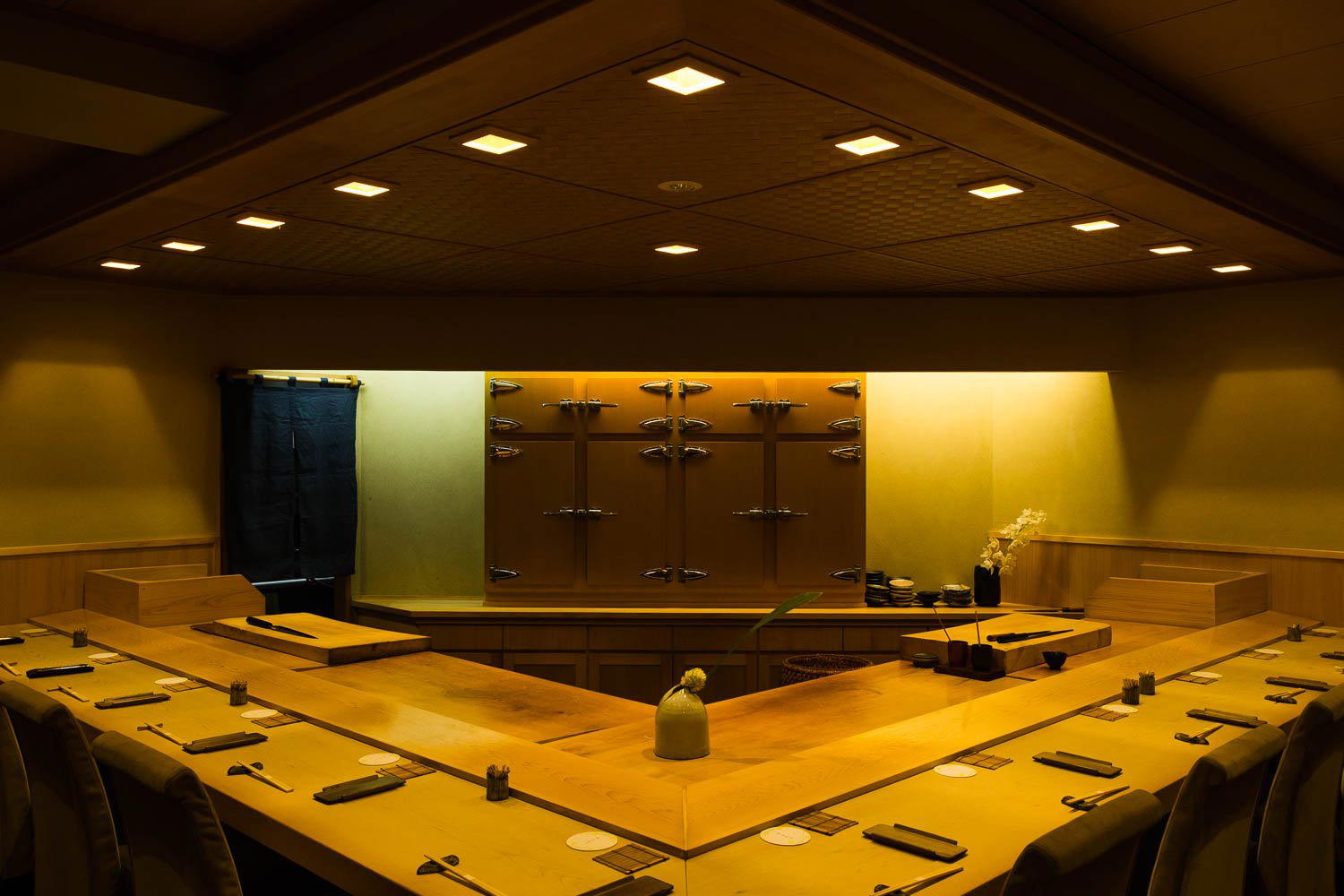
The counter is in a basement space, described in the venue data as B1F, which places it in a category of Tokyo dining rooms that trades on intimacy over spectacle. Twelve seats, all at the counter, no private rooms. The setting is noted as a relaxing space with spacious seating, an unusual descriptor for a basement counter, and one that suggests the room does not feel compressed despite being below street level.
The drinks program is focused on sake and shochu, with the venue described as particular about both. In the context of a sushi counter, a sake selection is not incidental, the pairing logic between nigiri and nihonshu (particularly junmai and junmai daiginjo styles) is a central part of how the meal functions as a whole. Counters that claim to be particular about sake are making a specific claim about procurement and selection depth, not just availability.
Counter is non-smoking throughout. Credit cards are accepted broadly: Visa, Mastercard, JCB, American Express, and Diners. Electronic money and QR code payments are not accepted.
The Neighbourhood and Getting There
Asagaya functions differently from Tokyo's better-known dining districts. It lacks the restaurant density of Shinjuku or the international profile of Roppongi, but it holds a reputation among Tokyoites as a neighbourhood with genuine local character, record shops, independent izakayas, long-established shotengai (shopping streets). Dining here does not feel curated for visitors, which is precisely the point for the category of traveller inclined to look past central Tokyo's concentrated fine dining.
The walk from Asagaya Station's south exit takes two to three minutes. The route passes the police box at the exit, continues down the narrow road, and turns right at the Smile Hotel. The counter is approximately 167 metres from the station entrance, in a building on the right side of a secondary side street. There is no parking on site.
For those building a broader Tokyo itinerary, the city's restaurant scene extends well across the dining spectrum. L'Effervescence and Sézanne represent the French fine dining tier; RyuGin anchors the kaiseki end; Crony occupies the innovative end of the contemporary spectrum. Shunsuke positions itself firmly in the traditional sushi counter format, operating at a price point and address that separate it from that central cluster. Our full Tokyo restaurants guide maps the broader scene, while separate guides cover hotels, bars, wineries, and experiences across the city.
If the Tokyo trip extends to other regions, the Japanese fine dining circuit includes HAJIME in Osaka, Gion Sasaki in Kyoto, akordu in Nara, Goh in Fukuoka, 1000 in Yokohama, and 6 in Okinawa. For international reference points at the fish-focused end of the spectrum, Le Bernardin in New York City and Atomix in New York City represent the highest tier of their respective categories.
Planning Details
Reservations: Phone (+81-3-3391-3118) or reportedly via website; availability opens at the start of each month. Cancellation policy: 100% charge for same-day and day-before cancellations. Hours: Monday to Saturday, 18:00–midnight, with two shifts (18:00–20:50 and 21:00–24:00); occasionally closed Mondays, confirm in advance. Budget: JPY 20,000–29,999 per person at dinner. Seats: 12 counter seats only; no private rooms. Payment: Visa, Mastercard, JCB, Amex, Diners accepted; no electronic money or QR payments. Dress code: Not specified. Access: Approximately 2–3 minutes on foot from Asagaya Station south exit; no on-site parking.
Frequently asked questions
What makes Shunsuke worth seeking out?
The awards record is the clearest evidence: Tabelog Silver in 2026 (score 4.33), with Silver and Bronze recognition stretching back to at least 2017, and selection for the Tabelog Sushi Tokyo Top 100 in 2021, 2022, and 2025. That sustained recognition across nearly a decade places the counter in a small group of Tokyo sushi venues that have maintained peer-reviewed quality without the address premium of Ginza. The dinner price range of JPY 20,000–29,999 sits noticeably below the central-Tokyo omakase bracket, while the awards profile is comparable. For a reader willing to book ahead and travel to Asagaya, that gap represents genuine value relative to what the Tabelog data implies about quality.
What do regulars order at Shunsuke?
The venue data describes the counter as particular about fish, with an omakase format typical of counters in this category, meaning the selection follows the chef's choice rather than à la carte ordering. The drinks focus is on sake and shochu, with the venue specifically noting attention to nihonshu quality.
Can Shunsuke adjust for dietary needs?
Given the omakase format and the small-counter structure, it is advisable to communicate requirements directly when making a reservation. The phone number is +81-3-3391-3118. For complex dietary needs, contacting the counter well in advance, not at the point of the monthly reservation opening, gives the kitchen adequate notice to determine whether adjustments are possible. Approaching this as a direct request rather than an assumption is the appropriate approach for any counter of this type.
Cost and Credentials
Comparable venues nearby, for context on price, style, and recognition.
| Venue | Cuisine | Price | Awards | Notes |
|---|---|---|---|---|
| ShunsukeThis venue (the venue you are viewing) | Edomae Sushi Omakase | $200–300 | Tabelog Silver #125 | Not listed |
| Hato | Modern Kaiseki-Style Sushi Omakase | $200–300 | Tabelog Silver #34 | Shibuya, Modern Kaiseki-Style Sushi Omakase |
| Sushi Ochi | Traditional Japanese Sushi | $30–50 | Tabelog 100 #60 | Minato, Traditional Japanese Sushi |
| Sushi Takeuchi | Traditional Japanese Omakase | $150–200 | Not listed | Shibuya, Traditional Japanese Omakase |
| Sushi Tokami | High-End Sushi Omakase | $200–300 | Not listed | Chūō, High-End Sushi Omakase |
| sushi riku | Edomae Omakase | $300–500 | Tabelog Bronze #369 | Shibuya, Edomae Omakase |
Recognition history
Dated appearances from independent guides and award organizations, with the underlying list record or original source where available.
Tabelog Silver #125
Tabelog
Full recognition history (3 entries)
Tabelog Silver
Tabelog
Tabelog 100 #46 · No. 46
Tabelog · Tabelog 100 - Sushi - TOKYO - 2025
Continue exploring
More in Tokyo
Restaurants in Tokyo
All restaurants in Tokyo →


Bars in Tokyo
All bars in Tokyo →



Details
- Elegant
- Intimate
- Sophisticated
- Special Occasion
- Date Night
- Chefs Counter
- Open Kitchen
- Sake Program
- Omakase
- Counter Dining
- Sake
Current opening hours
- Monday
- 6 PM–12 AM
- Tuesday
- 6 PM–12 AM
- Wednesday
- Closed
- Thursday
- 6 PM–12 AM
- Friday
- 6 PM–12 AM
- Saturday
- 6 PM–12 AM
- Sunday
- 6 PM–12 AM
Hours can change for holidays and private events. Hours as of .
Relaxing, serene space with spacious counter seating made of kiso hinoki wood in a quiet residential hideout.