Our verdict
Omicho Market has anchored Kanazawa's seafood supply chain since the Edo period, earning it the informal title of the city's kitchen. The covered market's stalls offer direct access to the Sea of Japan catch that underpins kaiseki dining across the region, from winter snow crab to spring cherry shrimp. For visitors, it is a working market first and a sightseeing point second.

Pearl is the En Primeur Club membership app, where members save venues, book tables and use the concierge.
The menu
What to order
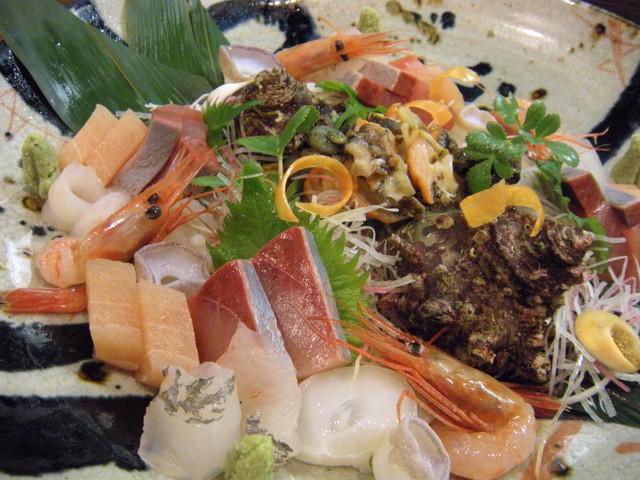
- Kaisendon (seafood rice bowl)
- Nodoguro sushi
- Omicho croquette
- Kanazawa oden
- Gold leaf ice cream
Where Kanazawa's Seafood Begins
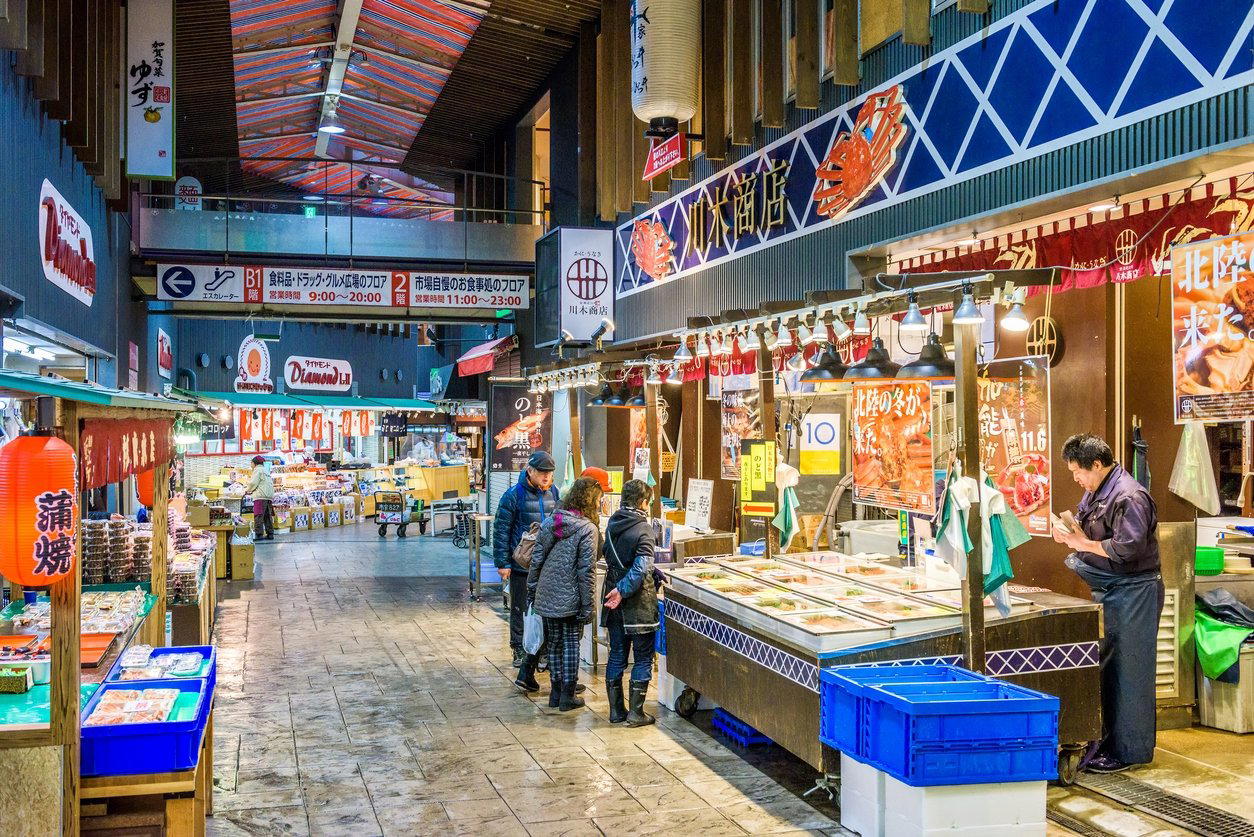
Walk the covered arcade of Omicho Market on a Tuesday morning in late November and the air carries salt and cold concrete before you see a single stall. Polystyrene boxes packed with ice line the walkways; fishmongers call across to one another in Kaga dialect; and the overhead fluorescents cast a flat, functional light over snow crab legs the length of your forearm. This is not a food hall curated for tourism. It is the supply infrastructure for a city that has maintained one of Japan's most serious regional food cultures for several centuries, and it reads as such.
Kanazawa's culinary standing rests in large part on geography. The Sea of Japan coast runs close, the Noto Peninsula extends north into productive cold waters, and the Kaga plain delivers rice, root vegetables, and freshwater fish inland. Omicho sits at the convergence of those supply lines, functioning as the node through which ingredients pass before reaching the kaiseki tables of venues like Dokkan and Amanatto Kawamura, as well as the city's broader restaurant ecosystem. Understanding the market is, in practical terms, a prerequisite for understanding what Kanazawa puts on a plate.
The Sourcing Logic Behind Kanazawa's Table
Japan's premium seafood culture depends on short, traceable supply chains, and Kanazawa's proximity to Kanazawa Port and the Noto fishing harbours gives it a structural advantage over inland cities. At Omicho, that advantage is visible in real time. Vendors specify catch origin on handwritten tags: fish from Wajima, crab from Kaga, prawns from Noto. This is the same specificity that drives allocation decisions at Michelin-level kaiseki counters across Japan, where ingredient provenance is as central to the menu as technique. Venues in other cities, from Gion Sasaki in Kyoto to HAJIME in Osaka, source premium seafood through similar wholesale relationships, but the market format at Omicho makes the underlying logic transparent in a way that a restaurant counter does not.
The seasonal rhythm here is pronounced. Winter, running from roughly December through February, brings zuwaigani (snow crab), the ingredient that defines Kanazawa's cold-season identity. Prices in the stalls reflect the premium attached to Kaga-branded crab, which carries a certification tag and commands a measurable premium over unmarked catch from the same waters. Spring shifts the focus toward shiroamaabi (sweet white shrimp), a Toyama Bay speciality that moves through Noto-area markets before arriving here. Summer brings sea urchin and young yellowtail. Autumn is the transition season, when vendors reload with the first cold-water fish ahead of the crab season. Visiting outside winter is not a lesser experience, but arriving between December and February aligns with the period when the market's sourcing depth is most evident.
How to Use the Market as a Visitor
Omicho functions across two registers for visitors. The first is observational: the market's covered arcade layout, established in its current general form during the Edo period and expanded through the twentieth century, is navigable on foot in under an hour and offers a condensed view of Ishikawa Prefecture's ingredient range. The second is participatory: a cluster of small eating counters and prepared-food stalls along the inner corridors sells cooked seafood, rice bowls, and grilled items sourced directly from adjacent vendors. These are operational businesses serving market workers and locals alongside tourists, which keeps quality incentives honest in a way that purpose-built food halls often do not.
Logistics are practical rather than complex. The market sits in central Kanazawa, walkable from the Katamachi and Korinbo districts, and is most accessible in the morning when vendor selection is at its fullest. Many stalls begin closing down or depleting stock by early afternoon, particularly for premium items. There is no formal booking for the eating counters; turnover is quick and seating is compact. For visitors arriving from further afield, Kanazawa is two and a half hours from Tokyo by Hokuriku Shinkansen, a connection that brought a measurable increase in visitor volume after the line's 2015 opening. The market absorbed that increase without significantly restructuring its operational character, which tells you something about the depth of its local trade base. For broader context on eating well across the city, the full Kanazawa restaurants guide maps the range from market-adjacent counters to formal kaiseki.
Omicho in the Context of Japan's Market Culture
Japan has a well-documented tradition of wholesale and public markets that feed premium dining ecosystems. Toyosu in Tokyo operates at a different scale entirely, functioning primarily as a wholesale node with limited public access. Nishiki in Kyoto is a retail and tourist market that has shifted meaningfully toward packaged goods over the past two decades. Omicho occupies a middle register: more accessible than Toyosu, more operationally intact than Nishiki, and more regionally specific than either. Its ingredient range reflects Ishikawa Prefecture's particular marine and agricultural profile rather than a national selection.
That specificity connects it to the broader question of why Kanazawa's food culture has maintained coherence while other regional Japanese cities have seen theirs dilute. The answer involves the continuity of local sourcing relationships, the density of serious restaurants relative to population, and the presence of Kanazawa's own kaiseki tradition, sometimes called Kaga cuisine, which developed under the Maeda clan's patronage and placed a premium on seasonal local produce. Venues across the city, from the French-influenced Budoonomori Les Tonnelles to the more casual Go! Go! Curry, exist within a food culture that Omicho helps sustain at the ingredient level. The gold-leaf craft shops of Hakuichi nearby reflect the same Kaga aesthetic that runs through the city's table.
For context on how similar sourcing-first philosophies translate to finished plates at high-end level, the counters at Harutaka in Tokyo and Goh in Fukuoka both demonstrate what happens when direct-source seafood relationships are built into a restaurant's operating model from the start. Regional peers worth noting include 三本木 長谷川制 in Nanao and 湖麺屋侶 in Takashima, both of which operate within the same Hokuriku ingredient geography that Omicho supplies. Further afield, 夕張山乃 in Sapporo and 麻羽屋 in Nishikawa Machi show how cold-water Japanese seafood culture extends north into Hokkaido. The comparison with western destinations like Le Bernardin in New York City or Atomix underlines how differently sourcing transparency operates in market-integrated systems versus destination-restaurant models. Even akordu in Nara and Birdland in Sakai point to how Japan's regional food culture finds expression through specific local supply networks rather than generic national ones.
Frequently asked questions
What is the best time of year to visit Omicho Market in Kanazawa for seasonal seafood?
November through March is the window that draws serious visitors to Kanazawa's market, coinciding with the zuwaigani (snow crab) season, when Noto Peninsula boats land some of the most sought-after crab in Japan. Buri (yellowtail) peaks in winter as well, when cold Sea of Japan waters concentrate the fat content. Arriving in this window gives you access to the species that define Kanazawa's reputation as one of Japan's foremost seafood cities.
What should I order at Omicho Market?
Kanazawa's position between the Noto Peninsula harbours and Kanazawa Port means the market's strength is in cold-water species: snow crab (zuwaigani) in season, yellowtail (buri), and local flatfish. Several stalls offer prepared seafood and quick counter meals, so eating at the source is practical rather than ceremonial. Priorities shift by season, so ask vendors directly what arrived that morning.
How hard is it to get a table at Omicho Market?
Omicho is a public market, not a reservation-based restaurant, so there is no booking process for general access. Counter seats at the small eating stalls inside the arcade operate on a walk-in basis and can fill quickly during weekend midmornings. Arriving before 10am on weekdays gives you the best access to both vendors and seating.
What has Omicho Market built its reputation on?
The market's reputation rests on its role as the primary sourcing point for Kanazawa's restaurant community, which itself has one of the higher concentrations of Michelin-recognised dining outside Tokyo and Kyoto. Its covered arcade layout has operated in its current general form for decades, giving it the institutional weight that wholesale buyers and chefs rely on. The short supply chain from Noto and Kanazawa Port is the structural reason Kanazawa's seafood tables perform at the level they do.
Do they accommodate allergies at Omicho Market?
Omicho is a multi-vendor public market, so allergy accommodation depends entirely on the individual stall or counter restaurant. Shellfish and fish are the dominant product categories, which makes the market a high-risk environment for crustacean or finfish allergies. Visitors with serious allergies should communicate directly with each vendor before purchasing prepared food.
Is Omicho Market good value for money?
For access to the same seafood supply chain feeding Kanazawa's top restaurants, the market offers straightforward pricing without the service overheads of a formal dining room. Counter meals inside the arcade typically cost a fraction of what the same species would cost plated at a kaiseki counter in the city. The value proposition is direct: proximity to the source, not a discounted version of a premium experience.
Peers You’d Cross-Shop
Comparable venues nearby, for context on price, style, and recognition.
| Venue | Cuisine | Price | Awards | Notes |
|---|---|---|---|---|
| Omicho MarketThis venue (the venue you are viewing) | Fresh Seafood Market & Casual Dining | $10–20 | Not listed | Not listed |
| Tsubomi | Traditional Japanese sweets & kakigori cafe | $10–20 | Tabelog 100 #92 | Kanazawa |
| Rakugan Moroeya Nishichaya Karyo Ajiwai | Traditional Japanese wagashi & kakigori cafe | $10–20 | Tabelog 100 #73 | Kanazawa |
| Kureha | Traditional Japanese cafe & wagashi tea house | $10–20 | Tabelog 100 #55 | Kanazawa |
| ちくわ | Modern Kanazawa Oden | $20–30 | Not listed | Kanazawa |
| China Dining Queen | Cantonese Chinese | $20–30 | Tabelog 100 #13 | Kanazawa |