
Our verdict
Muroi sits in Kyoto's Kita Ward, away from the tourist circuits of Gion and Higashiyama, in a district whose quieter register shapes the dining experience from the first approach. The address places it within a tradition-weighted northern quarter of the city, where the relationship between food, season, and place tends to be taken seriously rather than performed.

Pearl is the En Primeur Club membership app — saves, bookings, and concierge access live there. Same editors, same standards.
A Northern Quarter, A Different Register
Kyoto's dining reputation is built largely on the corridor between Gion and the Kamo River, where kaiseki houses compete on depth of lineage and the number of black-and-white Michelin announcements framed near the entrance. The city's Kita Ward operates on a different frequency. The neighbourhood around Takagamine, where Muroi holds its address at 6 Takagamine Kuromoncho, is one of the older, less trafficked residential reaches of northern Kyoto, a district whose character is formed by proximity to Daitokuji temple complex and the quieter domestic rhythms of a ward that sees far fewer visiting plates and tour groups than the southern precincts. Coming here for dinner is already a positioning decision.
That geographical remove from the competitive cluster of ¥¥¥¥ kaiseki houses along the Gion–Pontocho axis is not incidental. Properties like Gion Sasaki, Kikunoi Honten, and Hyotei anchor that southern and central tier, each carrying decades of Michelin validation and a guest list with a significant international proportion. The further north you travel, the more the audience shifts toward Kyoto residents and repeat visitors who have already worked through the canonical addresses. Dining in Kita Ward tends to mean dining for people who already know where everything else is.
What the Address Implies About the Experience
In Japanese restaurant culture, address is rarely accidental. The decision to operate in a northern residential quarter rather than near the high-visibility precincts of Gion or Kawaramachi carries specific implications about intended audience, format, and pace. Restaurants in these quieter northern districts of Kyoto typically operate at smaller scale, with fewer covers, a less international walk-in trade, and a booking dynamic driven more by word of mouth and repeat custom than by guidebook traffic. Mizai and Isshisoden Nakamura represent the kind of deeply embedded Kyoto dining that operates with quiet assurance rather than marquee visibility, and Muroi belongs to that broader tradition of Kyoto restaurants that trust their context to do part of the work.
For the visiting diner, the practical consequence is that Muroi requires advance planning. Northern Kyoto restaurants of this type are not walk-in propositions, and given the limited public-facing information currently available, reaching out through your hotel concierge or a reputable reservation service is the most reliable route to a confirmed booking. Concierges at the better Kyoto properties, including several listed in our full Kyoto hotels guide, maintain relationships with neighbourhood restaurants precisely because these spaces do not advertise heavily or maintain high-visibility online booking portals.
The Wine Dimension in a City Built on Tea
Kyoto's drinking culture has historically been structured around sake, shochu, and the ceremonial language of tea, with wine arriving late and establishing itself unevenly across the city's restaurant spectrum. At the top tier of the kaiseki category, wine programs have developed with serious intent over the past two decades, moving from perfunctory lists of recognisable Bordeaux to curated cellars with genuine dialogue between the sommelier's choices and the seasonal progression of a multi-course meal. The challenge of pairing wine with kaiseki is real: a cuisine built on restraint, umami depth, and the deliberate avoidance of fat and char does not accommodate tannic reds in the way that a European tasting menu might. The most thoughtful programs lean toward Burgundy whites for the early dashi-forward courses, mature Champagne as a structural anchor, and aged German Riesling or Alsatian bottles when sweetness and acidity need to carry a dish.
In the wider Kansai dining circuit, this question of wine integration is handled with particular seriousness at certain addresses: HAJIME in Osaka operates a cellar whose depth reflects years of intentional acquisition, and akordu in Nara approaches the pairing question from a Western culinary base with strong wine credentials. Visitors with specific cellar expectations or allocation-level bottle requests should confirm details directly before booking, ideally through a concierge who can communicate with the restaurant in Japanese.
Placing Muroi in the Broader Japan Map
For visitors building a multi-city dining itinerary across Japan, Kyoto's northern dining tier is one node in a wider network of serious, low-volume restaurants that repay dedicated travel. Harutaka in Tokyo operates in a similar register of quiet authority, and further afield, Goh in Fukuoka, Bleston Court Yukawatan in Nagano, and giueme in Akita each represent the regional variant of the same principle: that Japan's most compelling dining experiences are distributed well beyond the obvious city-centre coordinates. Internationally, the comparison holds at a structural level with addresses like Le Bernardin in New York City or Emeril's in New Orleans, where the relationship between location, established reputation, and format creates a consistent guest expectation. Muroi's Kita Ward address places it in that category of restaurants where getting there is part of the signal you send about your priorities as a diner.
For broader context on how the city's dining, drinking, and hospitality options map across its many distinct quarters, our full Kyoto restaurants guide, our full Kyoto bars guide, our full Kyoto wineries guide, and our full Kyoto experiences guide provide the wider framework for structuring time in the city.
Planning a Visit
Muroi's address in Kita Ward places it roughly in the northern reaches of the city, accessible by taxi from central Kyoto in under thirty minutes from most hotel districts. Given the residential neighbourhood and the restaurant's apparent low public profile, arriving by taxi rather than on foot from a transit stop is the practical choice, particularly for evening visits. Booking through a hotel concierge or specialist reservation service is strongly recommended over attempting direct contact, and confirmation of any dietary requirements, including allergies, should be communicated clearly at the time of booking rather than on arrival, since kitchens operating at this scale and format in Kyoto depend on advance notice to adjust the seasonal progression of a set menu.
Frequently asked questions
Where is Muroi in Kyoto?
Muroi is located at 6 Takagamine Kuromoncho, Kita Ward, Kyoto, 603-8464, Japan, Kyoto.
Where exactly is Muroi located in Kyoto, and how do I get there?
Muroi is at 6 Takagamine Kuromoncho in Kita Ward, in the northern reaches of Kyoto near Daitokuji temple. It is not served directly by subway and is most reliably reached by taxi from central Kyoto, which typically takes under thirty minutes from Kyoto Station depending on traffic. Confirm the exact address with your driver, as the Takagamine district is a quiet residential area with limited signage.
What do people recommend at Muroi?
Given the format typical of northern Kyoto specialist restaurants in the Takagamine area, the expectation is a seasonal set menu built around whatever the kitchen has committed to that week or month. There is no à la carte to navigate. The discipline of the format is the recommendation: you eat what the season allows, in the sequence the kitchen sets.
Do I need a reservation for Muroi?
Yes, and the earlier the better. A restaurant operating in a residential quarter of Kita Ward, at 6 Takagamine Kuromoncho, without a publicly listed phone or booking portal, is not a walk-in proposition. Your best approach is contact through a hotel concierge in Kyoto or a specialist dining reservation service with local reach.
What makes Muroi worth seeking out?
The address itself is the argument. Takagamine is not where restaurants go to be found easily; it is where they go to operate on their own terms, close to Daitokuji and the northern cultural axis of the city. That distance from the Gion-and-Kamo concentration means the experience is shaped by the kitchen's priorities rather than the expectations of high-traffic tourism.
What if I have allergies at Muroi?
Communicate allergies in full at the time of booking, not on arrival. Kaiseki kitchens operating at small scale in Kyoto build courses far in advance around specific seasonal ingredients, and substitution on the day is structurally difficult. The format only works when the kitchen has complete information from the start.
Is a meal at Muroi worth the investment?
The value question at this tier of Kyoto dining is less about cost-per-dish than about what the format delivers: a coherent seasonal progression in a restaurant that has chosen a northern residential address over Gion visibility. That choice filters the room and concentrates the kitchen's attention. For visitors who understand what that trade-off means, it is a different kind of return than a decorated Gion counter provides.
Comparable Venues
Comparable venues nearby, for context on price, style, and recognition.
| Venue | Cuisine | Price | Awards | Notes |
|---|---|---|---|---|
| MuroiThis venue — the venue you are viewing | Modern Kyoto Kaiseki | $150–200 | Not listed | Not listed |
| 要庵西富家 (要庵 西富家) | Traditional Kaiseki Ryokan | $500+ | Not listed | Gion/Kawaramachi |
| Gion Fuji | Michelin-starred Tempura Omakase | $150–200 | Tabelog 100 #1 | Higashiyama |
| 草喰 なかひがし | Michelin 2-Star Seasonal Kaiseki | $50–100 | 2 Michelin Stars · La Liste Top Restaurants | Higashiyama (near Ginkaku-ji) |
| Kyo-Suiran (京 翠嵐) | French-Inspired Traditional Kaiseki | $200–300 | Not listed | Arashiyama |
| ユキフラン佐藤 | Seasonal Japanese Kaiseki | $100–150 | Not listed | Gion |
Recognition history
Dated appearances from independent guides and award organizations, with the underlying list record or original source where available.
Opinionated About Dining Top Restaurants in Japan Recommended
Opinionated About Dining
Continue exploring
More in Kyoto
Restaurants in Kyoto
All restaurants in Kyoto →
Bars in Kyoto
All bars in Kyoto →
Hotels in Kyoto
All hotels in Kyoto →
Wineries in Kyoto
Browse all →
Details
- Intimate
- Elegant
- Cozy
- Classic
- Quiet
- Date Night
- Solo
- Special Occasion
- Chefs Counter
- Open Kitchen
- Historic Building
- Sake Program
- Local Sourcing
- Omakase
- Counter Dining
- Vegetarian Friendly
- Vegan Options
Current opening hours
- Monday
- Closed
- Tuesday
- Closed
- Wednesday
- 12–2 PM, 6–10 PM
- Thursday
- 12–2 PM, 6–10 PM
- Friday
- 12–2 PM, 6–10 PM
- Saturday
- 12–2 PM, 6–10 PM
- Sunday
- 12–2 PM, 6–10 PM
Hours can change for holidays and private events. Last verified .
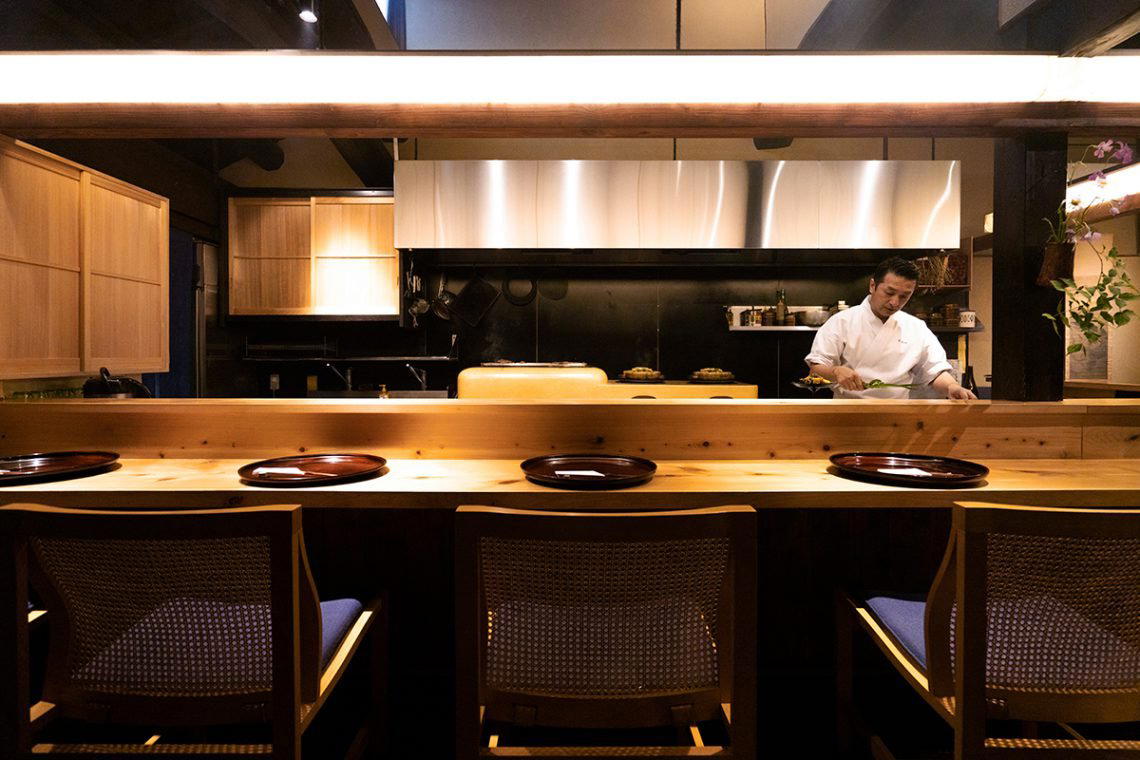
Warm dim lighting in a traditional kominka with quiet focused energy at the hinoki counter overlooking the open kitchen.