
Medika Soba Kingyo belongs to Tokyo’s serious suburban ramen tier, where small counters, short service windows and repeat recognition matter more than central postcode glamour. Its Tabelog Ramen TOKYO 100 selections from 2023 through 2025, seven-seat counter format and changing soup signal a shop built for focused ramen drinkers rather than leisurely dining.
Pearl is the En Primeur Club membership app — saves, bookings, and concierge access live there. Same editors, same standards.
- Address
- 東京都日野市石田2-9-1
- Website
- ameblo.jp
 Saves & bookings on Pearl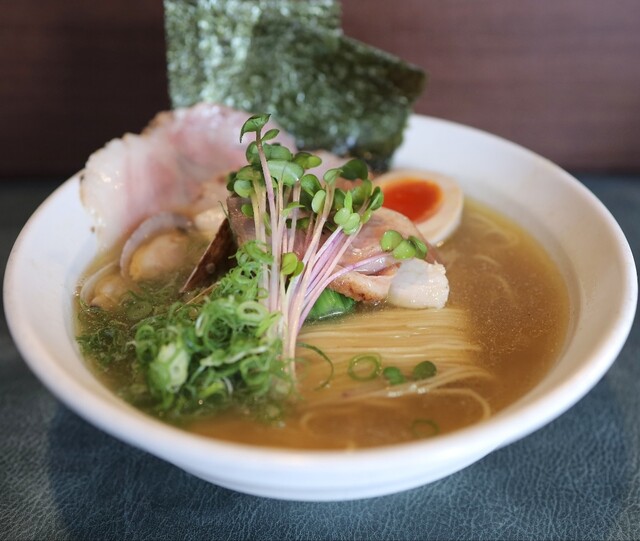
Approaching a small ramen counter on Tokyo’s western side changes the meal’s rhythm before the bowl arrives. Central ramen addresses often trade on station density and late-night turnover; out toward Hino, the pace is narrower and more deliberate, with the queue part of the service system. Medika Soba Kingyo fits that suburban Tokyo pattern: compact, rule-bound and organized around a daily soup decision rather than a sprawling menu.
Tokyo ramen now reaches far beyond the old shorthand of shoyu, shio, miso and tonkotsu. The sharper division is between high-volume shops as commuter infrastructure and specialist counters that require planning around limited capacity, ticket-machine ordering and soup availability. The latter has become one of the city’s serious eating categories, and the Tabelog Ramen TOKYO 100 list has helped codify it. Selection in 2023, 2024 and 2025 places this shop in that conversation, among ramen rooms judged less by décor than by broth identity, noodle handling and consistency within a punishingly narrow service model.
A changing soup format inside Tokyo's specialist ramen tier
The evolution here comes through rotation, not expansion. The curtain system indicates the day’s soup direction: red for Medika, white for dried sardines. That small signal matters in Tokyo ramen culture, where repeat customers track broth style with the attention wine drinkers give vintage variation. It also keeps the experience from becoming static without turning the restaurant into a tasting-menu operation.
This is where Medika Soba Kingyo separates itself from the city’s casual noodle mainstream. A seven-seat counter compresses the meal into a precise sequence: queue, ticket, bowl, exit. Reservations are unavailable, so the counter belongs to diners who accept ramen’s older democratic bargain: first arrival rather than concierge access. It is not luxurious in the hotel sense, but it is exacting, rewarding people who understand that a small ramen shop can be as operationally disciplined as a formal restaurant.
The price band also explains the category’s appeal. Tokyo can ask luxury money for sushi, tempura and kaiseki, yet some of its sharper food arguments still happen in the JPY 1,000 to JPY 1,999 range. Compared with Anjuna or OLD NEW DINER, both in a higher dinner band while still casual Tokyo options, this counter stays in the ramen lane, where value is measured by concentration and repeatability, not table length or wine service. Patisserie du Chef FUJIU occupies another low-ticket specialist niche in the city, but ramen’s pressure is different: the bowl must land immediately, repeatedly and in front of a waiting line.
The discipline of a seven-seat counter
Small Tokyo ramen shops often run on etiquette as much as cooking. Here, queue rules are part of the meal’s architecture: diners are asked not to hold places, not to assemble inside the line after parking, and not to park on the street in front of the shop. Those details sound mundane until the setting is clear. With only seven counter seats, one delayed group or badly managed car arrival can distort service for everyone behind it.
The ticket machine adds old-school ramen pragmatism. Cash discipline, small bills and coins remain useful at counters like this, even in a city where many dining categories have shifted toward cards and QR payments. The shop now supports new bills, and exchange for higher denominations is possible, but arriving prepared keeps the line moving. This is not theatre; it is how a compact ramen operation protects its tempo.
Location changes the decision. Manganji is not Ginza, Shinjuku or Roppongi, and that is part of the point. Tokyo’s ramen map has long rewarded travelers who look beyond hotel corridors and department-store dining floors. A four-minute walk from Manganji Station on the Tama Monorail keeps the shop within reach, while the western-city setting filters out diners who only eat within the Yamanote loop. For visitors using Our full Tokyo restaurants guide, it is a reminder that serious meals in Tokyo are not confined to central wards.
The restaurant opened in 2022, so its Tabelog Ramen TOKYO 100 selections from 2023 through 2025 signal quick consolidation rather than long nostalgia. That matters in a ramen scene where new shops constantly appear and attention can fade after one season of social-media heat. Repeated selection suggests the operation has settled into a current direction: small, soup-led and confident enough to let the curtain announce the day’s focus.
How to place it within a Tokyo dining day
Medika Soba Kingyo is better treated as a destination ramen stop than a flexible add-on between museum reservations. The service window is limited, soup can sell out, and the shop closes three days a week. A good Tokyo itinerary gives this counter its own slot rather than using it as a backup lunch. Pairing it with western Tokyo movement makes more sense than crossing the city on a tight central schedule.
For travelers mapping a broader Tokyo food day, the contrast is useful. Akihabara’s casual drinking and grill culture can pull diners toward . 鮪と炭火焼き うお炭 秋葉原店, while Shinjuku browsing may point to 12/10 Shinjuku ten. Yakitori sits in another compact-counter tradition at 124. KAGURAZAKA (Yakitori), and lighter city stops such as 2D Cafe or 3 Chome no Curry Ya San show how Tokyo’s casual categories often carry as much identity as formal dining rooms.
Readers building beyond restaurants can cross-check Our full Tokyo hotels guide, Our full Tokyo bars guide, Our full Tokyo wineries guide and Our full Tokyo experiences guide. For a wider Japan and Japanese-food map, compare the regional spread from -Grilled beef Sukiyaki- KAMAKURA TANUKIAN 鎌倉 たぬき庵 in Kamakura.cafe in Osaka.know in Kumamoto, (Shoku) Vietnam in Kawasaki, [Curry Senmon Ten] Maruyama Kyoju. in Sapporo and [ki:] in Kyoto to overseas Japanese formats such as Jōdo Saké Bar in Los Angeles and Onigiri Time in Pasadena.
A Lean Comparison
Comparable venues by category and price.
| Venue | Cuisine | Price | Notes |
|---|---|---|---|
| Medika Soba KingyoThis venue — the venue you are viewing | Hino, Japanese Ramen | $ | Not listed |
| Uchitate ya | Toshima, Handmade Udon Noodle Shop | $ | Not listed |
| Taiyaki Wakaba | Not listed | $ | Shinjuku, Traditional Japanese taiyaki & wagashi shop |
| Namake | Not listed | $ | Ōta, Casual Japanese izakaya standing bar |
| Wagashi Dokoro Oosumi Tamaya Ginza ten | Chiyoda, Japanese Wagashi Shop | $ | Not listed |
| DOMINICA Ginza ten | Not listed | $ | Chūō, Soup curry specialty (Sapporo-style Japanese curry) |
Recognition history
Dated appearances from independent guides and award organizations, with the underlying list record or original source where available.
Tabelog 100 #60 · No. 60
Tabelog · Tabelog 100 - Ramen - TOKYO - 2025
Continue exploring
More in Tokyo
Restaurants in Tokyo
Browse all →



Bars in Tokyo
Browse all →



Hotels in Tokyo
Browse all →




Wineries in Tokyo
Browse all →
At a Glance
- Cozy
- Quiet
- Solo
- Casual Hangout
- After Work
- Late Night
- Standalone
An intimate, no-frills ramen counter with just a handful of seats, a calm and focused atmosphere, and a classic neighborhood feel where guests quietly enjoy carefully crafted bowls of broth-heavy ramen.