
Taiyaki Wakaba belongs to Tokyo’s old-school wagashi circuit rather than the city’s dessert-as-theatre tier. Its counter-service rhythm, take-out format, Tabelog 100 selection for Tokyo Japanese sweets in 2023, and sub-¥1,000 budget place it in a category where craft is judged by repetition, queue discipline, and the quality of a single everyday sweet.
Pearl is the En Primeur Club membership app — saves, bookings, and concierge access live there. Same editors, same standards.
- Address
- Japan, 〒160-0011 Tokyo, Shinjuku City, Wakaba, 1 Chome−10 1F
- Phone
- +81 3-3351-4396
- Website
- 246.ne.jp
 Saves & bookings on Pearl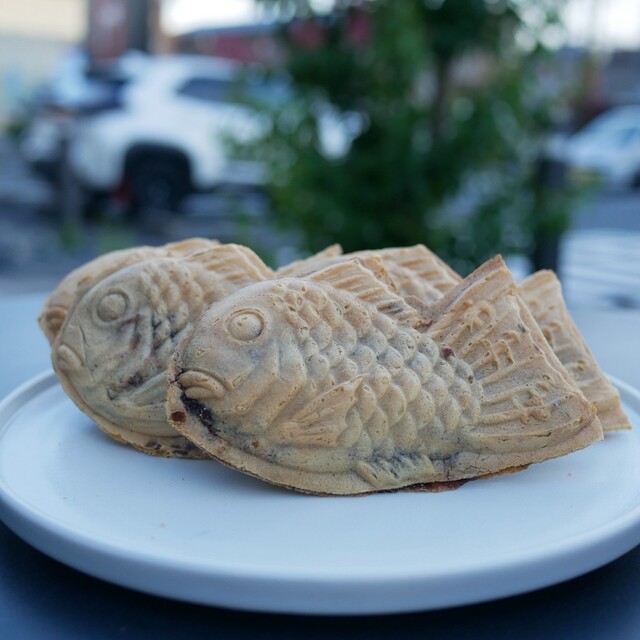
Approaching a serious taiyaki shop in Tokyo is not like entering a pâtisserie or booking dessert. The cues are modest: compact frontage, purposeful customers, and the impatience of people who know hot griddled sweets have a short window. Taiyaki Wakaba sits in Wakaba, near Yotsuya, in a Shinjuku pocket more residential and institutional than neon-lit. That matters: taiyaki belongs to the city’s daily-snack grammar, not its grand-dining vocabulary.
The form seems simple: fish-shaped batter, sweet bean filling, a griddle, paper wrapping, eaten warm or carried away. Tokyo treats simple foods as technical tests. Sushi counters calibrate rice temperature; soba shops judge water, flour, and timing; wagashi shops measure sweetness against texture and season. Taiyaki shares that culture of specialization. The point is not novelty, but whether a shop can repeat a modest thing with enough discipline that people cross town for it.
Tokyo taiyaki as a ritual of heat, queue, and restraint
The strongest taiyaki depends on timing. Unlike plated dessert, it loses authority as it cools, so the transaction has pace: order, wait, receive, step aside, eat before the shell softens. Serious taiyaki shops are rarely for lingering. Wakaba lists take-out and 14 table seats for those who want to pause, but the core experience is quick and focused.
Within Tokyo sweets culture, taiyaki sits apart from styled cafés. It is closer to senbei, imagawayaki, dorayaki, and other everyday confections that carry craft through texture and proportion rather than decoration. The benchmark is not component count, but whether batter, filling, sweetness, and heat arrive in balance. A low price band can coexist with serious reputation: average spend is listed below JPY 999, but scrutiny is not casual.
Taiyaki Wakaba’s Tabelog 100 recognition for Tokyo Japanese traditional sweets and Japanese sweets cafés in 2023 places it in a selective local field, not a luxury ranking. Tabelog’s Hyakumeiten lists tend to reward category depth; for wagashi, that often means narrow menus, repeat local custom, and clear craft identity. The same record lists earlier Tabelog 100 selections for Tokyo sweets in 2018, 2019, 2020, and 2022, signaling continuity rather than one burst of attention.
The shop is often discussed with Tokyo’s old taiyaki triumvirate, alongside Naniwaya in Azabu-Juban and Yanagiya in Ningyocho. These are not dessert rooms competing on décor, but specialist addresses judged on commitment to one form. In Tokyo’s broader hierarchy, Wakaba counters high-spend destinations such as Sushi Sho Yotsuya or Mitani, where ritual is formalized through courses, seating cadence, and price. Here, ritual is compressed into minutes, yet treated with comparable seriousness.
Why the craft reads differently from a café dessert
Japanese sweets often work by restraint: sweetness is controlled, texture carries meaning, and seasonality enters without long explanation. Taiyaki’s charm is the tension between folk-food familiarity and precision. The fish shape looks playful, but the format is unforgiving. Too-thick batter turns heavy; too-sweet filling overwhelms bean grain; mismanaged heat collapses the outside-inside contrast.
Wakaba’s listed categories, taiyaki, obanyaki, café, and Japanese traditional sweets, put it in a practical hybrid zone. It is neither formal tea house nor trend café built for photography. Summer adds shaved ice, aligning it with Tokyo warm-weather sweets habits, when kakigori culture expands beyond specialist dessert bars. That seasonal detail shows how old confectionery shops adapt without abandoning central craft.
Etiquette is simple: do not treat the visit like a long meal. Read it as a short stop within a larger Yotsuya or Shinjuku day, especially if the itinerary includes heavier dining. Pair taiyaki with a later counter meal or izakaya booking rather than forcing it into dessert-after-dinner duty. For a wider city plan, Our full Tokyo restaurants guide gives the broader restaurant field, while Our full Tokyo bars guide, Our full Tokyo hotels guide, Our full Tokyo experiences guide, and Our full Tokyo wineries guide place the snack within a full-day route.
Tokyo’s range makes sequencing easy. A sweet stop near Yotsuya can precede yakitori at 124. KAGURAZAKA (Yakitori), a casual café detour such as 2D Cafe, or a compact meal at 3 Chome no Curry Ya San. Shinjuku and Akihabara itineraries can pull in 12/10 Shinjuku ten or. 鮪と炭火焼き うお炭 秋葉原店. The contrast is the point: Tokyo lets a sub-¥1,000 sweet carry as much cultural specificity as a formal meal.
The practical reading: low cost, narrow format, serious expectations
The address is a short walk from Yotsuya Station, easy to fold into a central Tokyo day without building an excursion around it. Hours run during the day; the shop closes Wednesdays and Sundays, so plan for lunch-hour or afternoon rather than late-night eating. Reservations are unavailable, payment is cash-only, and there is no parking: a small traditional sweets stop built for direct, low-friction transactions.
Those details clarify who should prioritize it. Travelers chasing elaborate tasting menus may underrate taiyaki because the price is low and the format brief. That is a mistake. Tokyo food culture is not arranged by price alone. Some of the city’s clearest lessons come from single-item specialists, and Wakaba shows how craft, repetition, and neighbourhood habit create reputation without ceremony. Children are welcome, the room is non-smoking, and table seating is listed, but read it as a disciplined snack counter with limited pause time, not a café afternoon.
It also fits a wider Japanese casual-food map that rewards specificity over scale. Outside Tokyo, the same editorial logic applies to places as different as -Grilled beef Sukiyaki- KAMAKURA TANUKIAN 鎌倉 たぬき庵 in Kamakura.cafe in Osaka.know in Kumamoto, (Shoku) Vietnam in Kawasaki, [Curry Senmon Ten] Maruyama Kyoju. in Sapporo, and [ki:] in Kyoto. Even Japanese food culture abroad, from Jōdo Saké Bar in Los Angeles to Onigiri Time in Pasadena, often succeeds when it respects the same principle: a narrow form executed with discipline beats a long menu with weak conviction.
The verdict is not luxury. Taiyaki Wakaba is compelling because it compresses Tokyo’s dining values into an inexpensive, time-sensitive sweet: specialization, restraint, speed, and repeat craft. In a city where food pilgrimages often point toward omakase counters and prix fixe rooms, this is the counterargument in paper wrapping.
Style and Standing
Comparable venues side-by-side for orientation.
| Venue | Cuisine | Price | Notes |
|---|---|---|---|
| Taiyaki WakabaThis venue — the venue you are viewing | Traditional Japanese taiyaki & wagashi shop | $ | Not listed |
| Uogashi Nihon-ichi (魚がし日本一) | Standing Sushi Bar | $ | Shibuya |
| Kitchen Taka | Japanese yoshoku (Western-style comfort food) counter | $ | Shinjuku |
| Toranomon Okanoeisen Shinjuku takashimaya ten | Japanese traditional sweets (wagashi) | $ | Shibuya |
| Mizuho | Traditional Japanese wagashi (mame daifuku specialty) | $ | Shibuya |
| Sabameshi no Sabashou | Japanese saba-focused cafeteria | $ | Chiyoda |
Recognition history
Dated appearances from independent guides and award organizations, with the underlying list record or original source where available.
Tabelog 100 #1 · No. 1
Tabelog · Tabelog 100 - Japanese traditional sweets / Japanese sweets cafe - TOKYO - 2023












At a Glance
- Classic
- Cozy
- Quiet
- Solo
- Casual Hangout
- After Work
- Late Night
- Family
- Standalone
- Historic Building
- Design Destination
- Street Scene
Current opening hours
- Monday
- 9 AM–5 PM
- Tuesday
- 9 AM–5 PM
- Wednesday
- Closed
- Thursday
- 9 AM–5 PM
- Friday
- 9 AM–5 PM
- Saturday
- 9 AM–5 PM
- Sunday
- Closed
Hours can change for holidays and private events. Last verified .
The atmosphere is that of a nostalgic neighborhood sweet shop: a small, simple room with table seating, a glass-encased griddle where taiyaki are cooked one by one, bright but gentle lighting, and a calm, quietly local feel despite its fame.