
Michelin Plate
Our verdict
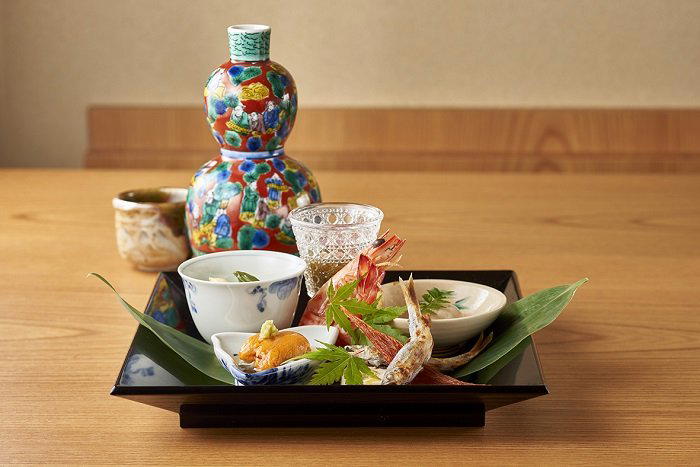
A Michelin Plate counter in Osaka's Kitashinchi district where the cooking sequence is built around temperature, aroma, and immediacy. Sashimi arrives with unconventional dressings including nori soy sauce and monkfish liver ponzu, while char-grilled beef and winter shabu-shabu of bear and boar are prepared directly in front of diners. The meal closes with a comparative flight of takikomi-gohan, seasoned rice cooked to order.

Pearl is the En Primeur Club membership app — saves, bookings, and concierge access live there. Same editors, same standards.
- Address
- 1 Chome-5-2 Tamatsukuri, Chuo Ward, Osaka, 540-0004, Japan
- Hours
- Mon 6–11:30 PMTue–Wed 5:30–11:30 PMThu 5:30 PM–12 AMFri–Sat 5 PM–12 AMSun 5–11 PM
- Directions
- Get directions
The menu
What to order
- Char-grilled beef
- Sashimi with nori seaweed soy sauce
- Takikomi-gohan
Counter Cooking as a Discipline
Osaka's Kitashinchi district has long operated as the city's most concentrated arena for serious Japanese cooking. Within a few blocks, the price range runs from mid-tier robatayaki to three-Michelin-star kaiseki at venues like Kashiwaya Osaka Senriyama, and the neighbourhood's reputation means diners approach it with calibrated expectations. Inside that spectrum, a smaller cohort of counters has built followings not on ceremony or accumulation of credentials, but on a stripped-back insistence that food must arrive at the exact moment it is ready. Kitashinchi Yumiba Shinnosuke belongs to this cohort.
The counter arrangement here is not decorative. It is structural to the entire proposition: the preparation surface is the dining room, and the sequence of the meal is governed by temperature and aroma rather than by a fixed printed menu. In Osaka's higher-end Japanese dining scene, this kind of real-time discipline sits somewhere between izakaya directness and the precision of kaiseki formats at venues like Tenjimbashi Aoki or Yugen. Yumiba Shinnosuke occupies a middle register, priced at ¥¥¥ and recognised with a Michelin Plate in both 2024 and 2025, sitting below the city's starred tier but well above the informal end of the market.
Where Sashimi Breaks From Convention
Across Japan, sashimi service has its conventions: wasabi and soy sauce, a few slices of pickled ginger, clean white fish before fatty fish, the sequence tightly controlled. The format works because it subordinates flavour to the intrinsic quality of the fish itself. Yumiba Shinnosuke departs from this orthodoxy without abandoning its underlying logic. Sashimi here arrives with unconventional dressings, including nori seaweed soy sauce and a preparation involving monkfish liver with ponzu. Both choices introduce a secondary layer of umami rather than sweetness or acid alone, which keeps the focus on marine character rather than diluting it.
This kind of flavour adjacency in sashimi dressing has parallels in Kyoto kaiseki tradition, where citrus-forward ponzu is used at counters such as Gion Sasaki, but the monkfish liver component brings a richer, fermented register more common in northern Japanese cooking than in Kansai. The result is a dish that reads as specifically local in its sourcing instincts while drawing on broader Japanese ingredient logic.
Fire, Proximity, and Winter Game
The counter format at Yumiba Shinnosuke concentrates most visibly around its char-grilled preparations. Beef is cooked over direct heat in front of diners, and the performance element here is functional rather than theatrical: the distance between the grill and the plate is measured in seconds, which is precisely the point. The temperature doctrine that drives the kitchen's organisation becomes most legible in this sequence.
In winter, the menu shifts to include shabu-shabu of bear and boar. Game cooking of this register is rare in an urban Osaka context. Bear meat, sourced from mountain hunting in Japan's colder prefectures, has a distinct iron richness that requires careful handling to keep the broth from turning heavy; boar is leaner and more assertive than domestic pork. Neither ingredient is a novelty item here. Their inclusion is consistent with the counter's broader orientation toward ingredients that demand precision in temperature management. Shabu-shabu, with its paper-thin slices passed briefly through barely simmering broth, is a format designed to hold that kind of fine margin. Diners seeking comparably serious game preparations in the wider Kansai region might find context in the way seasonal ingredients shape menus at Oimatsu Hisano or in Nara's more rural-influenced cooking at akordu.
Closing on Rice
Takikomi-gohan, rice cooked with various seasoning ingredients in a single pot, is one of Japanese cuisine's more understated traditions. At casual tables, it tends to appear as a single comforting option to close a meal. At Yumiba Shinnosuke, the closing course is structured as a comparative flight across multiple preparations, each seasoned differently, inviting direct side-by-side tasting. This format asks more of the diner than a single bowl does. It also makes explicit a principle that runs through the rest of the counter experience: that the meal is designed to produce active comparison rather than passive reception. The differences between a dashi-seasoned rice and one built around mushroom or root vegetable are subtle by design. They reward attention in the same way that the sashimi dressings do.
Within Osaka's wider Japanese restaurant scene, this rice-forward closing sequence is relatively uncommon at the ¥¥¥ tier. The three-Michelin-starred end of the market, which includes Kashiwaya Osaka Senriyama, tends to treat the rice course as a ritual transition point rather than a tasting exercise. Yumiba Shinnosuke's approach is more informal in register but no less considered in execution.
The Counter Discipline in Context
Understanding Yumiba Shinnosuke as a counter restaurant matters for setting expectations correctly. Counter dining in Japanese culinary culture is not simply a seating arrangement; it is a hospitality philosophy that distributes attention differently from table-service formats. At a counter, the front-of-house function and the kitchen function are largely unified. The cook and the person serving are often the same, which compresses the usual relay of information between kitchen and floor. Every judgment about when a dish is ready, how to read a diner's pace, and whether to explain or simply present is made in real time from the same position.
This model has established counters across Japan's serious dining scene, from the omakase sushi rooms in Tokyo explored through venues like Harutaka and technically-driven Japanese formats at Myojaku and Azabu Kadowaki, to regional formats in Fukuoka such as Goh and further afield in Yokohama and Okinawa. At Yumiba Shinnosuke, the configuration reinforces the temperature-and-aroma doctrine that shapes the menu. You sit close enough to the preparation surface to register the shift in smell as beef comes off the grill. That is not incidental; it is part of the service design.
For those building a broader picture of Osaka's Japanese dining category, the counter format here offers a useful reference point in a city whose reputation for direct, ingredient-driven eating extends well beyond its kaiseki rooms. The Michelin Plate recognition across two consecutive years signals consistency without conferring star-level prestige. That positioning is honest. This is a counter that rewards return visits and culinary curiosity more than it rewards occasion dining. It sits at a price point, ¥¥¥, that overlaps with the lower end of Osaka's starred Japanese restaurants, including Miyamoto, making direct comparison of value a reasonable exercise for regular visitors to the city.
For more context on where Yumiba Shinnosuke fits in the wider city, see our full Osaka restaurants guide. Those planning a broader Osaka visit can also explore our full Osaka hotels guide, our full Osaka bars guide, our full Osaka wineries guide, and our full Osaka experiences guide.
Know Before You Go
- Address: 1 Chome-5-2 Tamatsukuri, Chuo Ward, Osaka, 540-0004, Japan
- Cuisine: Japanese (counter format, fire-cooked, seasonal game)
- Price range: ¥¥¥
- Recognition: Michelin Plate 2024 and 2025
- Seasonal note: Bear and boar shabu-shabu is a winter feature; availability varies by season
- Seating: Counter arrangement around the preparation surface; proximity to the kitchen is integral to the experience
- Booking: Contact details not publicly listed; approach via local concierge or direct inquiry to the Kitashinchi address
Frequently asked questions
What should I budget for a meal at Kitashinchi Yumiba Shinnosuke?
Pricing at Kitashinchi Yumiba Shinnosuke is listed as ¥¥¥.
Where do I go for Kitashinchi Yumiba Shinnosuke?
Kitashinchi Yumiba Shinnosuke is located at 1 Chome-5-2 Tamatsukuri, Chuo Ward, Osaka, 540-0004, Japan, Osaka.
Has Kitashinchi Yumiba Shinnosuke won any awards?
Kitashinchi Yumiba Shinnosuke has received recognition including: The owner-chef prizes nothing more than the temperature and aroma of his cooking. All dishes are prepared and served fresh, so counter seating is arranged around the preparation surface. In a twist, the sashimi is served with unconventional….
What dish is Kitashinchi Yumiba Shinnosuke famous for?
No single preparation defines the counter in isolation. The most discussed elements are the sashimi served with unconventional dressings such as nori seaweed soy sauce and monkfish liver with ponzu, and the char-grilled beef prepared over direct heat in front of diners. In winter, the menu extends to shabu-shabu of bear and boar, a seasonal offering that draws attention well beyond the immediate neighbourhood. The meal closes with takikomi-gohan, rice cooked with seasoning ingredients, presented as a comparative tasting of flavours rather than a single finale dish.
Recognition Snapshot
| Venue | Cuisine | Price | Awards | Notes |
|---|---|---|---|---|
| Kitashinchi Yumiba ShinnosukeThis venue — the venue you are viewing | Japanese Omakase Counter Dining | $150–200 | Michelin Plate | Not listed |
| HAJIME | Avant-Garde Japanese Fine Dining | $300–500 | 3 Michelin Stars · World's 50 Best #83 | French, Innovative |
| La Cime | Modern French with Japanese Ingredients | $150–200 | 2 Michelin Stars · World's 50 Best #13 | French |
| Kashiwaya Osaka Senriyama | Seasonal Kaiseki Omakase | $200–300 | 3 Michelin Stars · La Liste Top Restaurants | Japanese |
| Taian | Traditional Japanese Kaiseki Omakase | $150–200 | 3 Michelin Stars · La Liste Top Restaurants | Kaiseki, Japanese |
| Fujiya 1935 | Modern Japanese with European influences | $100–150 | 2 Michelin Stars · La Liste Top Restaurants | Innovative |
Recognition history
Dated appearances from independent guides and award organizations, with the underlying list record or original source where available.
Michelin Plate
Michelin
Full recognition history (3 entries)
Michelin Plate
Michelin
Michelin Plate
Michelin
Continue exploring
More in Osaka
Restaurants in Osaka
Browse all →




Bars in Osaka
Browse all →

Hotels in Osaka
Browse all →



Wineries in Osaka
Browse all →
Details
- Intimate
- Elegant
- Sophisticated
- Date Night
- Special Occasion
- Business Dinner
- Chefs Counter
- Open Kitchen
- Sake Program
- Omakase
- Counter Dining
Current opening hours
- Monday
- 6–11:30 PM
- Tuesday
- 5:30–11:30 PM
- Wednesday
- 5:30–11:30 PM
- Thursday
- 5:30 PM–12 AM
- Friday
- 5 PM–12 AM
- Saturday
- 5 PM–12 AM
- Sunday
- 5–11 PM
Hours can change for holidays and private events. Last verified .
Relaxing counter seating around the preparation area with focus on fresh, aromatic cooking in an intimate setting.