Gojoya occupies a considered address in Osaka's Chuo Ward, positioning itself within a city where dining ritual carries as much weight as the food itself. The Uchihiranomachi district places it at a remove from Dotonbori's volume, and in Osaka that distinction matters. For readers building a serious itinerary, it belongs in the same conversation as the city's more deliberate kaiseki and kappo counters.
Pearl is the En Primeur Club membership app — saves, bookings, and concierge access live there. Same editors, same standards.
- Address
- 2 Chome-1-11 Uchihiranomachi, Chuo Ward, Osaka, 540-0037, Japan
- Phone
- +81669455045
- Website
- 94katu5jyoya.com
- Directions
- Get directions
 Saves & bookings on Pearl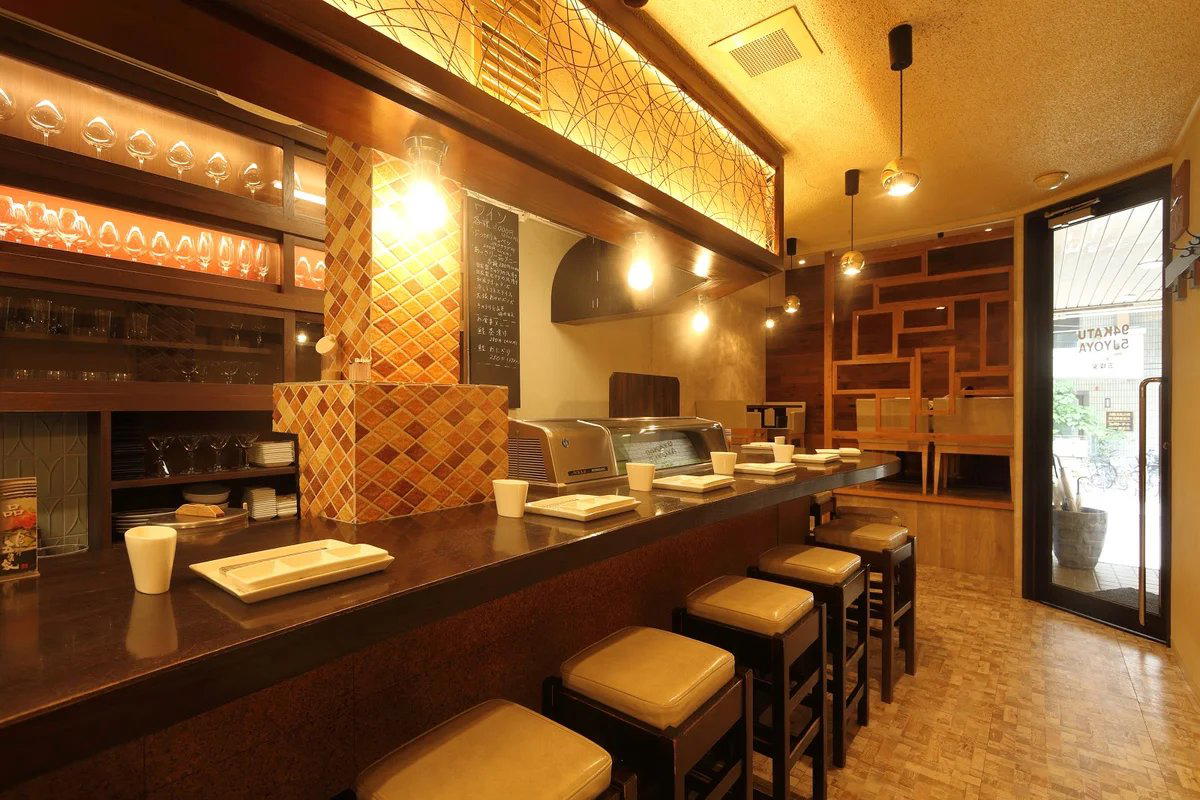
The Weight of a Meal in Chuo Ward
Osaka's Chuo Ward does not announce itself the way Dotonbori does. There are no illuminated crabs rotating above the street, no queues spilling onto bridge railings. What Uchihiranomachi offers instead is a kind of civic density that dates to the merchant-city era: narrow blocks, persistent quiet after dusk, and buildings that have housed serious commerce for generations. It is in this district that Gojoya sits at 2 Chome-1-11 Uchihiranomachi, in a neighbourhood whose character has long favoured the deliberate over the spectacular.
In a city defined by eating as a social practice, where the phrase kuidaore (eat until you drop) functions as both joke and genuine cultural code, the quieter quarters of Chuo Ward represent the other register: eating as attention, as ritual, as a structured experience that demands time and reciprocal focus from both kitchen and guest. That tension, between Osaka's boisterous street-food identity and its deeply formal dining traditions, is the context any serious restaurant in this district inhabits whether it chooses to or not.
The Ritual Before the Food Arrives
Japanese dining at the more considered end of the spectrum operates through a set of conventions that most visitors encounter without fully reading. The pacing is intentional, not incidental. Courses arrive in a sequence that has been decided in advance, and the interval between them is part of the design. In kaiseki and kappo formats, the kitchen's communication with the dining room is continuous and often invisible to the guest: a temperature calculated so that ceramic cools to the right degree by the time it is eaten, a broth timed so its surface is still moving when it appears at the table.
These customs are not exclusive to any single venue; they are the grammar of a culinary tradition that Osaka has practised for centuries alongside Kyoto, with its own merchant-class inflections. Where Kyoto's kaiseki has long carried imperial and tea-ceremony associations, Osaka's equivalent developed through the cooking culture of the chonin, the townspeople class whose commercial confidence shaped a cuisine more interested in directness and ingredient honesty than in refinement for its own sake. Restaurants in Chuo Ward that operate in this tradition tend to reflect that lineage: less about visual architecture on the plate, more about the quality of dashi, the handling of seasonal fish, the discipline with which a kitchen keeps itself to what is good rather than what is impressive.
For guests arriving from outside Japan, or even from other Japanese cities, understanding this distinction changes how a meal reads. The absence of theatrical plating is not restraint in the European modernist sense; it is a different hierarchy of values, one in which the ingredient's intrinsic quality is the signal and decoration would be noise. Venues like Ajikitcho Bunbuan and Aka to Shiro operate within this tradition at different price tiers, as does Ajihei Sonezaki, whose positioning in the city's kappo register offers a useful comparison point for readers mapping Osaka's mid-to-upper dining tier.
Situating Gojoya in Osaka's Competitive Field
Osaka's dining field has bifurcated at the leading end. On one side are venues that have attracted international recognition: HAJIME in Osaka, which holds three Michelin stars and operates in a register closer to contemporary French haute cuisine than to any traditional Japanese format, is the clearest example. On the other side is a denser cluster of kaiseki, kappo, and specialist counters that operate at high quality without the same international profile, serving a local clientele that values institutional knowledge and consistency over novelty.
Gojoya is a Fusion Kushikatsu Omakase restaurant in Osaka's Chuo Ward, where Uchihiranomachi places it geographically and, by association, culturally in the latter camp. This is not a neighbourhood that premium tourists find by accident. It functions as a working business district whose restaurants have historically been sustained by local regulars and business dining rather than by guidebook traffic. For comparison, Calendrier and Az represent the kind of quieter, technically focused venues that occupy this same city register without requiring the scaffolding of major awards recognition to maintain their position.
Across the Kansai region, serious restaurants in this tier tend to share certain structural features: limited seat counts, counters rather than full dining rooms, menus that shift with market availability rather than running fixed across seasons. Gion Sasaki in Kyoto and akordu in Nara both operate in adjacent traditions with enough proximity to Osaka that a well-constructed Kansai itinerary would address all three cities. Outside the region, Harutaka in Tokyo and Goh in Fukuoka represent the national peer field at the upper counter-dining tier.
How to Approach a Meal in This Quarter
For visitors whose previous reference points for formal Japanese dining are international outposts or hotel restaurants, a few structural realities are worth understanding in advance.
For context on how premium counter dining operates at venues with this orientation beyond Japan, Le Bernardin in New York City and Lazy Bear in San Francisco both operate through similarly structured pacing and pre-committed tasting formats, though in entirely different culinary registers.
Readers building longer Japan itineraries may also consider Abon in Ashiya, affetto akita in Akita, Aji Arai in Oita, Ajidocoro in Yubari District, and Akakichi in Imabari as part of a wider regional survey of Japan's serious dining outside the capital.
Comparable Venues
Comparable venues nearby, for context on price, style, and recognition.
| Venue | Cuisine | Price | Notes |
|---|---|---|---|
| GojoyaThis venue — the venue you are viewing | Fusion Kushikatsu Omakase | $$ | Not listed |
| Yomogi | Polished Udon and Japanese Courses | $$ | Fukushima |
| Yoshino Sushi | Traditional Osaka Hakozushi | $$ | Chūō |
| 本湖月 | japanese | Not listed | Chūō |
| 月泉 | Japanese Izakaya | Not listed | Kita |
| 食堂たのし | Modern Japanese Izakaya | $$ | Kita |
Continue exploring
More in Osaka
Restaurants in Osaka
Browse all →




Bars in Osaka
Browse all →

Hotels in Osaka
Browse all →




Wineries in Osaka
Browse all →
At a Glance
- Lively
- Energetic
- Classic
- Group Dining
- Casual Hangout
- Solo
- Open Kitchen
- Chefs Counter
Current opening hours
- Monday
- 5–11 PM
- Tuesday
- 5–11 PM
- Wednesday
- 5–11 PM
- Thursday
- 5–11 PM
- Friday
- 5–11 PM
- Saturday
- 5–11 PM
- Sunday
- Closed
Hours can change for holidays and private events. Last verified .
Lively kitchen tempo with nostalgic charm; the energy of deep-frying skewers creates an engaging, casual atmosphere.