
Yokohama’s curry culture is not confined to central dining districts, and Curry Senmon Ten KEN makes the case for the suburban counter as a serious format. A 12-seat, no-frills curry specialist in Aobadai with repeat Tabelog Curry 100 selections, it belongs to the city’s low-price, high-discipline tier rather than its reservation-led dining circuit.
Pearl is the En Primeur Club membership app — saves, bookings, and concierge access live there. Same editors, same standards.
- Address
- 10-18 Tsutsujigaoka, Aoba Ward, Yokohama, Kanagawa 227-0055, Japan
- Phone
- +81 45-982-6266
- Website
- tabelog.com
 Saves & bookings on Pearl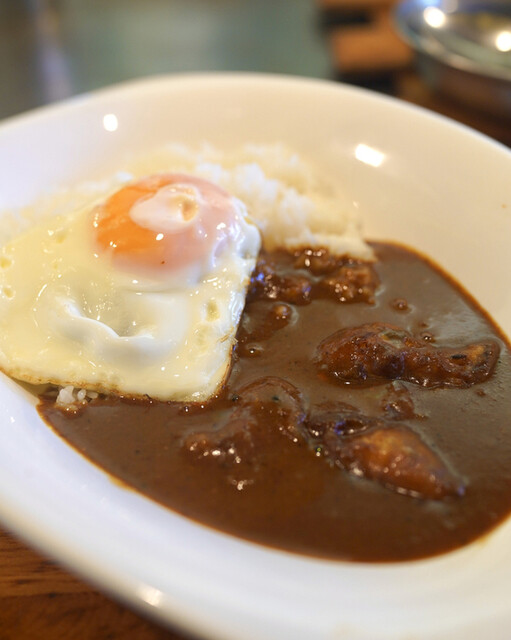
Approach the Aobadai end of Yokohama’s dining map and the rhythm changes. The room is not built around ceremony or long-form service; it is counter seating, close quarters, quick turnover, and the kind of small-team coordination that defines much of Japan’s serious everyday cooking. Curry shops at this level rely less on theatre than on repetition: a compact menu logic, a kitchen that moves in view, and front-of-house work that keeps the room from feeling stalled even when all 12 seats are taken.
That is the useful frame for Curry Senmon Ten KEN. Yokohama has polished hotel dining, Chinatown institutions, ramen counters, pastry specialists, and coastal-date restaurants, but its curry culture often lives in smaller, more functional rooms. Recognition from Tabelog’s Curry EAST “Tabelog 100” in 2024, with previous selections in 2023, 2020, 2019, 2018, and 2017, places this shop inside a competitive regional curry category rather than a neighbourhood-only conversation. The Tabelog score of 3.67 also signals a place that has earned attention in a category where casual pricing does not mean casual standards.
A small counter format where curry depends on pace, not pageantry
Japanese curry has split into several parallel traditions: home-style roux, kissaten plates, spice-forward independent shops, and specialist counters that build their reputation through consistency rather than luxury signals. The Aobadai format belongs to that last group. With counter seating and a 12-seat footprint, service depends on tight handoffs between the cooking line and the room. In a larger restaurant, small delays disappear into the choreography of drinks, bread, or table checks. At a curry counter, every pause is visible.
This is where the team dynamic matters. The kitchen’s job is not only to cook; it has to regulate timing, portions, take-out flow, and counter turnover. The front-of-house role is similarly practical: seat allocation, payment flow, and keeping solo diners, families, and pairs moving through a narrow service channel. A shop this small cannot hide behind decor or a long drinks list. Its reputation is built on whether the operation holds together across lunch pressure, dinner service, and repeat custom.
The category also rewards clarity. In Yokohama, budget-conscious specialists can sit beside more expensive destination restaurants without competing on the same terms. Ramen Sugimoto and Men Dokoro Akimoto occupy a higher everyday spend band in the comparison set, while PUISSANCE and Un Petit Paquet show how Yokohama’s sub-¥1,000 and low-price tiers can include both sweet and savoury specialists. Against that backdrop, Curry Senmon Ten KEN reads as a disciplined curry counter rather than a cheap fallback.
Aobadai's case for leaving the central Yokohama circuit
Yokohama visitors often default to Minato Mirai, Kannai, Chinatown, or the station area because those districts compress sightseeing and dining into an easy loop. Aobadai asks for a different decision. It sits in the city’s residential west, where restaurants serve regulars as much as culinary tourists, and where the reward is usually format-specific rather than scenic. That matters for curry. The dish travels well across class and occasion in Japan, but specialist shops gain authority through local repetition: commuters, solo diners, families, and small groups returning because the meal fits ordinary life.
For travellers, that makes the calculus sharper. This is not the place to structure an evening around long service, wine, or celebratory dining. It is a focused stop for readers who understand that Japanese food culture is often at its strongest in narrow formats: yakitori counters, ramen shops, tonkatsu rooms, curry specialists, and sushi bars all work from the same principle of concentration. The question is not whether the room feels grand; it is whether the format has enough discipline to justify the detour.
Yokohama’s broader restaurant map helps put that detour in perspective. For grilled-skewer structure, compare the counter logic at 1000 (Yakitori (Grilled chicken skewers)); for older local dining patterns, Aichun and Ajowan point in different directions. Curry travellers can also look at Alpenjiro Honten, while casual Japanese dining in other cities has useful parallels at Anzen Shokudo, (Shoku) Vietnam in Kawasaki, and [Curry Senmon Ten] Maruyama Kyoju. in Sapporo.
How to place it within a Yokohama itinerary
The strongest argument for Curry Senmon Ten KEN is editorial rather than scenic: it shows how serious Japanese dining can sit inside a low-price, small-room structure without adopting tasting-menu grammar. The awards history is the trust signal, but the more telling feature is the alignment of category, scale, and neighbourhood. A 12-seat curry counter in Aobadai has to be exact about what it is; there is little room for concept drift.
That makes it a better fit for a food-led Yokohama day than for a broad first-time city tour. Pair it with a west-side itinerary or treat it as a category stop for readers already comparing curry, ramen, and other specialist counters across Japan. For broader planning, use Our full Yokohama restaurants guide alongside Our full Yokohama hotels guide, Our full Yokohama bars guide, Our full Yokohama wineries guide, and Our full Yokohama experiences guide. Regional comparison can stretch further, from -Grilled beef Sukiyaki- KAMAKURA TANUKIAN 鎌倉 たぬき庵 in Kamakura to. 鮪と炭火焼き うお炭 秋葉原店 in Tokyo.cafe in Osaka.know in Kumamoto, Jōdo Saké Bar in Los Angeles, and Onigiri Time in Pasadena.
Compact Comparison
Comparable venues in the metro at similar price points.
| Venue | Cuisine | Price |
|---|---|---|
| Curry Senmon Ten KENThis venue — the venue you are viewing | Aoba, Japanese Curry | $ |
| Mendokoro Tatsunoki | Hodogaya, Japanese Ramen | $ |
| Menba Hamatora | Kanagawa, Ramen | $ |
| Ramen Free Birds | Sakae, Specialty Ramen Shop | $ |
| Men Dokoro Akimoto | Aoba, Ramen & Tsukemen | $ |
| Gumyoji Hekan | Minami, Ramen & Soba Izakaya | $ |
Recognition history
Dated appearances from independent guides and award organizations, with the underlying list record or original source where available.
Tabelog 100 #8 · No. 8
Tabelog · Tabelog 100 - Curry - EAST - 2024
Continue exploring
More in Yokohama
Restaurants in Yokohama
Browse all →


Bars in Yokohama
Browse all →




Hotels in Yokohama
Browse all →



Wineries in Yokohama
Browse all →
At a Glance
- Cozy
- Classic
- Family
- Solo
- Casual Hangout
- Standalone
Current opening hours
- Monday
- Closed
- Tuesday
- Closed
- Wednesday
- 11:30 AM–2:30 PM, 5:30–9:30 PM
- Thursday
- 11:30 AM–2:30 PM, 5:30–9:30 PM
- Friday
- 11:30 AM–2:30 PM, 5:30–9:30 PM
- Saturday
- 11:30 AM–2:30 PM, 5:30–9:30 PM
- Sunday
- 11:30 AM–2:30 PM, 5:30–9:30 PM
Hours can change for holidays and private events. Last verified .
A cozy, homely, hideout-style curry shop with a small counter-only dining room and a quiet, no-frills atmosphere focused on the food.