Our verdict
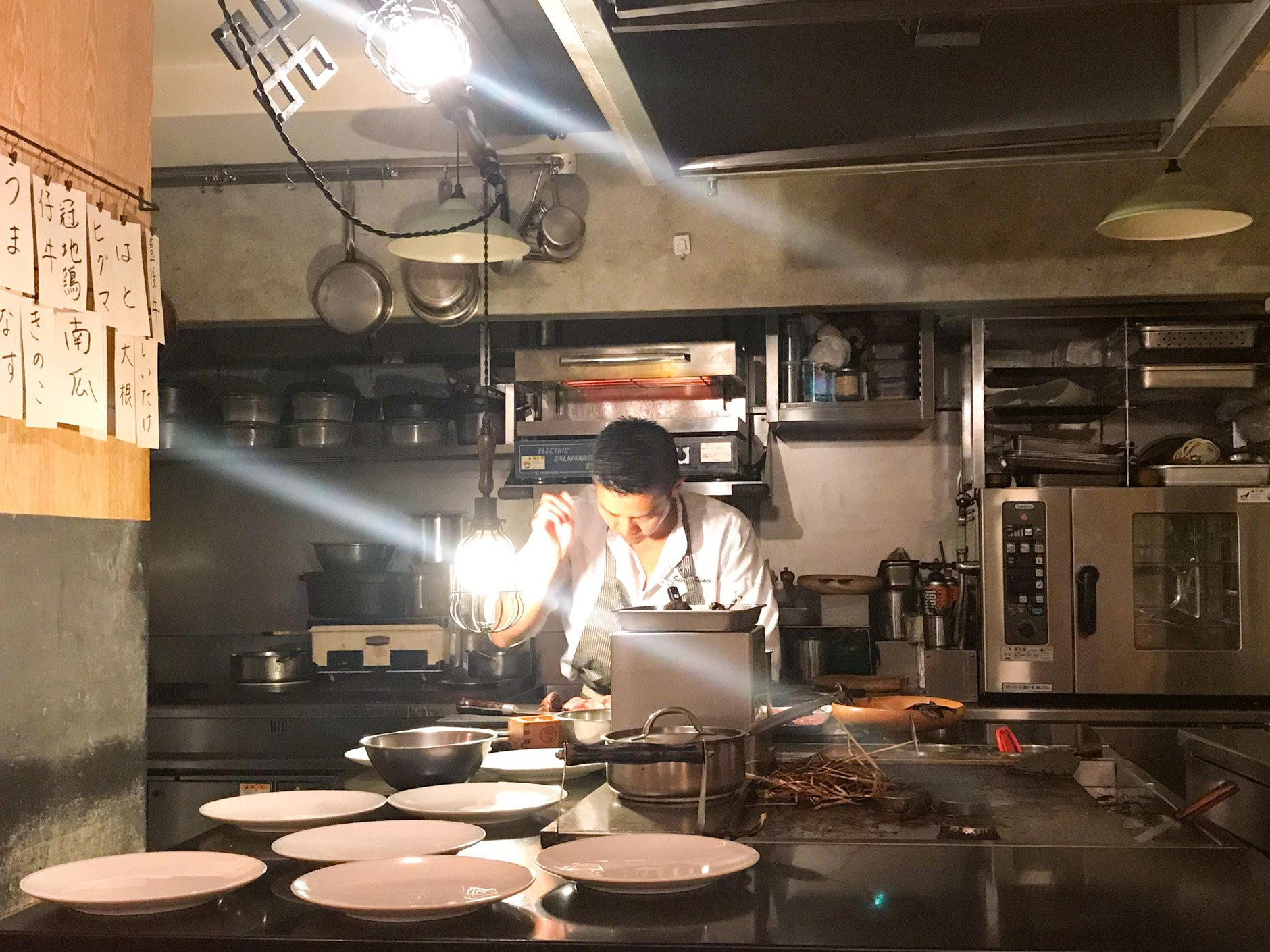
Anis pairs a Modern French Bistro approach with an open kitchen and chefs counter, plus a sake program for lunch or dinner at a quiet, leisurely pace.

Pearl is the En Primeur Club membership app — saves, bookings, and concierge access live there. Same editors, same standards.
- Address
- 初台1-9-7 (初台T&T 1F), 渋谷区, 東京都, 151-0061
- Directions
- Get directions
The menu
What to order
- Hari hari potato
- 4-hour cooked turnip
Hatsudai's Quiet Corner: Reading Anis Against Tokyo's French Dining Scene
The approach to Anis sets a particular expectation. Hatsudai, the district just west of Shinjuku where the restaurant occupies the ground floor of the 初台T&T; building on Hatsudai 1-9-7, is not a neighbourhood that draws dining tourists in the way Ginza or Roppongi does. That geographic remove is itself a signal — in Tokyo, restaurants in quieter residential-adjacent pockets tend to survive on local loyalty and word-of-mouth rather than footfall, which tends to produce a more focused, less performative dining room. The city has a long tradition of this: serious cooking sustained by a regular clientele, away from the spectacle corridors.
French Cooking in Tokyo: A Tradition That Runs Deep
Tokyo's relationship with French cuisine is not recent or superficial. The city spent decades absorbing classical technique through Japanese chefs who trained in France and returned to apply that rigour to local ingredients and sensibilities. That lineage produced a category of restaurants that sit between two traditions without fully belonging to either — neither the grand Parisian institution nor the kaiseki counter, but something formed at their intersection. The leading examples of this form, from L'Effervescence in Nishi-Azabu to Sézanne in the Four Seasons Marunouchi, occupy four-symbol price brackets and carry international recognition. But the tradition they represent reaches further down the price spectrum and further into the city's quieter neighbourhoods, into places like Hatsudai.
This matters for how you read Anis. The restaurant sits in a city where French cooking has been absorbed and reinterpreted across several generations of chefs. That means even a modest or mid-register French address in Tokyo may carry more technical seriousness than its neighbourhood or exterior suggests. The gap between a restaurant's location profile and its actual kitchen discipline can be significant here in a way it might not be in other cities.
Where Anis Sits in the Competitive Field
Tokyo's French dining broadly splits into two tiers. The upper bracket, L'Effervescence, Sézanne, Crony, involves multi-course tasting formats, significant per-head investment, and extended advance booking. The lower tier is neighbourhood bistro territory: approachable, often wine-forward, casual in format.
What the address does confirm is that Anis is not positioning itself alongside Ginza's top-floor dining rooms. Its peers in Hatsudai and the surrounding Shibuya-ward pockets tend to be smaller operations where the kitchen-to-dining-room ratio is high and the room itself modest. In Tokyo's French scene, that often correlates with cooking that prioritises substance over staging, a different value proposition from the city's award-circuit addresses but not a lesser one.
For comparison, the prix-fixe counters at Harutaka in the sushi category, or the kaiseki precision at RyuGin, represent Tokyo's version of cooking at full ceremonial register. Anis is almost certainly operating at a different register, closer in spirit, perhaps, to a serious neighbourhood address than to those formal institutions.
The Cultural Stakes of Anise as a Reference Point
The name itself is worth noting. Anis, the French and Spanish word for anise, the aromatic herb and spice with roots across Mediterranean cooking, gestures toward something: either a signature ingredient, a flavour philosophy, or simply a name borrowed for its resonance. Anise appears in classical French preparation as a backdrop note in certain fish dishes, in pastis-based reductions, and in liqueur work.
Across Japan, there are restaurants where a single ingredient or flavour family anchors the entire menu logic, from HAJIME in Osaka to Gion Sasaki in Kyoto to akordu in Nara. Each of those addresses uses a conceptual frame to organise its cooking. Whether Anis does the same at the ingredient level or keeps the name purely symbolic is something the meal itself would clarify.
Getting There and Planning Your Visit
Hatsudai station on the Keio New Line is the most direct access point, and the restaurant's address on Hatsudai 1-9-7 places it within a short walk of the station exit. This is a useful fact for anyone building a broader Shibuya-ward itinerary: Hatsudai is close enough to central Shibuya to fold into an evening that might begin or end in the main commercial area, but removed enough to feel like a deliberate destination rather than a stopgap. The neighbourhood is not a dining cluster, which means Anis is not benefiting from surrounding foot traffic, it draws the people who specifically want to be there.
Because no booking method, hours, or website data are confirmed in the available public record, the practical recommendation is to approach planning cautiously: verify current hours and reservation availability through a search of recent Japanese dining platforms (Tabelog is the most comprehensive for Tokyo) or through direct contact before committing to an evening. Tokyo restaurants at this address type can keep irregular hours or operate on reservation-only formats that aren't obvious from the exterior.
For a broader picture of the city's French and high-end dining, our full Tokyo restaurants guide maps the competitive field across price tiers and cuisine types. For those extending travel beyond the capital, Goh in Fukuoka and regional addresses like Bistro Ange in Toyohashi or Birdland in Sakai illustrate how seriously French-influenced cooking has taken root across the country, not just in the capital.
For global reference points on what serious French-lineage cooking looks like at the highest institutional level, Le Bernardin in New York City and Atomix, also in New York, represent how similar cross-cultural culinary dialogues play out in a different metropolitan context. The comparison is instructive: Tokyo and New York both host restaurants formed at the intersection of French technique and local ingredient cultures, and both cities reward the diner who knows which tier they're choosing into.
Frequently asked questions
How do I find Anis?
Anis is located at 初台1-9-7 (初台T&T; 1F), 渋谷区, 東京都, 151-0061, Tokyo.
How does Anis in Hatsudai differ from Tokyo's high-profile French restaurant circuit?
Anis occupies the ground floor of a building on Hatsudai 1-9-7, a few minutes from Hatsudai station on the Keio New Line — a location that places it outside the Ginza-to-Minami-Aoyama corridor where Tokyo's most decorated French rooms tend to cluster. That geography shapes the atmosphere: Hatsudai draws a local audience rather than an expense-account crowd, which typically produces a different register of service and pacing.
What should I order at Anis?
Given the restaurant's position in Hatsudai's quieter dining scene and Tokyo's broader French tradition of classical technique, the focus is likely on composed, ingredient-led plates rather than theatrical multi-course formats. Your server is the right source for what's rotating on the night.
Do they take walk-ins at Anis?
Restaurants at this address in Hatsudai tend to operate as small, neighbourhood-scale rooms where walk-in availability varies sharply by day and season. A direct approach to the restaurant before visiting is the practical move.
What do critics highlight about Anis?
Within Tokyo's French dining field, the restaurants that draw consistent critical attention — L'Effervescence, Sézanne — operate in higher-profile districts with multi-course tasting formats. Anis sits in Hatsudai, which positions it closer to the neighbourhood-specialist tier that often builds reputation through regulars rather than headline coverage.
Can Anis adjust for dietary needs?
No dietary accommodation policy is documented for Anis. French kitchens in Tokyo vary considerably in how they handle requests — some smaller rooms with fixed menus have limited flexibility, while others adapt course by course. The safest approach is to contact the restaurant ahead of your booking to confirm what's possible.
Should I splurge on Anis?
Hatsudai's dining addresses generally run at lower price points than Ginza or Minami-Aoyama equivalents, which makes restaurants in this district worth considering when the goal is serious cooking without the premium that a central Tokyo postcode adds to the bill.
Comparable options at a glance, pulled from our tracked venues.
| Venue | Cuisine | Price | Awards | Notes |
|---|---|---|---|---|
| AnisThis venue — the venue you are viewing | Modern French Bistro | Not listed | Not listed | Not listed |
| Harutaka | Edo-Style Omakase Sushi | $200–300 | 3 Michelin Stars · World's 50 Best #76 | Sushi |
| L'Effervescence | Modern French with Japanese Influences | $200–300 | 3 Michelin Stars · World's 50 Best #69 | French |
| RyuGin | Modern Kaiseki | $500+ | 3 Michelin Stars · World's 50 Best #41 | Kaiseki, Japanese |
| Crony | Modern French with Japanese Influences | $150–200 | 2 Michelin Stars · World's 50 Best #34 | Innovative, French |
| Florilège | Modern French-Japanese Plant-Based Fine Dining | $50–100 | 2 Michelin Stars · World's 50 Best #31 | French |













