Piazza Margana is one of central Rome's quietest medieval squares, and Angelino a Tor Margana has occupied its corner for decades, serving the kind of Roman trattoria cooking that the city's historic centre increasingly struggles to sustain. The address alone, a cobblestoned piazza with a medieval tower overhead, signals a different pace from the tourist-facing restaurants of the nearby Capitoline. Expect traditional Roman cuisine in a setting that earns its atmosphere without theatrical effort.
Pearl is the En Primeur Club membership app — saves, bookings, and concierge access live there. Same editors, same standards.
- Address
- Piazza Margana, 37, 00186 Roma RM, Italy
- Phone
- +39669920637
- Website
- opentable.com
- Directions
- Get directions
 Saves & bookings on Pearl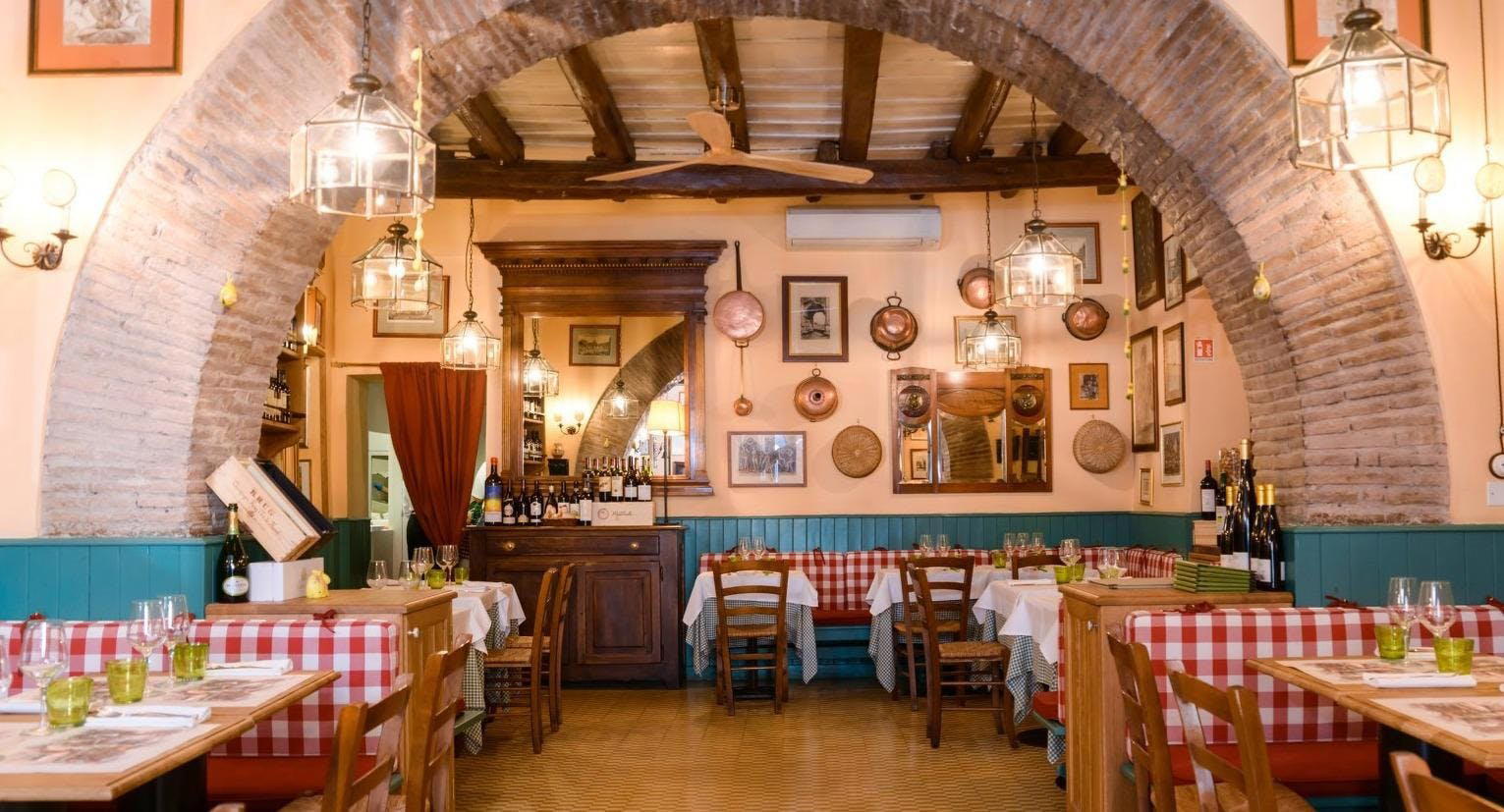
A Square That Rome Forgot to Modernise
Piazza Margana sits in the triangle between the Capitoline Hill, the Teatro di Marcello, and the Ghetto, close enough to the city's most visited monuments to catch overflow foot traffic, far enough off the standard tourist circuit to retain the quality of silence that defines Rome's oldest residential pockets. The medieval Torre Margana anchors one end of the square; low-slung ochre buildings close in on the other three sides. Arriving here at dusk, when the light drops behind the roofline and the cobblestones hold the last of the day's warmth, is to understand why this corner of the city's historic centre has attracted the same kind of durable, neighbourhood-anchored restaurant for generations.
Angelino a Tor Margana is a Traditional Roman Trattoria in Rome on Piazza Margana, 37, with. It is that restaurant, the kind of address that exists because the square demanded it, not because a concept was imposed upon a location. In Rome's dining hierarchy, this is the trattoria tier rather than the tasting-menu tier. Its competitive set is not Il Pagliaccio or Acquolina; it is the shrinking category of cucina romana restaurants in the historic centre that have not pivoted to brunch formats or international menus in response to tourist pressure.
What the Menu Reveals About the Kitchen
In Rome, a trattoria menu read carefully is a declaration of intent. The architecture of a traditional Roman menu, antipasti, primo, secondo, contorno as separate courses, imposes a logic that many contemporary restaurants have abandoned in favour of small-plates formats or single tasting routes. When a kitchen maintains that classical structure in 2024, it signals a commitment to the rhythm of the Roman meal rather than the efficiency of the modern service model. Dishes flow in a sequence tied to season and tradition: cured local products or fried starters giving way to pasta, then braised or grilled proteins, then vegetables ordered separately.
Roman pasta cooking in the historic centre sits within a narrow but demanding canon. Cacio e pepe, carbonara, amatriciana, and gricia are the four poles around which most cucina romana menus orbit, and each is a technical exercise with almost no margin for improvisation, the ratio of fat, starch water, and timing determines success in a way that richer, more complex sauces do not. Kitchens in this tradition are judged on execution of constraint, not breadth of invention. That is a different standard from what drives recognition at Enoteca La Torre or Achilli al Parlamento, where creative departure from tradition is the explicit premise.
The secondo course in Roman trattoria cooking tends toward offal, slow braises, and grilled cuts, a tradition rooted in the quinto quarto (fifth quarter) cooking of the Testaccio slaughterhouse district that spread across the city's working-class osterie in the twentieth century. Coda alla vaccinara, abbacchio alla scottadito, and trippa alla romana are the reference points. Not every kitchen in the historic centre executes this tier with equal seriousness; those that do occupy a specific and genuinely smaller category than the pizza-pasta generalists that fill the surrounding streets.
The Historic Centre's Trattoria Problem
Rome's centre storico has shed traditional restaurants at an accelerating rate over the past fifteen years. Rising rents, tourist-volume economics, and the labour costs of maintaining a kitchen that cooks from raw product daily have pushed many owners toward simpler, faster formats. What remains in the genuinely traditional tier is a thinning field. The restaurants that have persisted tend to share a few characteristics: a fixed address with low turnover, a local clientele that books alongside the tourists, and a menu that changes with season rather than trend.
This thinning makes addresses like Piazza Margana more legible as part of a pattern. Durability in a location this central is itself an argument: the square's relative obscurity has functioned as a filter, keeping away the highest-volume tourist traffic and supporting a slower-paced, more repeat-oriented dining model. Compare this to the area immediately around the Pantheon or Piazza Navona, where a restaurant's address often works against its kitchen, the foot traffic raises revenue expectations but lowers the quality threshold required to survive.
For readers comparing options across Roman dining tiers, La Pergola operates at the opposite pole, three Michelin stars, a wine cellar that runs to several thousand labels, and a tasting menu format that makes it one of Rome's most formally ambitious restaurants. The trattoria register and the fine-dining register serve different functions in the city, and the distinction matters more in Rome than in most European capitals, because the classical tradition here is both the baseline and the competition.
Italy's Broader Fine-Dining Context
Understanding where a Roman trattoria sits requires some sense of what Italy's serious restaurant tier looks like at the national level. Outside Rome, the country's most-discussed kitchens include Osteria Francescana in Modena, Piazza Duomo in Alba, Le Calandre in Rubano, and Uliassi in Senigallia. Further south, Reale in Castel di Sangro and Quattro Passi on the Amalfi Coast represent a different Italian fine-dining geography. Dal Pescatore in Runate has held three Michelin stars for decades, pointing to how Italy's leading kitchens are often as rooted in a specific rural or small-town setting as they are in technique.
None of these are the reference point for Angelino a Tor Margana. The relevant comparison is the category of central-Rome osterie and trattorie that have maintained a serious kitchen through decades of neighbourhood change, a category that warrants attention precisely because it is becoming harder to find.
Planning a Visit
Piazza Margana is walkable from the Capitoline Museums and the Ghetto, roughly ten minutes from Campo de' Fiori, and about the same distance from the Pantheon. The square itself has no through-traffic, which makes it one of the quieter outdoor dining settings in this part of the city. Phone and booking information were not confirmed at the time of writing; visitors should verify current hours and reservation policy directly before arriving, as trattorie in this category typically maintain limited weekly schedules and may close for summer breaks.
Style and Standing
Comparable venues nearby, for context on price, style, and recognition.
| Venue | Cuisine | Price | Notes |
|---|---|---|---|
| Angelino a Tor MarganaThis venue — the venue you are viewing | Traditional Roman Trattoria | $$ | Not listed |
| Fradiavolo Roma Ostiense | Contemporary Italian Pizza | $$ | Ostiense |
| Da Benito e Gilberto | Italian Seafood | $$ | Borgo |
| Ristorante La Tavernaccia Da Bruno | Traditional Roman Trattoria | $$ | Portuense |
| Mamma Angelina | Traditional Roman Trattoria with Fresh Seafood | $$ | Trieste |
| Papa Giovanni | Traditional Roman Trattoria | $$ | San Eustachio |
Continue exploring
More in Rome
Restaurants in Rome
Browse all →
Bars in Rome
Browse all →
Hotels in Rome
Browse all →
Wineries in Rome
Browse all →
At a Glance
- Classic
- Historic
- Cozy
- Casual Hangout
- Special Occasion
- Historic Building
- Extensive Wine List
- Street Scene
Current opening hours
- Monday
- 11 AM–11:30 PM
- Tuesday
- 11 AM–11:30 PM
- Wednesday
- 11 AM–11:30 PM
- Thursday
- 11 AM–11:30 PM
- Friday
- 11 AM–11:30 PM
- Saturday
- 11 AM–11:30 PM
- Sunday
- 11 AM–11:30 PM
Hours can change for holidays and private events. Last verified .
Cozy and traditional atmosphere evoking Rome's culinary past with rustic charm.