ì목 본ì
일목 본점 sits in Suyeong-gu, one of Busan's quieter residential dining corridors, away from the tourist-heavy Haeundae strip. The address on Gwangnam-ro places it within a neighbourhood where locals set the agenda and repeat visits define a restaurant's reputation. For those tracing Busan's less-advertised dining circuit, it belongs on the itinerary alongside the city's broader range of Korean dining traditions.
 Discover on Pearl
Pearl is the En Primeur Club membership app — saves, bookings, and concierge access live there. Same editors, same standards.
- Address
- 3 Gwangnam-ro 22beon-gil, Suyeong-gu, Busan, South Korea
- Phone
- +8250714610523
Suyeong-gu and the Shape of Busan's Local Dining Circuit
Busan's restaurant reputation is still largely written around Haeundae and Centum City, where international hotel dining and high-visibility Korean contemporary kitchens compete for the same well-travelled clientele. Suyeong-gu operates differently. The district, anchored by the residential blocks stretching inland from the coast, has cultivated a quieter tier of restaurants that run on local loyalty rather than tourist footfall. Gwangnam-ro and its side streets hold a disproportionate number of places where the regulars arrive on weekday evenings and where the absence of a dedicated English-language presence is a reliable signal of local intent. 일목 본점 sits on Gwangnam-ro 22beon-gil inside this circuit, at an address that reads as a neighbourhood destination rather than a destination restaurant in the international sense.
That geographic positioning matters for how you read the venue. In Korean dining, the suffix 본점 (bonjeom) designates an original or main branch, which carries its own weight in a culture where the founding location of a well-regarded restaurant holds a specific authority over any later outposts. It implies a lineage, a point of origin, and often a menu that has been refined over time through local demand rather than external critical pressure.
Reading the Menu Architecture from the Outside In
What can be read from the available signals is structural. Korean restaurant menus in this price and neighbourhood tier typically organise around one of several logics: a single anchor dish with supporting sides, a multi-course format that sequences proteins and broths, or a specialty-focused approach where depth in one category substitutes for breadth. The 본점 designation, combined with a Suyeong-gu address and the apparent absence of an international-facing web presence, suggests a kitchen that has built its identity around a core offering rather than a rotating seasonal programme designed for critical attention.
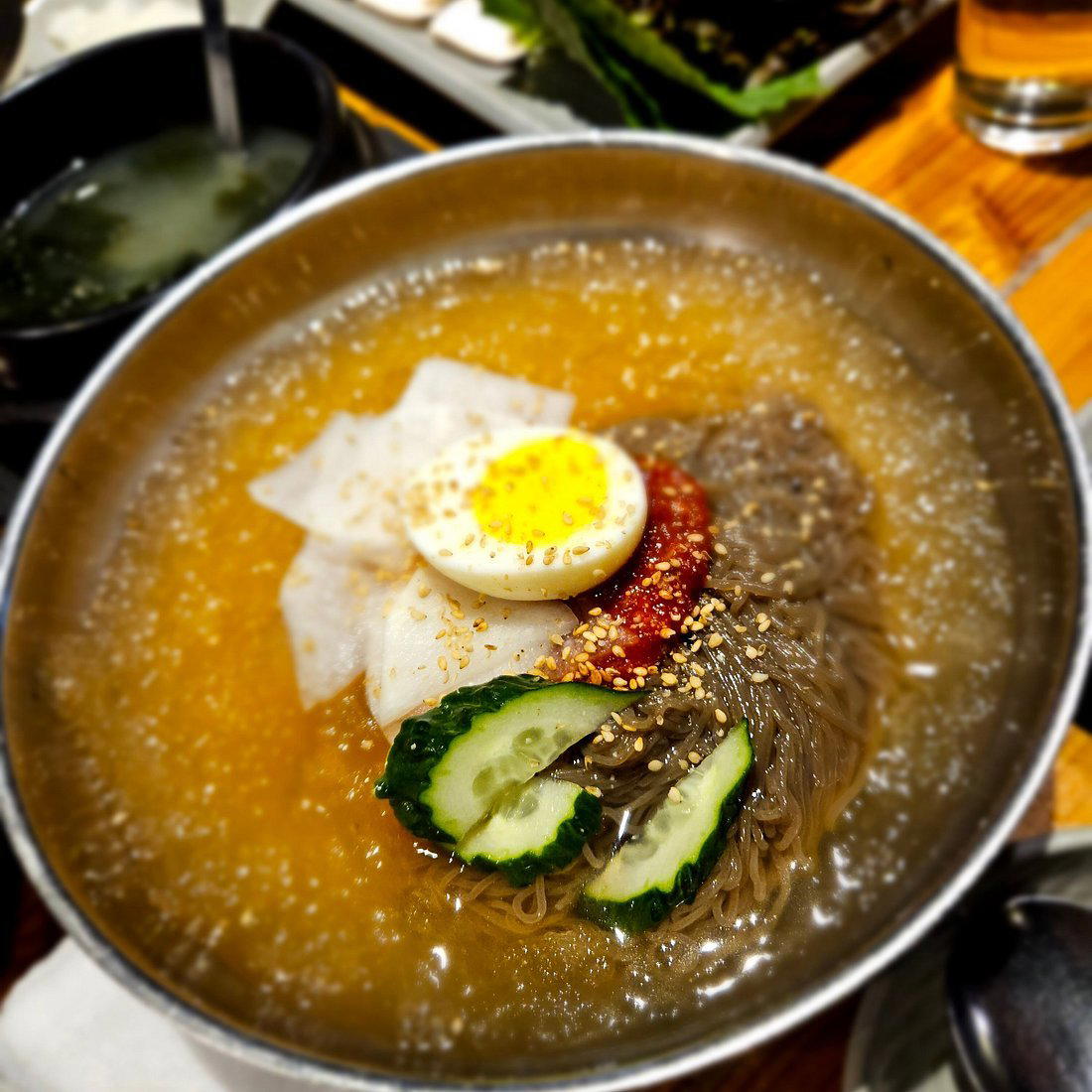
This architecture, where a single discipline anchors the menu and peripheral dishes exist to support rather than distract, is a structure common to some of Busan's most durable neighbourhood restaurants. 100.1.Pyeongnaeng in Busan demonstrates how a naengmyeon-focused kitchen can hold a following for years by deepening one tradition rather than diversifying it. 1969 Buwondong Kalguksu follows a comparable logic with hand-cut noodles. In Busan's local tier, restraint in scope is usually a strength, not a limitation.
For contrast, the city's upper-bracket dining rooms take the opposite approach. Mori in Busan operates as a Japanese kitchen at the ₩₩₩ tier, where the menu is broader and the experience is built for a different kind of occasion. Born and Bred anchors the ₩₩₩₩ steakhouse tier with a format built around premium beef cuts. Palate works the contemporary Korean register at the ₩₩ level. 일목 본점's position in this field remains to be confirmed by first-hand data, but its Suyeong-gu address and neighbourhood-facing profile suggest a more local, specialist tier than these comparators.
What the Neighbourhood Tells You
Suyeong-gu has a particular relationship with food in Busan. The district sits between the more tourist-oriented Haeundae to the northeast and the denser urban core of Jung-gu and Dong-gu to the west. It is a zone where working professionals and long-term residents form the primary dining public, and where restaurants tend to operate on repeat business. That context shapes what a kitchen here needs to do: consistency matters more than novelty, portion integrity matters more than presentation theatrics, and value at the local price point is non-negotiable.
This is the same dynamic that produces the durable specialty restaurants found across Korean cities in residential corridors. Doosoogobang in Suwon and Gyeongju Wonjo Kongguk in Gyeongju represent the same model in their respective cities: a kitchen that has earned its neighbourhood by doing one thing at a level that keeps locals from looking elsewhere. Whether 일목 본점 has achieved that status is a question of local reputation.
For the travelling diner, Suyeong-gu is worth approaching on its own terms. The neighbourhood is accessible from central Busan via the Busan Metro Line 2 (Suyeong Station), which connects to the broader city network including Seomyeon and Haeundae. From Suyeong Station, the walk to the Gwangnam-ro address covers ground that moves through a residential-commercial mix that reflects the district's character more accurately than the waterfront does.
Placing 일목 본점 in the Broader Korean Dining Frame
Korean fine dining at the national level has moved decisively toward a tasting menu format over the past decade, with Seoul leading that shift. Mingles in Seoul represents one of the more discussed examples of that evolution, where Korean ingredients are reframed through contemporary technique and multi-course sequencing. Atomix in New York City carries a version of that sensibility into an international market. These are restaurants where the menu architecture is explicitly designed to communicate a culinary argument.
Neighbourhood Korean restaurants like 일목 본점 operate in a different register entirely. The menu architecture here, if the neighbourhood context holds, is not about argument but about fluency: a kitchen that has internalised a tradition to the point where the menu is its natural expression rather than a constructed statement. That is a different kind of credibility, and for many regular visitors to Korea, it is the more satisfying one to seek out. The contrast is instructive across the country: 88돼지 in Jeju and Black Pork BBQ in Seogwipo anchor regional identity through specific protein traditions rather than contemporary reframing. Hwangnam Bread and Busan Steamed Bun in Gyeongju demonstrates how deeply localised food identities survive and attract visitors on the strength of specificity alone.
For those building an itinerary around Busan's full dining range, the EP Club Busan restaurants guide maps the city's dining circuit across price tiers and neighbourhoods, including options from the Suyeong-gu corridor alongside the more internationally profiled addresses in Haeundae and Centum. Dining Room (다이닝룸) and Gobojeong Galbi in Suwon represent comparable neighbourhood-anchored formats worth referencing for context. Badang Lounge in Jeju and Hinode in Seogwipo show how local-facing venues in Korean resort cities hold their own distinct identity separate from the broader tourism circuit.
Planning a Visit
일목 본점 is located at 3 Gwangnam-ro 22beon-gil, Suyeong-gu, Busan. This restaurant is walk-in friendly. Korean-language communication is likely the most reliable approach given the neighbourhood-facing character of the address.
Reputation First
Comparable venues nearby, for context on price, style, and recognition.
| Venue | Cuisine | Price | Awards | Notes |
|---|---|---|---|---|
| ì목 본ì This venue — the venue you are viewing | Korean Restaurant | , | ||
| 바다마루 전복죽 | 전복죽 전문 | $$ | , | 해운대구 중동 |
| ìµìºì°ì | Korean BBQ (Samgyeopsal) | $$ | , | Millak-dong |
| ì ë¡ë² ì´ì¤ | Korean | $$ | , | Millak-dong |
| Namagjib | Korean Pork Bone Soup Specialist | $ | , | Daeyeon 3(sam)-dong |
| 모리 | korean | , | Jung 1(il)-dong |