88돼지
88돼지 sits on 제원길 7 in 제주시, positioning itself within Jeju's well-established black pork tradition — a circuit where the sourcing of Jeju-native pork defines quality more than kitchen technique. For visitors working through the island's barbecue scene, this address represents a direct line to that regional ingredient story, grounded in place rather than presentation.
 Discover on Pearl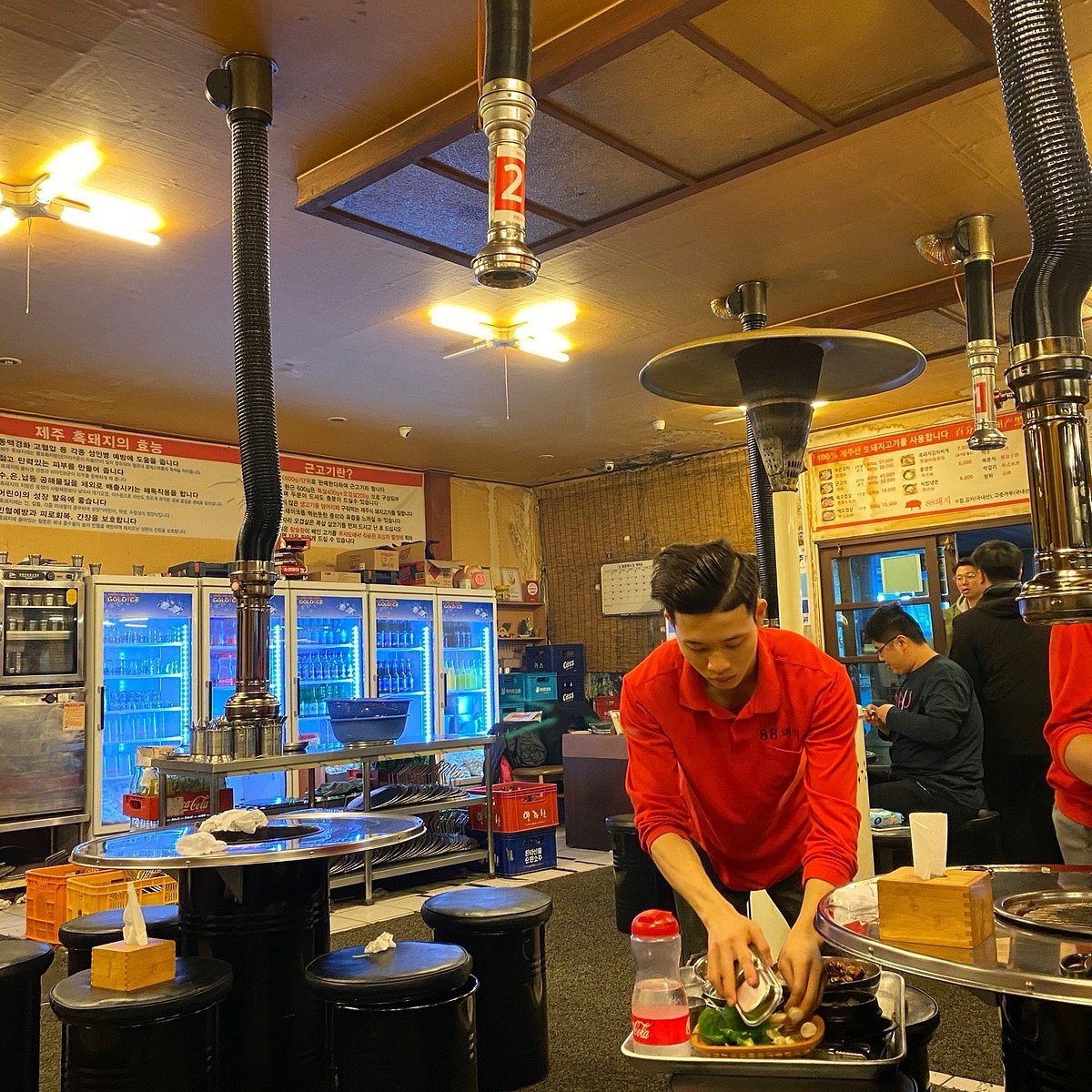
Jeju's Black Pork Tradition and Where 88돼지 Sits Within It
Jeju Island has built a regional food identity on a single ingredient: its native black pig, a breed raised on the island for centuries and distinct in fat distribution, texture, and flavour from the commercial white pork that dominates mainland Korean barbecue. The tradition is not merely culinary nostalgia — it reflects genuine agricultural differentiation. Jeju's volcanic terrain, specific feed conditions, and the island's physical isolation have produced a pork that inspires regional pride and, increasingly, serious sourcing conversations among the restaurants that serve it. Black Pork BBQ in Seogwipo represents the southern end of that circuit; 88돼지, at 제원길 7 in 제주시, sits at the northern end, closer to the island's administrative and commercial centre.
Across South Korea, the question of where pork comes from has grown more pointed as consumers distinguish between industrially raised product and breeds tied to specific geography. Mingles in Seoul and Atomix in New York City operate at the fine-dining end of Korean ingredient provenance — Atomix has held two Michelin stars , but the same sourcing logic, stripped of tasting-menu format, runs through Jeju's street-level barbecue circuit. At this tier, the table itself is the kitchen: raw or lightly marinated pork arrives at the grill built into the table, and the cook is the diner. What distinguishes one address from another is the pig behind the protein.
The shortlist, unlocked.
Hard-to-book tables, cellar releases, and concierge-planned trips.
Get Exclusive Access →The Approach and the Setting
제원길 7 places 88돼지 in a residential-commercial pocket of 제주시, away from the tourist-heavy Dongmun Market area but within reach of the city's practical centre. Streets in this part of Jeju city tend toward the functional , low-rise buildings, local signage, a clientele that skews toward residents rather than travellers with guidebooks open on their phones. The name itself, 88돼지, follows a direct Korean naming convention: a number paired with the word for pig, the kind of unadorned identity that in Jeju's barbecue culture signals confidence in the product over investment in brand aesthetics.
The atmosphere at this category of Jeju restaurant is defined less by interior design than by the mechanics of the meal: smoke rising from charcoal or gas grills, the sound of fat rendering, the systematic arrival of banchan alongside the main protein. This is the format that Jeju's barbecue culture has preserved largely unchanged while Seoul's dining scene has rotated through several trend cycles. For context on how Korean dining formats vary across price points and styles, our full 제주시 restaurants guide maps the range from casual grill houses to more formal island addresses.
Ingredient Sourcing and Why It Defines the Category
The sourcing question in Jeju black pork is more complicated than it appears from a menu. Not every restaurant serving 흑돼지 (heuk dwaeji) on the island uses pureblood Jeju native pig , a breed now protected under agricultural designation but still subject to crossbreeding pressure and supply constraint. The honest answer is that the full sourcing chain for any individual grill house in 제주시 requires direct inquiry, since public documentation is inconsistent at this tier of the market. What the category signals, however, is that proximity to the island's agricultural network matters: restaurants in Jeju city with long local tenure tend to maintain supplier relationships that mainland visitors cannot replicate, because the product does not travel well and is not widely available outside the island.
This dynamic positions Jeju's barbecue circuit differently from, say, the galbi tradition in Suwon, where Gobojeong Galbi #1 (가보정 1관) operates within a beef-centred heritage, or the temple food tradition documented at Baegyangsa Temple in Jangseong-gun, where ingredient logic is governed by Buddhist dietary codes. Jeju's black pork identity is secular and commercial, but it is genuinely regional in a way that the broader Korean pork barbecue market is not.
For visitors who have followed Korean cuisine's higher-register expressions at addresses like Dining Room (다이닝룸) in 부산광역시 or Mori in Busan, the Jeju grill house offers a different kind of argument for ingredient integrity: one that is built into an informal, shared format rather than a plated sequence.
Planning Your Visit
제원길 7 is a street address in 제주시 that requires either a taxi from the city centre or navigation by local bus , neither involves significant distance. Phone and booking data are not publicly documented for 88돼지, which is consistent with the walk-in model that Jeju's neighbourhood grill houses typically operate on. Arriving early in the dinner window (before 6:30 PM on weekends) reduces wait times at the category level, though specific capacity and policy details should be confirmed locally. Jeju's peak tourist season runs from late June through August and again in October, when the island draws visitors from the mainland for autumn foliage; during those windows, grill houses across 제주시 run at higher occupancy. Visitors combining a broader island itinerary with dinner at this address might orient around the Badang Lounge in Jeju for a contrasting post-dinner drinks format, or consider the quieter setting of Cheon Jee (천지) for a different register of Jeju dining. Further afield, Hinode (히노데) in 서귀포시 represents an interesting comparison point on the southern coast. Price range data is not confirmed in available records, but the black pork barbecue category in Jeju generally prices per portion of meat, with the total depending on group size and accompanying orders; the format is consistently more accessible than tasting-menu Korean addresses at the ₩₩₩₩ tier, such as Le Bernardin at the extreme upper end of fine dining internationally.
Frequently Asked Questions
- Is 88돼지 good for families?
- The grill-at-table format that defines Jeju's black pork circuit is generally family-compatible , shared plates, interactive cooking, and no formal dress requirement make it an accessible format across age groups. Jeju city's barbecue addresses at this category typically operate at price points that do not create financial pressure for group dining, though exact pricing for 88돼지 is not confirmed in available records and should be checked on arrival.
- Is 88돼지 formal or casual?
- The black pork barbecue category in Jeju operates at the casual end of the dining register. Smoke, communal grills, and shared banchan define the format city-wide , there are no dress codes documented for this address, and the street-level setting on 제원길 reinforces an informal, neighbourhood character. Seoul's higher-tier Korean addresses, by contrast, have moved toward more structured formats; Jeju's grill circuit has not followed that trajectory.
- What's the leading thing to order at 88돼지?
- No confirmed menu data is available for 88돼지, so specific dish recommendations cannot be responsibly made. Across Jeju's black pork category, the core order is consistently the heuk dwaeji itself , grilled pork belly or shoulder , accompanied by standard banchan and wrapped in perilla or lettuce with fermented sauces. That format is the structural anchor of every address in this circuit, and ordering around it is the reliable approach at any grill house in 제주시.
- Is 88돼지 reservation-only?
- No booking data is publicly confirmed for this address. Neighbourhood grill houses at this tier in Jeju city most commonly operate on a walk-in basis, which is the working assumption here. Arriving outside peak weekend dinner hours is the practical hedge; local inquiry on arrival will resolve any uncertainty. For reference, more formal Jeju addresses and Seoul restaurants at the ₩₩₩₩ tier routinely require advance booking weeks out, but that dynamic does not typically apply to street-level barbecue in 제주시.
- How does 88돼지 fit into Jeju's broader pork barbecue circuit compared to addresses in other Korean cities?
- Jeju's heuk dwaeji circuit is geographically specific in a way that pork barbecue in Seoul or Suwon is not , the island's native breed, agricultural conditions, and supplier networks create a regional product that mainland addresses cannot directly replicate. 88돼지 at 제원길 7 sits within that island-specific circuit, offering a grounded alternative to the more tourism-facing addresses near Jeju's main market areas. For comparison points across different Korean culinary traditions, Doosoogobang in Suwon and Injegol in Inje County each represent distinct regional food identities built around local ingredients and formats.
At-a-Glance Comparison
These are the closest comparables we have in our database for quick context.
| Venue | Cuisine | Price | Awards | Notes |
|---|---|---|---|---|
| 88돼지 | This venue | |||
| 7th Door | Korean, Contemporary | ₩₩₩₩ | Michelin 1 Star | Korean, Contemporary, ₩₩₩₩ |
| Eatanic Garden | Contemporary | ₩₩₩₩ | Michelin 1 Star | Contemporary, ₩₩₩₩ |
| Onjium | Korean | ₩₩₩₩ | Michelin 1 Star | Korean, ₩₩₩₩ |
| L'Amitié | French | ₩₩₩ | Michelin 1 Star | French, ₩₩₩ |
| Palate | Contemporary | ₩₩ | Michelin 1 Star | Contemporary, ₩₩ |
Need a table?
Our members enjoy priority alerts and concierge-led booking support for the world's most difficult tables.
Get Exclusive AccessThe shortlist, unlocked.
Hard-to-book tables, cellar releases, and concierge-planned trips.
Get Exclusive Access →