アクア・イン・ボッカ
Our verdict
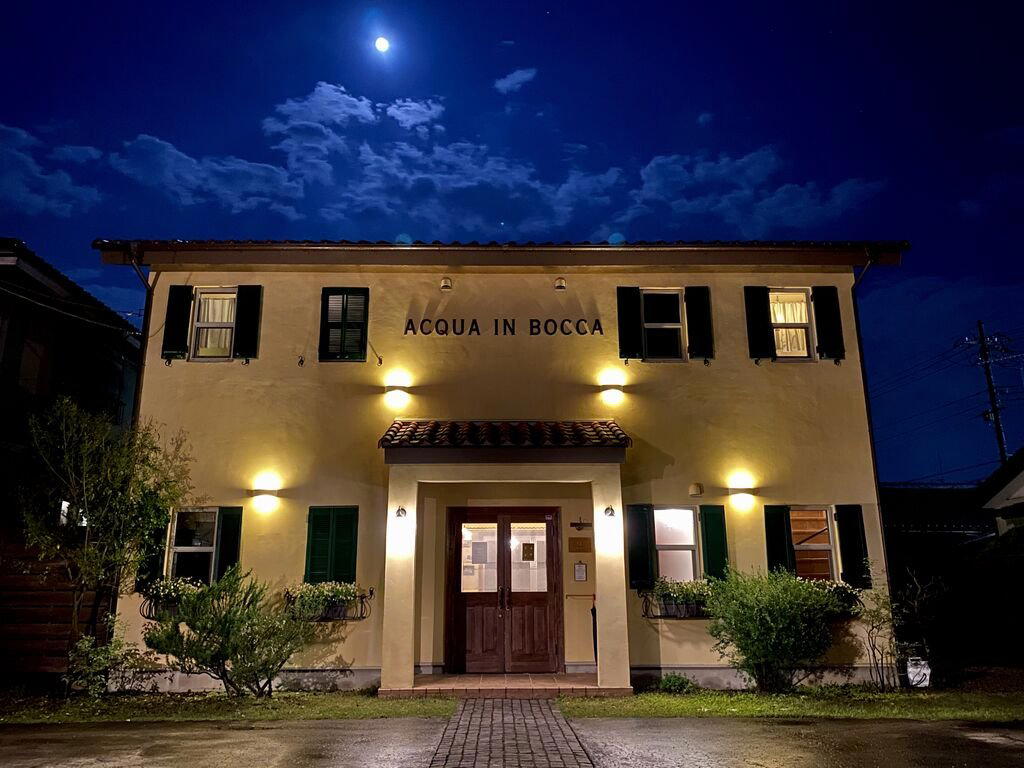
In Utsunomiya's Nakatomatsuri district, アクア・イン・ボッカ occupies a distinct position within a city better known for gyoza than for Western fine dining. Its Italian-inflected name signals an approach that sits at the intersection of European culinary structure and Japanese precision. For travelers extending beyond Tokyo's dining circuit, it represents the kind of regional ambition that rewards the extra ninety minutes on the Shinkansen.

Pearl is the En Primeur Club membership app, where members save venues, book tables and use the concierge.
The menu
What to order
- Squid ink pasta
- Ezo abalone with white vegetable sauce
- Risotto with sea urchin and flounder
Where Utsunomiya Slows Down to Eat
There is a particular quality to dining rooms in Japan's secondary cities that you rarely encounter in Tokyo or Osaka: the absence of performance. The tables are not proving anything. The room does not need to signal its own importance. In Utsunomiya, a city better known for gyoza culture than for refined dining, a meal at アクア・イン・ボッカ operates on exactly this register. The address, in the Nakatomatsuri district at 1 Chome-12-22, sits away from the transit-hub density of the city center, and that physical distance from the obvious is, in itself, a kind of editorial statement about the pace of the meal to come.
Japan's regional dining scene has matured considerably over the past decade. Cities at the Utsunomiya tier, roughly ninety minutes north of Tokyo on the Shinkansen, now support restaurants operating at ambitions well above what their population size might suggest. This is partly a Tokyo overspill effect: trained cooks who can no longer afford city rents, or who find the capital's competition exhausting, relocate to prefectural capitals where rent is lower, sourcing from local producers is more direct, and regulars are actually loyal. The result is a scattered but serious dining tier that rewards the traveler willing to look beyond the obvious city list. Our full Utsunomiya restaurants guide maps that tier in detail.
The Ritual of the Regional Table
In Japanese dining culture, the meal is rarely experienced as a sequence of isolated courses. It is a continuous, deliberate accumulation, with pace dictated by the kitchen rather than the guest. This is especially true at smaller, owner-operated establishments in regional cities, where the room is typically compact and the kitchen's rhythm becomes the room's rhythm. At venues operating in this format, the ritual begins before the first dish: in the way the space is arranged, the water is poured, the menu is presented or described. Each of these gestures sets expectations about what kind of attention the kitchen intends to give.
Regional Italian in Japan, where the name アクア・イン・ボッカ suggests an Italian-inflected sensibility, has developed its own particular version of this ritual. Japan absorbed Italian cuisine deeply in the 1980s and 1990s, and what emerged was not a copy but a synthesis: Japanese precision applied to Italian structural logic. Pasta texture is taken as seriously as sushi rice temperature. Seasonal produce sourcing follows the same rotational logic as kaiseki. The result, at serious restaurants in this mode, is a meal that reads as Italian in its bones but Japanese in its attention. Comparisons to akordu in Nara, which similarly bridges European and Japanese sensibilities, are instructive for understanding what this synthesis can achieve at its most considered.
Utsunomiya in Its Dining Context
Utsunomiya's dining identity has historically been dominated by gyoza, and that reputation is not unearned. The city's gyoza circuit draws domestic tourists and has genuine cultural depth. But that dominance has also meant that the city's more ambitious restaurants have operated somewhat below the radar of national food press, which tends to cluster its attention on the three major metro areas. This has advantages for the traveler: less competition for bookings, more accessible price points relative to equivalent quality in Tokyo, and rooms that are not filled with critics performing their own expertise.
The restaurants that have built credibility in Utsunomiya's quieter upper tier include Otowa Restaurant, which operates a French program with the kind of seasonal discipline you associate with kitchens that have both ambition and patience, and Kawasemi and Masashi, which hold their own corners of the city's more refined dining conversation. アクア・イン・ボッカ occupies a different register within this peer group, one shaped by its Italian-leaning identity in a city where Western fine dining is a minority pursuit.
For context on what serious Italian-European synthesis looks like at a national level, HAJIME in Osaka sets one kind of benchmark, and Gion Sasaki in Kyoto demonstrates how Japan's regional capitals support dining at considerable ambition. Further afield, Harutaka in Tokyo and Goh in Fukuoka show the range of what Japan's regional and metropolitan dining circuits have produced in the contemporary era.
The Shape of the Meal
Italian dining in Japan at the serious end tends to operate either as a full tasting menu or as a structured à la carte where the expectation of multiple courses is built into the room's pacing. Either way, the meal is long by the standards of casual trattoria dining. This is not inefficiency. It is a deliberate structuring of time: the guest is being asked to arrive somewhere different from where they started, and that journey requires duration. The parallel in Japan's own culinary tradition is obvious, and the synthesis makes sense precisely because both cultures share a fundamental seriousness about the meal as a bounded experience with a beginning, a middle, and an end that means something.
At this type of establishment, the correct approach is to let the kitchen lead. Arriving with a fixed idea of what you want to eat, or attempting to shortcut the sequence, works against the logic of the room. This is the case at similarly structured experiences across Japan's regional circuit, from a counter in Nanao to a destination room in Sapporo, and it holds here. The meal rewards patience.
Getting There and Planning the Visit
Utsunomiya sits on the Tohoku Shinkansen line from Tokyo, with journey times typically under 55 minutes from Utsunomiya Station on faster services. The Nakatomatsuri address is accessible from the city center by taxi or local transit. This is standard practice for smaller owner-operated venues in Japanese regional cities, where online booking infrastructure varies considerably and walk-in availability is often limited for dinner sittings.
The broader Utsunomiya dining circuit is worth structuring as a day trip or overnight from Tokyo. Other venues operating in the city's upper tier, including those explored in our Utsunomiya guide, give the visit sufficient depth to justify the Shinkansen fare. For comparison against similar regional Japanese dining formats beyond Tochigi Prefecture, the editorial records at a kaiseki room in Takashima, a country inn dining room in Nishikawa Machi, Birdland in Sakai, and Bistro Ange in Toyohashi provide useful reference points for what the regional Japanese fine-casual tier looks like in its various expressions. For a global perspective on where serious Italian-European dining sits on the international scale, Le Bernardin in New York City and Atomix in New York City represent the kind of institutional ambition against which regional Japanese venues increasingly position themselves, even at considerable geographic remove. Blue Ocean Steak in Nakagami District rounds out the regional Western-inflected comparison set.
Frequently asked questions
What's アクア・イン・ボッカ's location?
アクア・イン・ボッカ is located at 1 Chome-12-22 Nakatomatsuri, Utsunomiya, Tochigi 320-0057, Japan, Utsunomiya.
How far is アクア・イン・ボッカ from Utsunomiya Station, and is it easy to reach?
The restaurant is located at 1 Chome-12-22 Nakatomatsuri in central Utsunomiya, a short taxi or bicycle ride from Utsunomiya Station on the Tohoku Shinkansen line. Tokyo to Utsunomiya takes under 55 minutes on faster Shinkansen services, making this a viable day-trip or evening destination from the capital. Confirming transport options with the restaurant when you book is advisable, as evening departure times from smaller regional venues can shape how you plan your return.
What's the signature dish at アクア・イン・ボッカ?
The restaurant's Italian-inflected name points toward a kitchen working within European structure, and at owner-operated venues of this type in Japan's regional cities, the menu tends to reflect seasonal local produce interpreted through an Italian framework. Contacting the restaurant directly before your visit is the most reliable way to understand what's currently on the menu.
Do I need a reservation for アクア・イン・ボッカ?
For a restaurant of this type in Utsunomiya, owner-operated, Italian-leaning, and positioned in the city's small tier of Western fine dining, reservations are strongly advisable, particularly for dinner service. Smaller rooms in Japan's regional cities often have limited covers, and walk-ins carry real risk of being turned away. Booking ahead also allows you to flag dietary requirements, which at tasting-format venues typically need to be communicated in advance.
What is アクア・イン・ボッカ known for?
アクア・イン・ボッカ occupies a specific position in Utsunomiya's dining scene: it is Italian in orientation within a city whose food identity is dominated by gyoza. That positioning alone distinguishes it from most of what Utsunomiya offers domestic and visiting diners. The address on Nakatomatsuri puts it within the city proper, and the venue sits within the narrow tier of Western-leaning, owner-operated restaurants that serve as an alternative to the city's well-established Japanese dining circuit.
Can アクア・イン・ボッカ accommodate dietary restrictions?
Dietary accommodation at smaller owner-operated restaurants in Japan, particularly those running a set or tasting format, is possible but requires advance communication rather than an assumption at the table. Notifying the restaurant when you book, specifying allergies or exclusions clearly, gives the kitchen the lead time to adjust. Arriving without prior notice and expecting significant menu changes is not standard practice at venues of this type in Japan.
Is アクア・イン・ボッカ worth the price?
As a general reference point, Western fine dining at owner-operated restaurants in Japan's regional cities typically runs between ¥8,000 and ¥20,000 per person for an evening course, which places it below equivalent Tokyo venues while often delivering comparable kitchen focus. Whether that represents good value depends on what you find on the menu during your visit.
Cuisine Lens
Comparable venues nearby, for context on price, style, and recognition.
| Venue | Cuisine | Price | Awards | Notes |
|---|---|---|---|---|
| アクア・イン・ボッカThis venue (the venue you are viewing) | Authentic Tuscan Italian | $50–100 | Not listed | Not listed |
| BAR CHAMONIX | Classic Japanese cocktail bar | $50–100 | Tabelog 100 #15 | Enomachi / Orion Street |
| Masashi | Traditional Utsunomiya gyoza counter | $1–10 | Tabelog 100 #53 | Miyajimacho |
| Musshu OGAWA Paipu no Kemuri | Cocktail Bar | $20–30 | Tabelog 100 #21 | Utsunomiya |
| Kawasemi | Traditional Japanese Eel Izakaya | $50–100 | Tabelog 100 #65 | Odori |
| Koran | Traditional Utsunomiya gyoza specialist | $10–20 | Tabelog 100 #88 | near Utsunomiya Station (west side) |
Continue exploring
More in Utsunomiya
Details
- Elegant
- Romantic
- Classic
- Intimate
- Date Night
- Special Occasion
- Celebration
- Standalone
- Extensive Wine List
- Local Sourcing
- Prix Fixe
- A La Carte
- Italian Wine
- Pescatarian Friendly
Current opening hours
- Monday
- 6–10 PM
- Tuesday
- 6–10 PM
- Wednesday
- 6:30–10 PM
- Thursday
- 6:30–10 PM
- Friday
- 6:30–10 PM
- Saturday
- 6:30–10 PM
- Sunday
- 6–10 PM
Hours can change for holidays and private events. Last verified .
Warm, welcoming Italian atmosphere designed to evoke dining in Italy, with refined yet approachable service and wine selections.