
Sano’s ramen culture is built around aodake teuchi, the green-bamboo hand-kneading method that gives local noodles their irregular pull and bounce. Aodake Teuchi Ramen Hinataya belongs to the value-driven, craft-heavy end of that scene, with Tabelog Ramen EAST 100 recognition running from 2017 through 2025 and a format that keeps the focus on ramen and dumplings rather than ceremony.
Pearl is the En Primeur Club membership app — saves, bookings, and concierge access live there. Same editors, same standards.
- Address
- 548-7 Mendoricho, Sano, Tochigi 327-0041, Japan
- Phone
- +81 283-22-4620
- Website
- tabelog.com
- Directions
- Get directions
 Saves & bookings on Pearl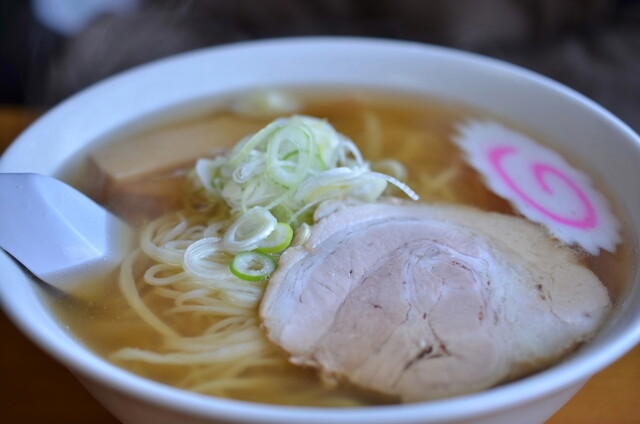
Approach Sano ramen through the room first: the rhythm is local, practical, and quick to reveal what matters. This is not the polished counter theatre of central Tokyo ramen, where limited seats and chef-facing choreography often become part of the meal. In Sano, the visual language is plainer: families, friends, counter seats, table groups, raised tatami-style seating, and bowls built around the city’s defining noodle craft. Aodake Teuchi Ramen Hinataya fits that grammar, a house-style restaurant where the serious point is not luxury but the handling of dough.
Sano’s signature is aodake teuchi, a green-bamboo hand-making technique associated with broad, uneven noodles that carry a different physical identity from machine-cut Tokyo styles. The craft matters because the noodle is not a neutral vehicle. Its irregularity changes how broth clings, how the bite varies across the bowl, and how quickly the meal reads as regional rather than generic. That is the useful frame for this restaurant: it is a study in a local noodle tradition operating at daily-meal pricing, not an imported prestige format translated into ramen.
Green-bamboo noodles define the argument
Ingredient sourcing, in ramen, is often discussed through tare, bones, dried seafood, or branded flour. Sano shifts the conversation toward technique and locality: the ingredient becomes meaningful only when the dough is worked into a texture the city recognizes as its own. Aodake Teuchi Ramen Hinataya’s category listing is concise, ramen and dumpling, which keeps the editorial signal clean. The point is not menu sprawl. It is whether the kitchen can express the Sano style with enough consistency to draw repeat recognition.
The recognition is substantial by local ramen standards. The restaurant has been selected for Tabelog Ramen EAST 100 across consecutive annual lists from 2017 through 2025, including the 2025 selection. That matters because ramen evaluation in Japan is granular and crowded; the category rewards specialization, price discipline, and repeatable craft more than dining-room spectacle. A Tabelog score of 3.75 places it in a competitive bracket where small technical differences count. In this context, the award history is less a trophy wall than a signal that Sano’s regional form can compete within eastern Japan’s broader ramen field.
Compared with nearby Sano names such as Menya Yosuke, Ramen Ogane, Nomura Ya Honten, and United Noodle Amenooto, the decision is less about chasing a single destination bowl than reading the city as a cluster. Sano rewards comparison eating: one shop may emphasize the noodle’s hand-cut irregularity, another the broth’s clarity, another the dumpling side of the table. The useful traveler’s move is to treat ramen here as a regional category with internal variation, not as a checklist of isolated storefronts.
A value-led room with serious ramen credentials
The pricing band reinforces the point. At under JPY 999, Aodake Teuchi Ramen Hinataya sits in the daily-use tier, closer to the civic rhythm of Sano than to the premium ramen counters that have become destination meals in larger cities. That affordability does not make the restaurant casual in editorial terms; it makes the craft easier to judge. When the room is not asking diners to pay for atmosphere, the noodle has to carry the case.
The format also helps explain the audience. Thirty seats, including counter seating, tables, and raised seating, create a broader social mix than a small urban counter. Children are welcome, private rooms are not part of the format, and the room is non-smoking. Take-out is listed, but the core experience remains the bowl-and-side-meal structure of a neighborhood ramen house. Payment is cash-led, with credit cards, electronic money, and QR code payments not accepted, which is common enough in regional Japan to be treated as planning intelligence rather than inconvenience.
Logistically, this is a Sano food stop that rewards a car-based itinerary. The nearest station is Tomita on the JR Ryomo Line, and the location is set up more naturally for drivers, with parking available. That matters for visitors building a Tochigi day around ramen rather than treating Sano as a quick rail-side detour. The city’s noodle culture is spread enough that walking between serious bowls is rarely the efficient plan.
How to read Sano beyond one bowl
Sano dining is not limited to ramen, but ramen gives the city its clearest culinary identity. The broader restaurant map includes old-line local dining, casual noodle houses, and newer specialist rooms, yet aodake teuchi remains the anchor because it ties technique to place. For a wider route, start with our full Sano restaurants guide, then decide whether the trip needs overnight logistics through our full Sano hotels guide, a drinking stop via our full Sano bars guide, broader regional producers through our full Sano wineries guide, or local programming in our full Sano experiences guide.
For readers mapping Japan through category rather than geography, Sano’s appeal is its contrast with other specialist formats. A meal here sits far from the beef-focused structure of -Grilled beef Sukiyaki- KAMAKURA TANUKIAN 鎌倉 たぬき庵 in Kamakura, the urban seafood-and-charcoal register of. 鮪と炭火焼き うお炭 秋葉原店 in Tokyo, or the cafe-led pacing of.cafe in Osaka. It also differs from the regional-modern language suggested by.know in Kumamoto, the Vietnamese focus at (Shoku) Vietnam in Kawasaki, the curry specialization of [Curry Senmon Ten] Maruyama Kyoju. in Sapporo, and the Kyoto register of [ki:] in Kyoto. Even overseas Japanese formats such as Jōdo Saké Bar in Los Angeles and Onigiri Time in Pasadena underline the same lesson: Japanese dining travels widely, but Sano ramen is tied tightly to method and place.
The restaurant is most persuasive when read as proof that regional craft does not need an expensive frame. The award history supplies external validation, the price keeps it grounded, and the Sano noodle tradition gives the meal its reason to exist. For travelers who care about where food comes from, the answer here is not only Tochigi. It is a local technique, repeated daily, until the noodle itself becomes the destination.
Comparable Spots, Quickly
Comparable venues by cuisine and price in the same metro.
| Venue | Cuisine | Price | Notes |
|---|---|---|---|
| Aodake Teuchi Ramen Hinataya | Traditional Sano-style aodake hand-rolled ramen | $ | Sano |
| Nomura Ya Honten | Japanese Noodle Shop | $ | Sano |
| United Noodle Amenooto | Modern Ramen & Tsukemen | $ | Horigome |
| Ramen Ogane | Traditional Sano-style ramen | $ | Ohashicho |
| Menya Yosuke | Sano-Style Ramen | $ | Tajima-cho |
| Buta Daigaku (豚大学) | Grilled Pork Bowl (Butadon) | $ | Shimbashi |
Recognition history
Dated appearances from independent guides and award organizations, with the underlying list record or original source where available.
Tabelog 100 #17 · No. 17
Tabelog · Tabelog 100 - Ramen - EAST - 2025
At a Glance
- Lively
- Classic
- Cozy
- Solo
- Family
- Casual Hangout
- After Work
- Group Dining
- Standalone
Current opening hours
- Monday
- 11 AM–2:30 PM
- Tuesday
- 11 AM–2:30 PM
- Wednesday
- Closed
- Thursday
- 11 AM–2:30 PM
- Friday
- 11 AM–2:30 PM
- Saturday
- 11 AM–4:30 PM
- Sunday
- 11 AM–4:30 PM
Hours can change for holidays and private events. Last verified .