Our verdict
Sushi Shimizu occupies a residential pocket of Nagoya's Nishi Ward, where the city's sushi tradition operates at a remove from the tourist circuits that define central Sakae. The address alone signals a certain kind of commitment from the diner: this is a destination chosen deliberately, not stumbled upon. Positioned within a city that has historically sat in the shadow of Tokyo and Osaka's sushi reputations, Shimizu represents the quieter, more local end of Nagoya's fine dining register.

Pearl is the En Primeur Club membership app, where members save venues, book tables and use the concierge.
Nishi Ward and the Geography of Quiet Intent
Nagoya's dining identity is not built on the same international visibility as Tokyo or Osaka, and that gap has consequences for where serious restaurants tend to operate. In the capital cities, premium counters cluster around known districts, Ginza, Kitashinchi, Gion, where foot traffic and reputation reinforce each other. In Nagoya, the dynamic runs differently. A significant tier of the city's considered dining sits away from Sakae's commercial density, in ward addresses that require the diner to arrive with a specific destination already in mind. Nishi Ward is one of those addresses. Sushi Shimizu's location at 2-chome, Meisei, places it firmly in this off-centre category: residential, deliberate, and legible only to those who already know what they are looking for.
The geography matters because it shapes the room before the first piece of fish is served. Counters in areas like Nishi Ward tend to attract a local clientele with repeated visits, rather than the mixed traffic of tourists and corporate diners that fills comparable seats in central Nagoya. For the diner arriving from outside the city, the Nishi Ward address functions as a kind of pre-qualification: if you have found Shimizu, you have probably done the work.
For broader orientation, our full Nagoya restaurants guide maps the city's dining character across its wards, from Sakae's more visible fine-dining corridor to the quieter residential pockets where much of Nagoya's serious cooking actually happens.
Nagoya's Sushi Position Within Japan's Broader Scene
Japan's sushi hierarchy is often discussed through the lens of its two dominant cities, Tokyo and Kyoto's broader Kansai region. Nagoya sits at an awkward middle distance from both. The city has its own pronounced food culture built primarily around miso-based dishes, hitsumabushi unagi, and chicken dishes tied to the local breed, and this regional identity can obscure the fact that Nagoya supports a tier of technically rigorous sushi that rarely receives the attention directed at comparable counters in the capital.
The comparison set matters here. Counters like Harutaka in Tokyo or HAJIME in Osaka operate within ecosystems where critical infrastructure, press coverage, international reservation platforms, award committees, has long been concentrated. Nagoya's serious sushi counters operate with less of that scaffolding, which means reputation tends to travel more slowly and via more personal channels. That structural difference is worth understanding before drawing comparisons on quality alone. The city also offers a contrast when set against venues like Gion Sasaki in Kyoto or akordu in Nara, where strong regional food identities coexist with a sustained fine-dining presence that has built international recognition over time.
Within Nagoya itself, the restaurant mix is notably pluralist. Alongside traditional Japanese formats, the city hosts Atsuta Horaiken, one of Japan's most-visited hitsumabushi specialists, Italian-influenced counters like Bacio and cucina Wada, and crossover formats such as Cucina Italiana Gallura, which operates in the sushi space despite its Italian name. The category is less siloed than it might appear from the outside. Chez Kobe adds another French-influenced register to this already varied picture. Sushi Shimizu sits within this plural environment as a format committed to the traditional counter model, at a remove from the crossover experiments that characterise part of the city's dining conversation.
The Wider Japanese Sushi Counter as a Format
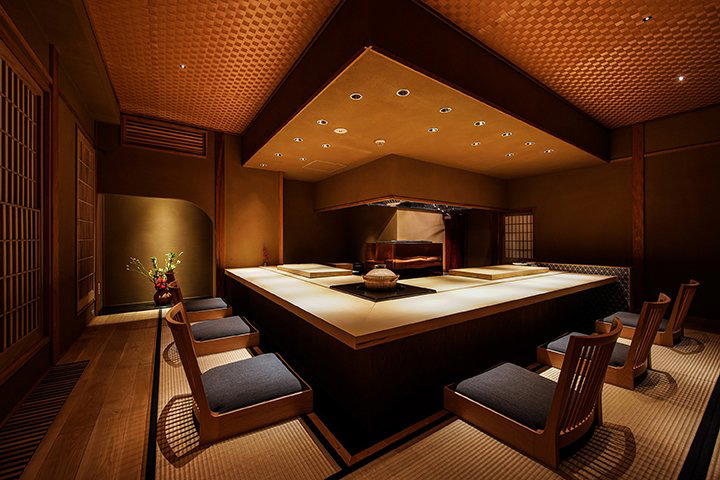
The omakase counter format, as it operates across Japan's mid-to-upper tiers, is built around a set of conventions that shape the experience as much as any individual piece of fish. Seat counts are small, often six to twelve, which allows the itamae to pace the meal individually. Diners sit at eye level with the chef's working surface. Conversation, if it happens, is direct and bilateral rather than mediated by a floor team. This intimacy is structural, not performative.
The format has analogues internationally. Le Bernardin in New York City represents a different but comparable philosophy around the primacy of the ingredient and the restraint of intervention. Atomix in New York City applies a counter-driven tasting format to Korean cuisine with similar attention to sequence and pace. In Japan, the tradition is older and the form more codified, but the underlying premise, that the ideal way to eat is in close proximity to the person who prepared your food, is shared.
Closer to home within Japan, counters like Goh in Fukuoka show how the format adapts to regional ingredient vocabularies while maintaining the structural discipline of the omakase model. Regional counters in less internationally profiled cities, including venues like a counter in Nanao and one in Sapporo, demonstrate how the format distributes itself across Japan's geography rather than centralising only in its two largest cities. Takashima and Nishikawa Machi add further proof that serious counter dining is a national rather than a metropolitan phenomenon. Birdland in Sakai extends this logic into yakitori, where the counter model has been applied with the same rigour.
Planning a Visit: What the Address Tells You
The Nishi Ward location translates into a specific logistical reality. Nagoya's subway network connects efficiently to the central wards, and Nishi Ward sits within reasonable reach of the city's main lines, though the specific Meisei address will require a short walk or taxi from the nearest station. For visitors arriving at Nagoya Station on the Shinkansen, the journey to Nishi Ward is direct rather than demanding, but it does require planning ahead rather than treating the visit as a casual detour between trains. Because the venue sits outside the primary tourist circuit, diners arriving from Tokyo or Osaka on a day trip would be advised to build the visit as a primary commitment rather than a secondary stop.
Frequently asked questions
Where is Sushi Shimizu in Nagoya?
Sushi Shimizu is located at 1 2 Chome-10-10 Meisei, Nishi Ward, Nagoya, Aichi 451-0064, Japan, Nagoya.
Is Sushi Shimizu worth visiting if you're already planning a trip to Nagoya for its more central dining districts?
Nishi Ward sits a short subway ride from Nagoya Station, making Sushi Shimizu logistically accessible even if your base is closer to Sakae or the city centre. Nagoya's sushi scene receives considerably less international coverage than Tokyo or Osaka, which means counters in quieter wards like Nishi operate outside the review circuit that inflates demand and prices at more prominent addresses. For a traveller already in Nagoya, that geographic remove from the tourist corridor is the practical reason to make the trip.
What dish is Sushi Shimizu famous for?
No specific signature dish has been publicly documented for Sushi Shimizu. The counter operates in Nagoya's Nishi Ward, a neighbourhood where sushi-ya tend to work within the omakase format, meaning the selection follows the chef's discretion based on seasonal availability rather than a fixed house speciality. Nagoya's proximity to Ise Bay gives local counters access to regional seafood that differs from the bluefin-centric menus typical of Tokyo's Tsukiji-adjacent restaurants.
How hard is it to get a table at Sushi Shimizu?
Reservation lead times for Sushi Shimizu have not been formally documented in available hospitality records. That said, serious omakase counters in Nagoya's outer wards, including Nishi Ward, typically operate with small seat counts and a loyal local clientele, which compresses availability even without the international demand that pressures Tokyo's top counters. Contacting the venue directly is the only reliable method to gauge current wait times, as no online booking platform is publicly listed.
Cuisine and Credentials
Comparable venues nearby, for context on price, style, and recognition.
| Venue | Cuisine | Price | Awards | Notes |
|---|---|---|---|---|
| Sushi ShimizuThis venue (the venue you are viewing) | Edomae Sushi Omakase | $100–150 | Not listed | Not listed |
| Teppan Yaki Jiro | Teppanyaki & Wagyu Steak | $50–100 | Tabelog 100 #31 | Naka |
| Sumibi Yakiniku Takenouchi Honten | Traditional Japanese Yakiniku | $50–100 | Tabelog 100 #77 | Nishi |
| Kikkou Hanare | Seasonal Omakase Sushi Counter | $100–150 | Tabelog 100 #29 | Nishi |
| Ningyocho Imahan Nagoya middorandosukuea ten | Traditional Japanese Sukiyaki & Shabu-Shabu | Not listed | Tabelog 100 #89 | Nakamura |
| Yakiniku Asahi | Private-room Wagyu Yakiniku | $50–100 | Tabelog 100 #46 | Higashi |